3D print The Alamo
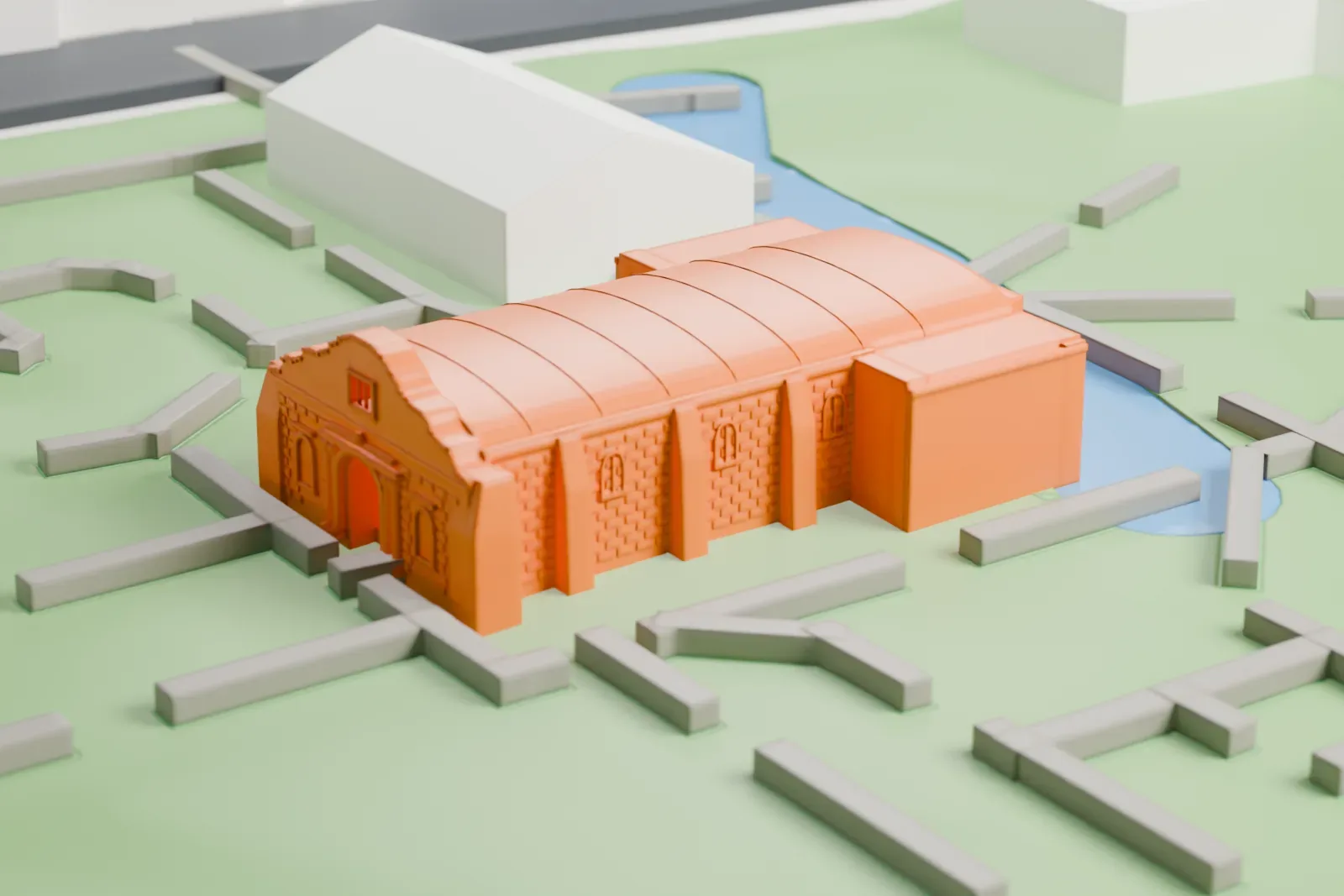
A free, printable model of the Alamo chapel with its curved roof and carved front, with the lawns, footpaths and nearby buildings around it, generated from real map data in your browser.
Free, in your browser. Exports a slicer-ready 3MF.
About The Alamo
The Alamo, in San Antonio, Texas, began as a Spanish mission and later served as a fortress. Catholic missionaries founded it in the 18th century. It was first called Misión San Antonio de Valero, and it was among the early Spanish missions in Texas, set up to convert American tribes to Christianity. In April 1718, Martín de Alarcón led an expedition that put up a temporary building of mud, brush and straw close to the source of the San Antonio River. In 1724 the tail end of a Gulf Coast hurricane wrecked the buildings, and the mission was relocated to its present site.
The mission's stone church was begun in 1744, and it collapsed in the late 1750s. A new chapel was started in 1758, built of limestone blocks 4 feet (1.2 m) thick. It was planned to rise three stories, with a dome above and a bell tower on each side. Only the first two levels were completed, and the bell towers, third story and dome were never built. Walls added around the mission homes in 1758 were 8 feet (2.4 m) high.
The mission was secularized in 1793, after which it stood empty. In the 19th century the complex became known as the Alamo, a name that may come from nearby cottonwood trees or from a military company that occupied the compound in 1803. On March 6, 1836, the compound saw the Battle of the Alamo, in which the defenders were wiped out, a turning point of the Texas Revolution. In 1905 the state legislature bought the remaining buildings and named the DRT (Daughters of the Republic of Texas) permanent custodian. UNESCO added the Alamo and four other San Antonio missions to its World Heritage list in 2015.
How it prints
Make this print opens the generator on a 600 m square around the landmark. Buildings print at close to true scale, so the landmark grows with the print size.
| Print size | Landmark height | Scale |
|---|---|---|
| 160 mm default | 3 mm | 1:3,750 |
| 200 mm | 4 mm | 1:3,000 |
| 256 mm | 4 mm | 1:2,344 |
-
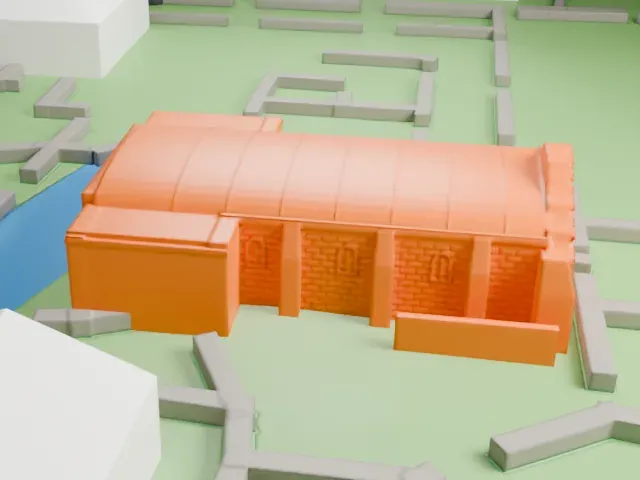 North
North
-
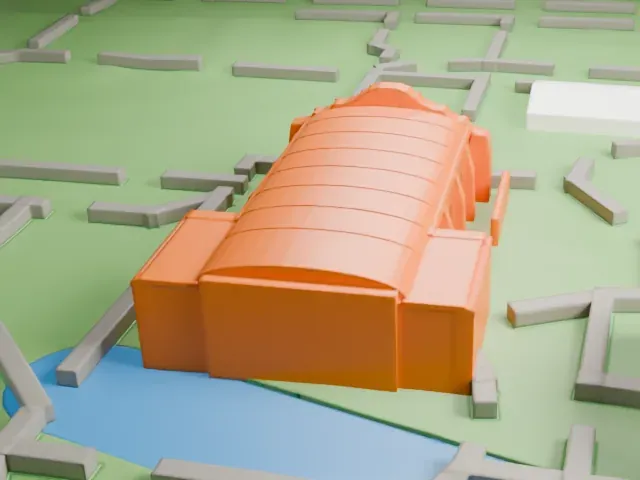 East
East
-
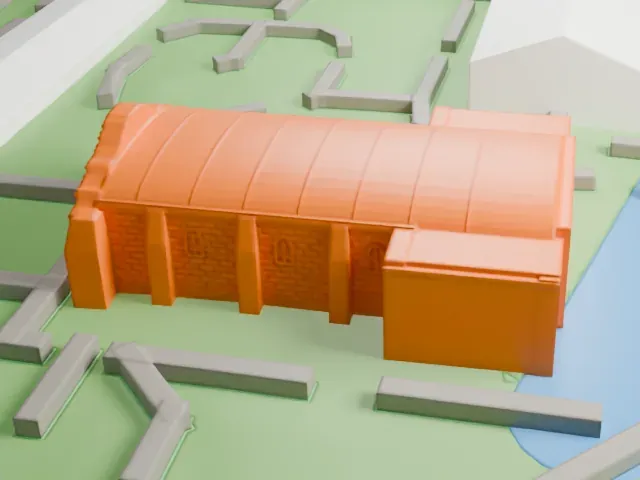 South
South
-
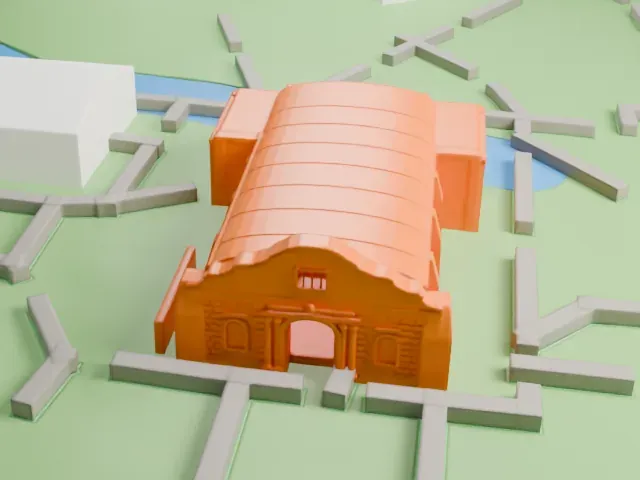 West
West
- Carved front and brick walls
- The west front has columns, niches and a curved top edge, and the side walls carry a brick pattern. Print friendly adapts these small details to your print scale; a larger print or Full detail keeps more of them.
- Curved vault roof
- The chapel roof is a long curved vault with thin ribs. Layers of 0.12 to 0.16 mm keep the curve smooth.
- One piece with the ground
- The Alamo is joined to the ground in the exported file, and the four-side check found no floating parts, so nothing needs gluing.
- Pick the detail for your nozzle
- In the Buildings settings, set Landmark detail to Print friendly to adapt thin parts and small details to the print scale. Full detail keeps every modeled feature, for larger prints or a finer nozzle.
- Colors
- Buildings, roads, water and ground arrive as separate filament slots in the 3MF. The Alamo takes the building color.
- File format
- You get a 3MF for Bambu Studio, OrcaSlicer or PrusaSlicer. Any of them can save it as STL if you need one.
About this model
The Alamo is one of more than 2,300 landmark models in Mini Skyline. They are made with AI, and each one is checked from four sides in its real surroundings before release. Everything around it is built from OpenStreetMap and Overture map data. If you would rather print the shape from map data, turn off Landmark models in the Buildings settings.
Common questions
Is there a The Alamo STL I can download?
Mini Skyline builds the file for you in your browser and exports 3MF, which every major slicer opens. If you need an STL, open the 3MF in your slicer and export it from there.
How big can I print it?
Any print size from 40 mm across. The Alamo grows with the print: about 3 mm tall on the default 160 mm print. For a model larger than your printer bed, Project Mode splits the area into tiles.
Is it free?
Yes. Generation runs in your browser, with no account and nothing behind a paywall.