3D print the Canadian Museum for Human Rights
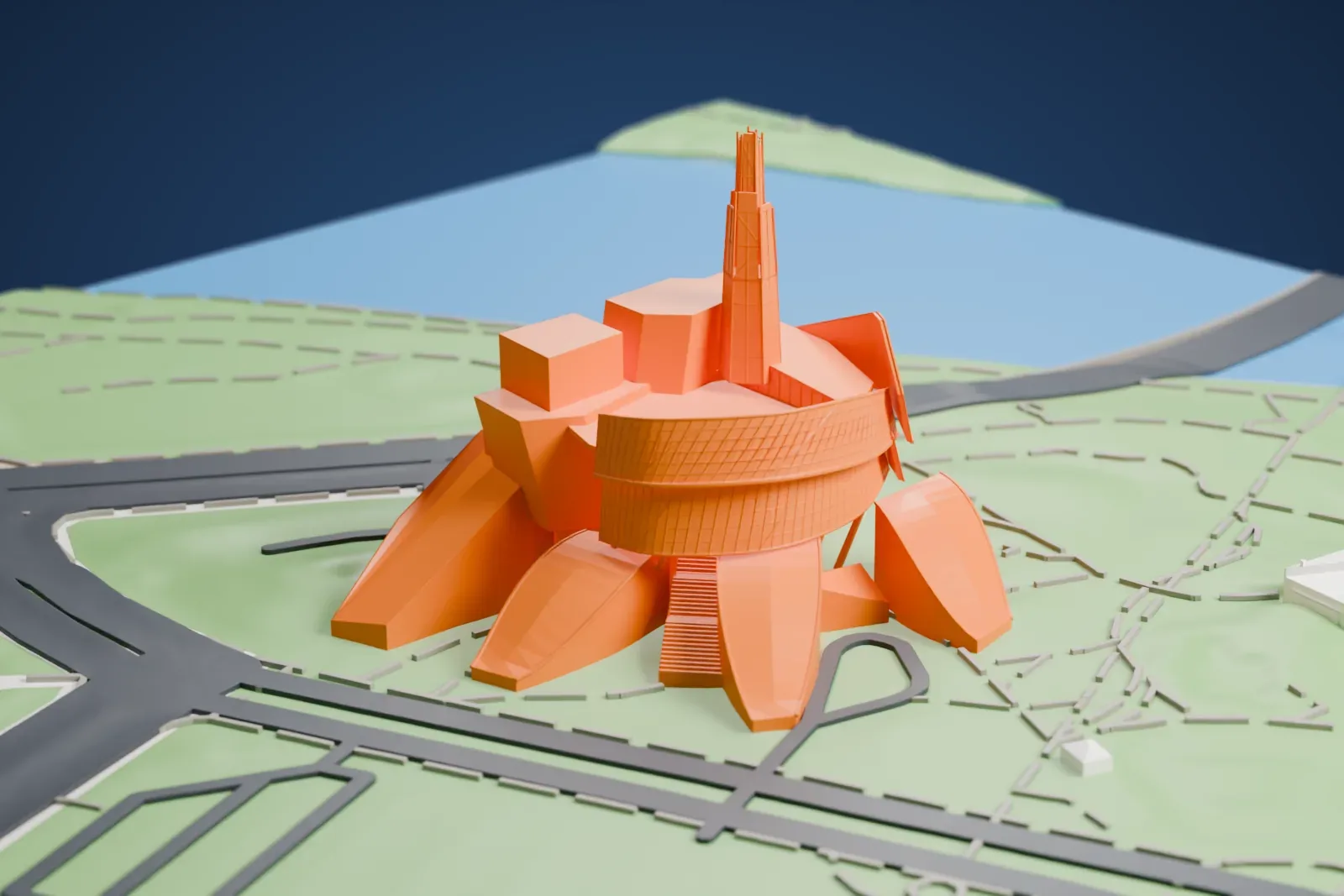
A free, printable model of angular wings clustered around a tall central spire, the Canadian Museum for Human Rights, with the grass, roads and water around it, generated from real map data in your browser.
Free, in your browser. Exports a slicer-ready 3MF.
About the Canadian Museum for Human Rights
The Canadian Museum for Human Rights, which is a national museum set up as a Canadian Crown corporation, stands in Winnipeg, Manitoba, beside The Forks. Legislation in 2008, Bill C-42, created it by amending The Museums Act of Canada. It is the country's first new national museum since 1967, and the first national museum anywhere in Canada outside the National Capital Region. It opened in 2014.
Izzy Asper, a Canadian lawyer and politician, is credited with the idea, which he first came up with on July 18, 2000. In 2003 the Friends, a private charity he had founded to build the museum, launched an international architectural competition that drew 100 submissions from 21 countries. The jury selected the design of architect Antoine Predock, who hails from Albuquerque, New Mexico.
Before building began, archeologists working with Elders excavated the site and recovered over 400,000 artifacts. Groundbreaking took place on December 19, 2008, and the last of 1,669 custom-cut glass pieces went in during September 2012. Predock imagined the visit as a journey: it starts with a descent into the earth, through the museum's "roots", and ends at the Israel Asper Tower of Hope, whose glass spire is 100 meters tall and gives views of downtown Winnipeg.
How it prints
Make this print opens the generator on a 600 m square around the landmark. Buildings print at close to true scale, so the landmark grows with the print size.
| Print size | Landmark height | Scale |
|---|---|---|
| 160 mm default | 27 mm | 1:3,750 |
| 200 mm | 34 mm | 1:3,000 |
| 256 mm | 44 mm | 1:2,344 |
-
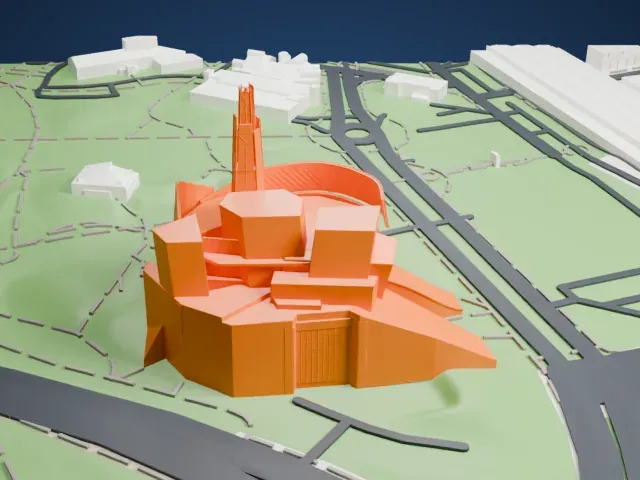 North
North
-
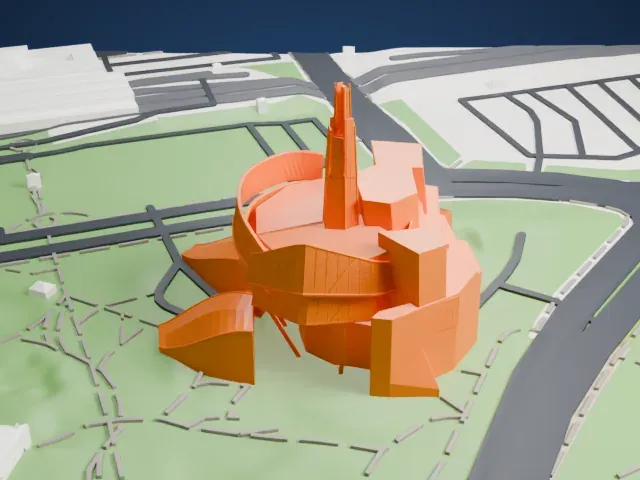 East
East
-
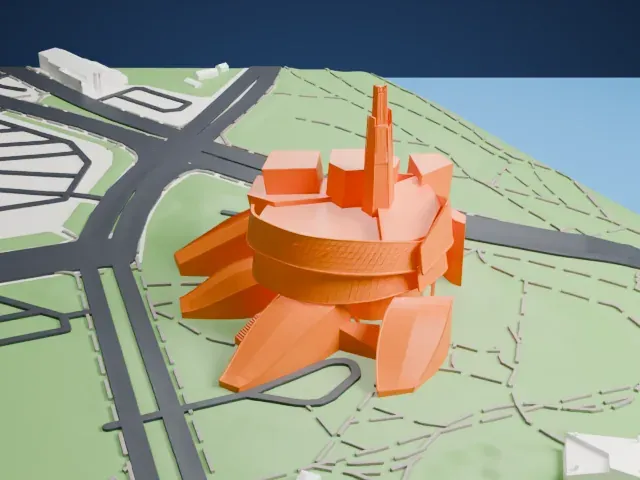 South
South
-
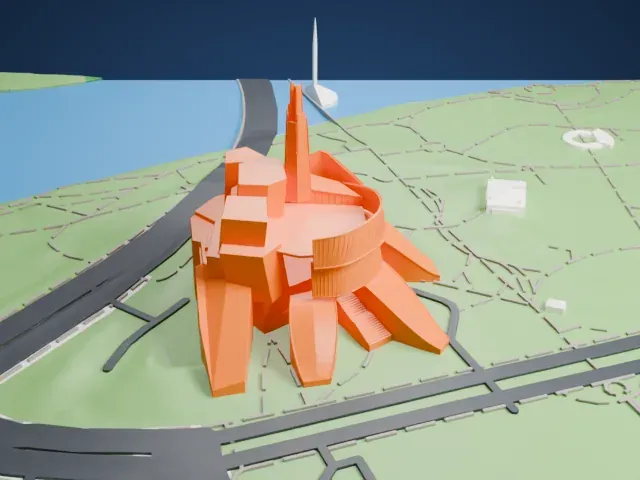 West
West
- Slim central spire
- A tall, thin spire rises from the middle of the building. Print friendly adapts it to the print scale; Full detail keeps it on larger prints. Print slowly with good cooling for the tip.
- Angular wings and curved band
- Sloping wings spread out around the base and a curved band circles the middle. A bigger print size keeps these edges distinct, and layers of 0.12–0.16 mm keep the sharp angles crisp.
- One piece with the ground
- The Canadian Museum for Human Rights is joined to the ground in the exported file, and the four-side check found no floating parts, so nothing needs gluing.
- Pick the detail for your nozzle
- In the Buildings settings, set Landmark detail to Print friendly to adapt thin parts and small details to the print scale. Full detail keeps every modeled feature, for larger prints or a finer nozzle.
- Colors
- Buildings, roads, water and ground arrive as separate filament slots in the 3MF. The Canadian Museum for Human Rights takes the building color.
- File format
- You get a 3MF for Bambu Studio, OrcaSlicer or PrusaSlicer. Any of them can save it as STL if you need one.
About this model
The Canadian Museum for Human Rights is one of more than 2,300 landmark models in Mini Skyline. They are made with AI, and each one is checked from four sides in its real surroundings before release. Everything around it is built from OpenStreetMap and Overture map data. If you would rather print the shape from map data, turn off Landmark models in the Buildings settings.
Common questions
Is there a Canadian Museum for Human Rights STL I can download?
Mini Skyline builds the file for you in your browser and exports 3MF, which every major slicer opens. If you need an STL, open the 3MF in your slicer and export it from there.
How big can I print it?
Any print size from 40 mm across. The Canadian Museum for Human Rights grows with the print: about 27 mm tall on the default 160 mm print. For a model larger than your printer bed, Project Mode splits the area into tiles.
Is it free?
Yes. Generation runs in your browser, with no account and nothing behind a paywall.