3D print Lichtenstein Castle
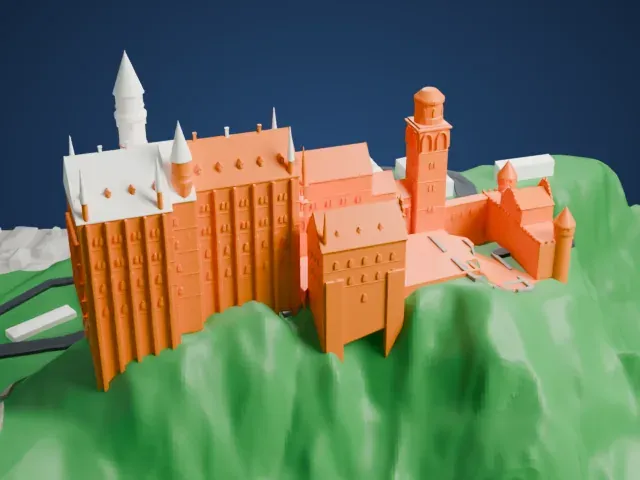
A free, printable model of Lichtenstein Castle and the steep green hillside and few buildings around it, generated from real map data in your browser.
-
 North
-
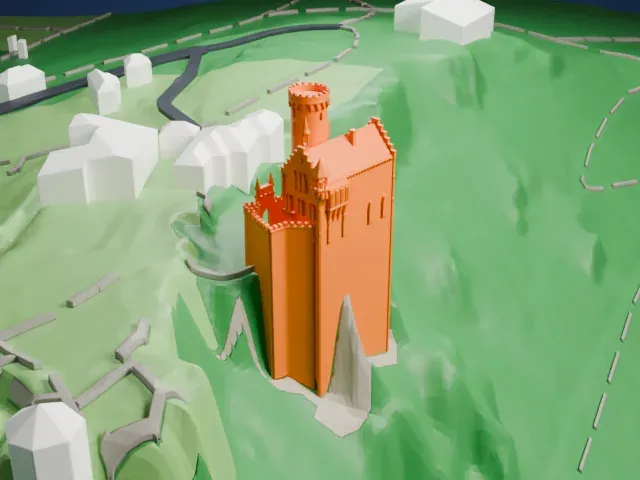 East
-
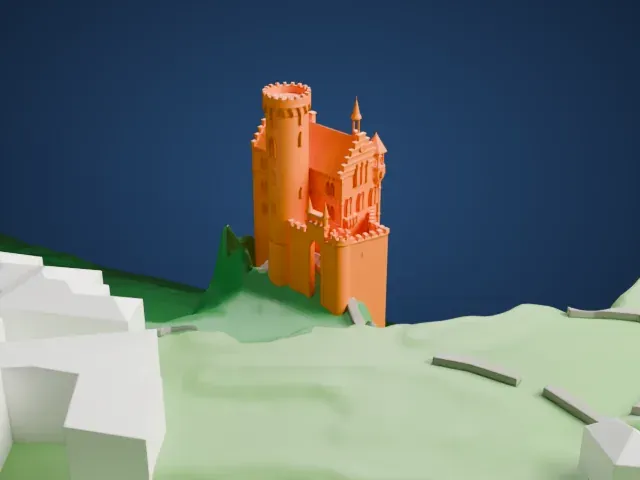 South
-
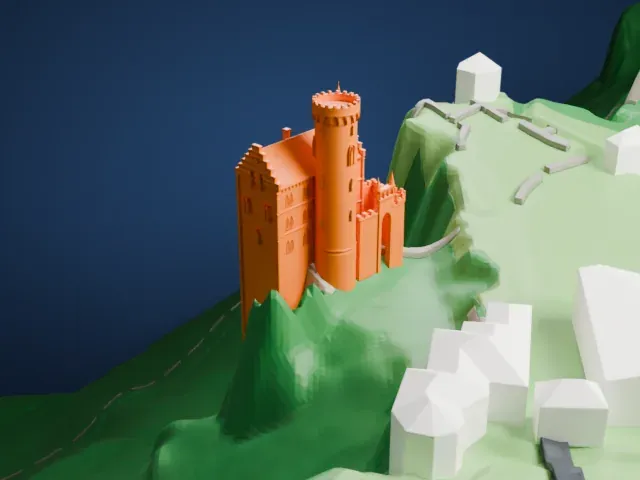 West
- On a 160 mm print
- 16 mm
- Scale
- 1:3,750
16 mm tall on a 160 mm print
Make this print opens the generator on a 600 m square around the landmark. Buildings print at close to true scale, so the landmark grows with the print size.
- Spires and stepped gables
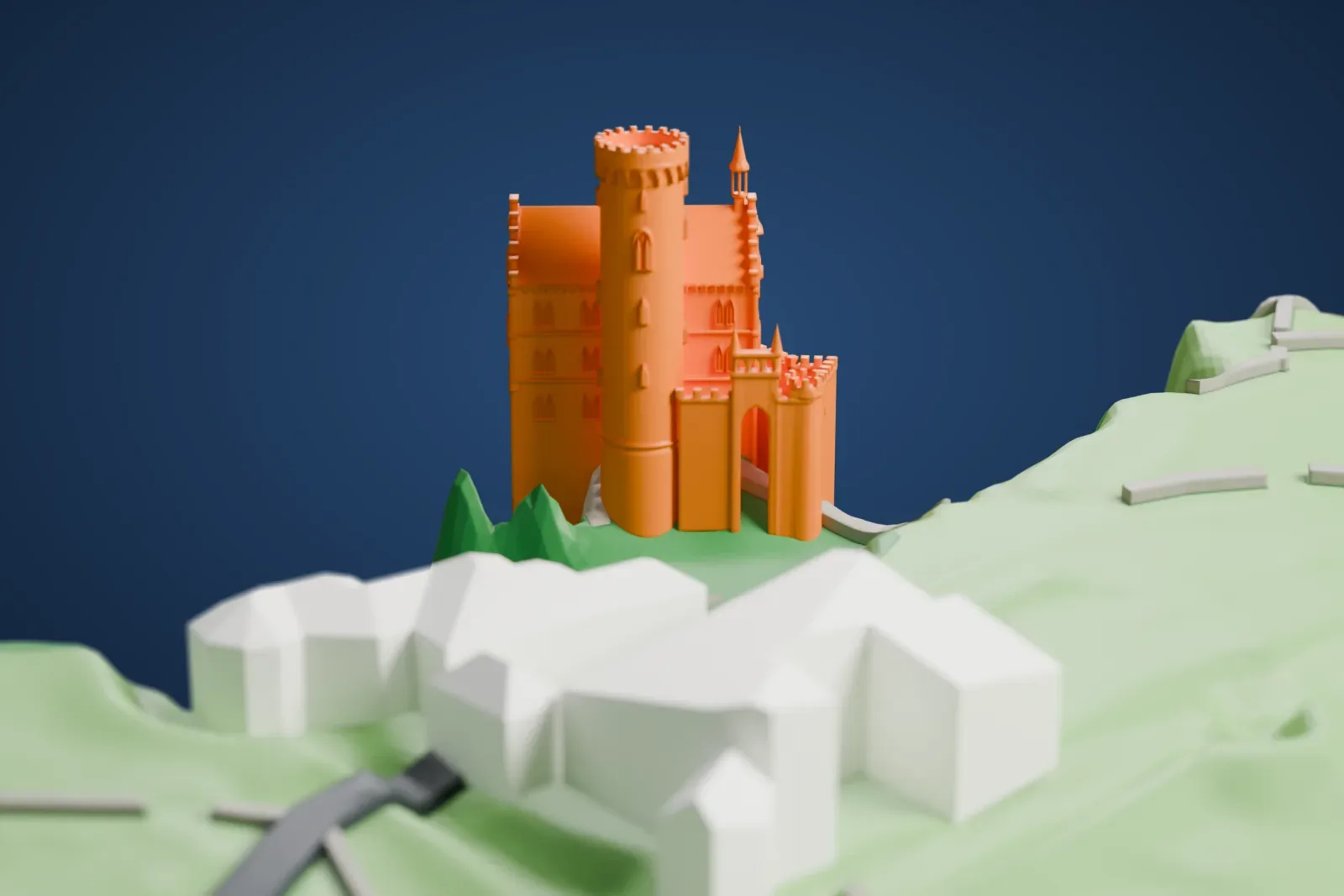
Small spires, pinnacles and stepped gables decorate the roofline. Print friendly adapts these thin parts to the print scale; Full detail keeps them, which suits a larger print.
- Tall tower on steep ground
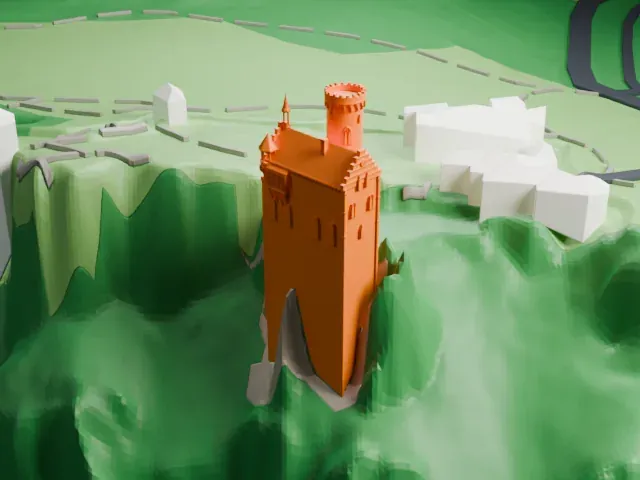
A slim round tower with a battlemented top rises above the castle, which stands on steeply sloping ground. Layers of 0.12 to 0.16 mm keep the battlements crisp, and printing slowly helps tall, thin parts.
- One piece with the ground
Lichtenstein Castle is joined to the ground in the exported file, and the four-side check found no floating parts, so nothing needs gluing.
- Pick the detail for your nozzle
In the Buildings settings, set Landmark detail to Print friendly to adapt thin parts and small details to the print scale. Full detail keeps every modeled feature, for larger prints or a finer nozzle.
- Colors
Buildings, roads, water and ground arrive as separate filament slots in the 3MF. Lichtenstein Castle takes the building color.
- File format
You get a 3MF for Bambu Studio, OrcaSlicer or PrusaSlicer. Any of them can save it as STL if you need one.
About Lichtenstein Castle
Lichtenstein Castle (Schloss Lichtenstein) is a Gothic Revival castle in southern Germany's Swabian Jura, and it is privately owned. It stands on an escarpment along the Swabian Jura's northwestern edge, above the Echaz valley near Honau, in the Reutlingen district of Baden-Württemberg. The altitude is 817 meters (2,680 feet), about 250 meters (820 feet) above the Echaz river. The name translates as 'shining stone' or 'bright stone'.
The present castle was built from 1840 to 1842 to a design by Carl Alexander Heideloff, and Johann Georg Rupp managed the construction. Its inspiration was the 1826 novel Lichtenstein by Wilhelm Hauff. Count Wilhelm von Urach, later the first duke of Urach, bought the estate in 1837, when it was only a crumbling ruin. He wanted a faithful imitation of a medieval castle, both as a home and to hold his collection of medieval art, arms and armor. The new building was set on the foundations of the 1390 castle, and from 1869 the dukes of Urach used it as their official residence.
Earlier castles stood on this escarpment. One dating from around 1100 was destroyed twice, in 1311 and again between 1377 and 1381, and a new castle went up in 1390 about 500 meters (1,600 feet) from the old ruins. King Frederick I of Württemberg took the castle apart down to its foundations in 1802 and put a hunting lodge in its place. After damage in World War II, the walls were restored in 1980, the second floor in 1998, and the upper floor and roof in 2002.
About this model
Lichtenstein Castle is one of more than 4,300 landmark models in Mini Skyline. They are made with AI, and each one is checked from four sides in its real surroundings before release. Everything around it is built from OpenStreetMap and Overture map data. If you would rather print the shape from map data, turn off Landmark models in the Buildings settings.
Keep exploring