3D print the Margravial Opera House
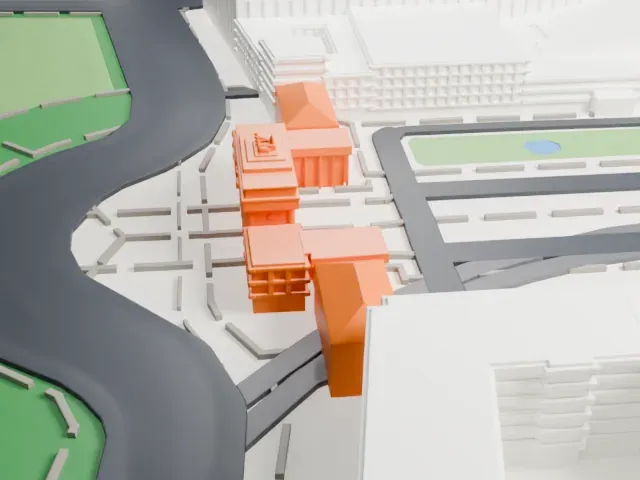
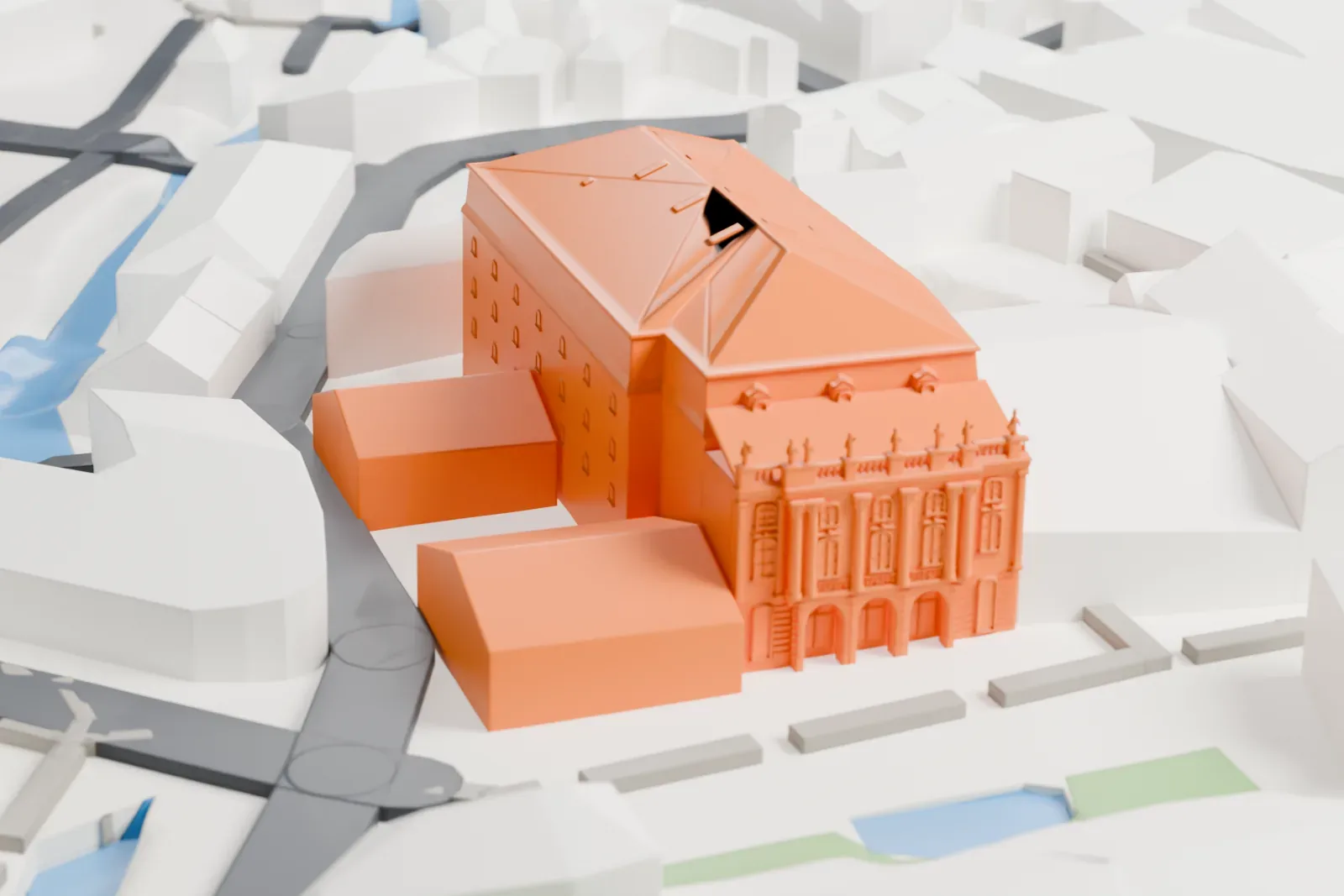
A free, printable model of the Margravial Opera House, a boxy hall with a hipped roof and a columned front, packed among nearby buildings, generated from real map data in your browser.
Free, in your browser. Exports a slicer-ready 3MF.
About the Margravial Opera House
The Margravial Opera House, called Markgräfliches Opernhaus in German, is a Baroque opera house in Bayreuth, a town in Germany. Construction ran from 1745 to 1750. Few theaters of its period survive in Europe, and this is one of them; it has been extensively restored. The opera house joined the UNESCO World Heritage List on June 30, 2012, because of its exceptional Baroque architecture. It was inaugurated for the marriage of the margrave couple's daughter Elisabeth Fredericka Sophie to Duke Charles Eugene of Württemberg.
Joseph Saint-Pierre, a French architect (ca. 1709–1754), drew the plans. He served as court builder to Frederick, the Hohenzollern margrave of Brandenburg-Bayreuth, and to Princess Wilhelmine of Prussia, his wife. The building measures 26 meters in height, 71.5 meters in length and 31 meters in width, and it sits where the street widens, giving carriages room to stop in front. Its sandstone facade, with large Corinthian columns, was meant to harmonize with nearby buildings and to echo the Place Vendôme in Paris. Atop a balustrade across the facade stand sculptures of Minerva, Apollo and six Muses.
Giuseppe Galli Bibiena and his son Carlo, from Bologna, designed the wooden interior in Italian Late Baroque style. The bell-shaped auditorium seats roughly 500 people and is covered in gold accents. The margrave's Court Loge sits opposite the stage and fills all three box stories. The stage is 27 meters (89 ft) deep, a depth that attracted the composer Richard Wagner.
How it prints
Make this print opens the generator on a 600 m square around the landmark. Buildings print at close to true scale, so the landmark grows with the print size.
| Print size | Landmark height | Scale |
|---|---|---|
| 160 mm default | 7 mm | 1:3,750 |
| 200 mm | 9 mm | 1:3,000 |
| 256 mm | 12 mm | 1:2,344 |
-
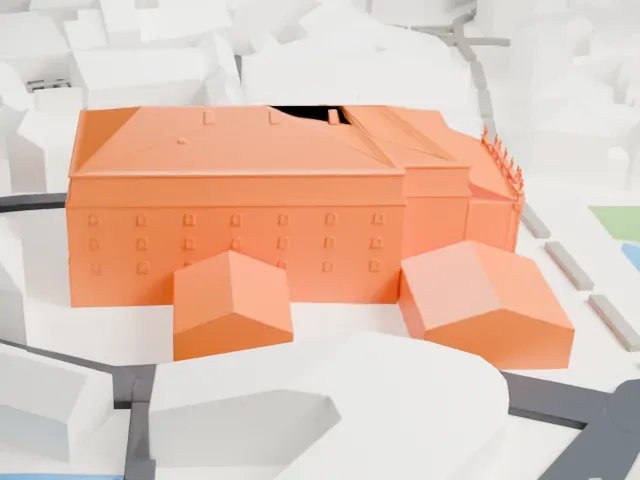 North
North
-
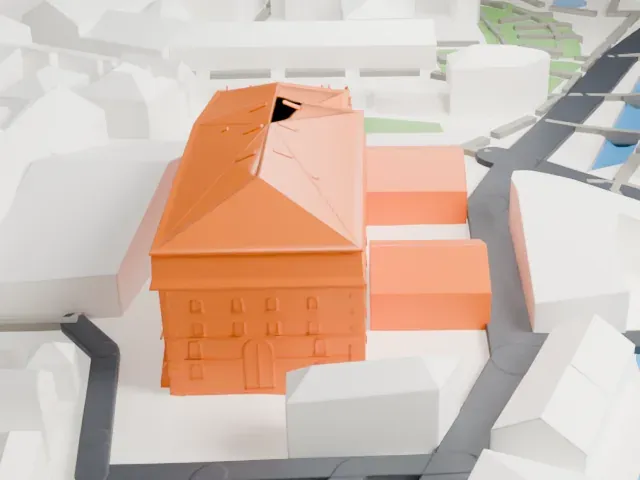 East
East
-
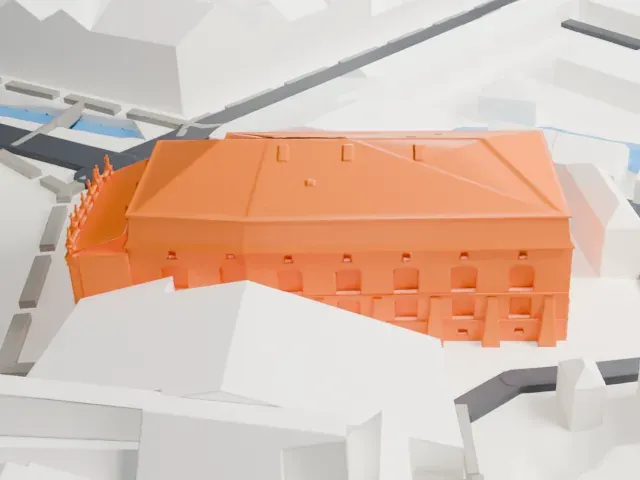 South
South
-
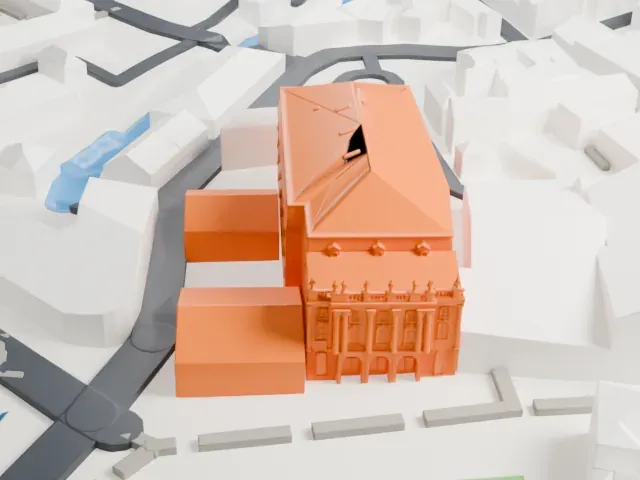 West
West
- Statues on the balustrade
- Small figures stand along the balustrade above the front columns. Print friendly adapts the smallest figures to your print scale; Full detail keeps them, best on a larger print.
- Slim columns on the front
- Slender columns frame the columned front. Layers of 0.12 to 0.16 mm keep their edges crisp, and a bigger print keeps more of the carved detail.
- One piece with the ground
- The Margravial Opera House is joined to the ground in the exported file, and the four-side check found no floating parts, so nothing needs gluing.
- Pick the detail for your nozzle
- In the Buildings settings, set Landmark detail to Print friendly to adapt thin parts and small details to the print scale. Full detail keeps every modeled feature, for larger prints or a finer nozzle.
- Colors
- Buildings, roads, water and ground arrive as separate filament slots in the 3MF. The Margravial Opera House takes the building color.
- File format
- You get a 3MF for Bambu Studio, OrcaSlicer or PrusaSlicer. Any of them can save it as STL if you need one.
About this model
The Margravial Opera House is one of more than 2,300 landmark models in Mini Skyline. They are made with AI, and each one is checked from four sides in its real surroundings before release. Everything around it is built from OpenStreetMap and Overture map data. If you would rather print the shape from map data, turn off Landmark models in the Buildings settings.
Common questions
Is there a Margravial Opera House STL I can download?
Mini Skyline builds the file for you in your browser and exports 3MF, which every major slicer opens. If you need an STL, open the 3MF in your slicer and export it from there.
How big can I print it?
Any print size from 40 mm across. The Margravial Opera House grows with the print: about 7 mm tall on the default 160 mm print. For a model larger than your printer bed, Project Mode splits the area into tiles.
Is it free?
Yes. Generation runs in your browser, with no account and nothing behind a paywall.