3D print the Mosque-Cathedral of Córdoba
A free, printable model of the Mosque-Cathedral of Córdoba and the old-town blocks, streets and river banks around it, generated from real map data in your browser.
Free, in your browser. Exports a slicer-ready 3MF.
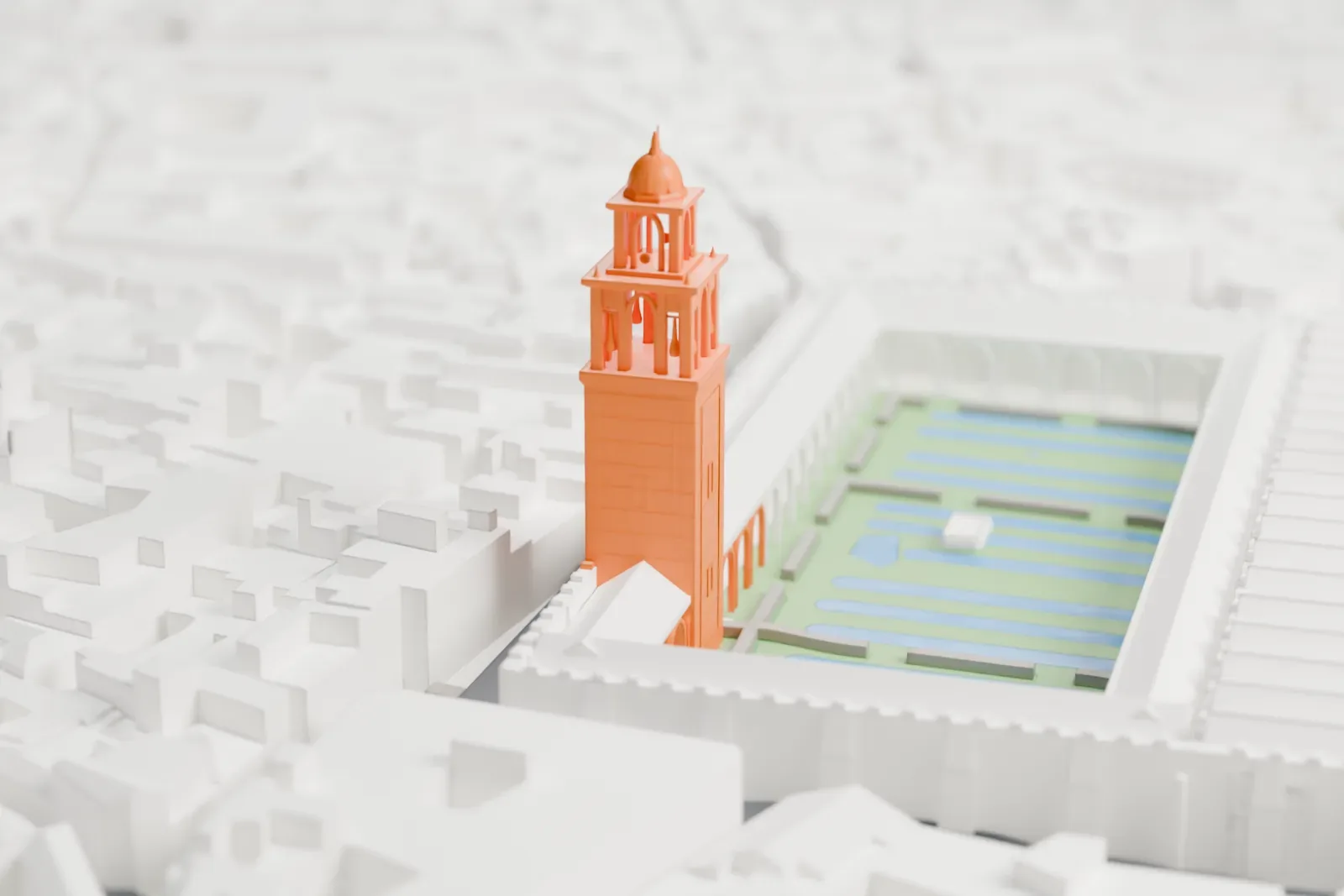
About the Mosque-Cathedral of Córdoba
The Mosque-Cathedral of Córdoba is a Roman Catholic cathedral serving the diocese of Córdoba, in Spain's Andalusia region. Its official name honors Our Lady of the Assumption, and its dedication is to the Assumption of Mary. Because it was once a mosque, it is also called the Mezquita, the Spanish word for mosque, and historically the Great Mosque of Córdoba. It still serves as the city's cathedral, with Mass celebrated there daily.
Abd al-Rahman I, who founded the Islamic Emirate of Córdoba, ordered the Great Mosque built in 785. Work began in 785–786 and was done a year later; reusing Roman and Visigothic columns and capitals helped keep it quick. The original mosque was roughly square, 74 or 79 meters on each side, with a hypostyle prayer hall in the south half and an open courtyard (sahn) in the north half. Its most famous innovation was the rows of two-tiered arches. Successors enlarged it several times, up to the late 10th century, adding a minaret finished in 958 and a richly decorated mihrab and maqsurah area finished in 971.
Christian forces from Castile took Córdoba in 1236, during the Reconquista, and the mosque was converted into a cathedral. The building changed little until a major project in the 16th century placed a Renaissance cathedral nave and transept at its center. The old minaret, by then a bell tower, was heavily remodeled around the same time. The mosque is a key landmark in Islamic architectural history and shaped later Moorish architecture in the Muslim world's western Mediterranean regions. UNESCO has listed it as a World Heritage Site since 1984.
How it prints
Make this print opens the generator on a 600 m square around the landmark. Buildings print at close to true scale, so the landmark grows with the print size.
| Print size | Landmark height | Scale |
|---|---|---|
| 160 mm default | 16 mm | 1:3,750 |
| 200 mm | 20 mm | 1:3,000 |
| 256 mm | 26 mm | 1:2,344 |
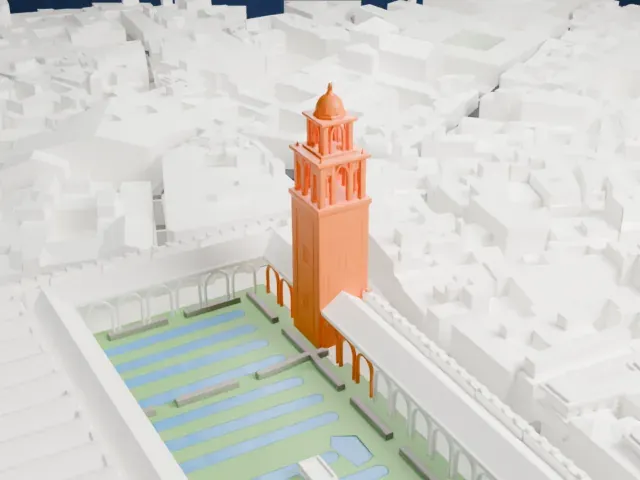
-
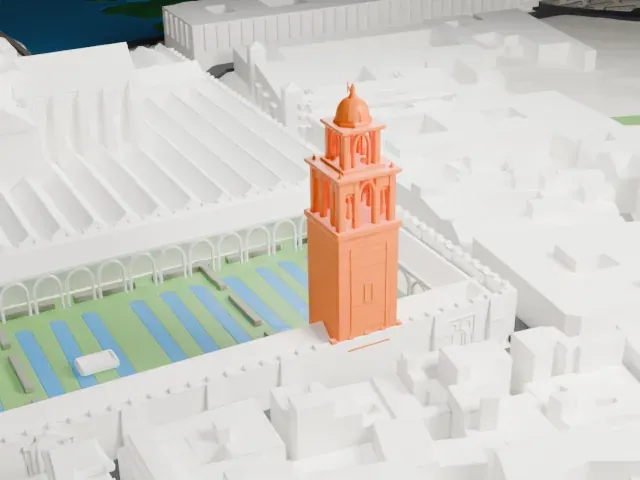 North
North
-
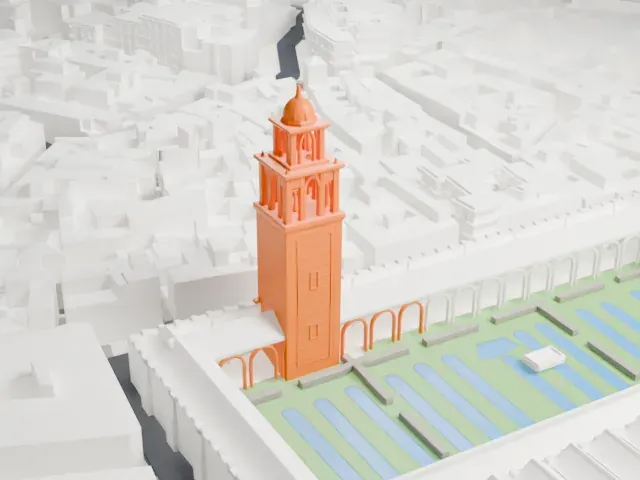
 East
East
-
 South
South
-
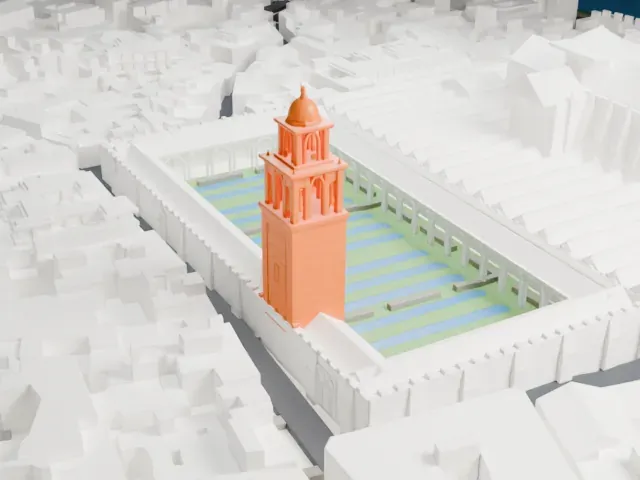 West
West
- Rows of repeating roof ridges
- The wide prayer hall is covered by many parallel pitched roofs side by side. A larger print size keeps each ridge distinct, and Print friendly adapts the narrowest gaps to the print scale.
- Slender tower and courtyard arcade
- A slim bell tower stands at one corner, and thin arches line the courtyard. Print slowly with good cooling, and use layers of 0.12 to 0.16 mm to keep the tower and arches crisp.
- Pick the detail for your nozzle
- In the Buildings settings, set Landmark detail to Print friendly to adapt thin parts and small details to the print scale. Full detail keeps every modeled feature, for larger prints or a finer nozzle.
- Colors
- Buildings, roads, water and ground arrive as separate filament slots in the 3MF. The Mosque-Cathedral of Córdoba takes the building color.
- File format
- You get a 3MF for Bambu Studio, OrcaSlicer or PrusaSlicer. Any of them can save it as STL if you need one.
About this model
The Mosque-Cathedral of Córdoba is one of more than 2,300 landmark models in Mini Skyline. They are made with AI, and each one is checked from four sides in its real surroundings before release. Everything around it is built from OpenStreetMap and Overture map data. If you would rather print the shape from map data, turn off Landmark models in the Buildings settings.
Common questions
Is there a Mosque-Cathedral of Córdoba STL I can download?
Mini Skyline builds the file for you in your browser and exports 3MF, which every major slicer opens. If you need an STL, open the 3MF in your slicer and export it from there.
How big can I print it?
Any print size from 40 mm across. The Mosque-Cathedral of Córdoba grows with the print: about 16 mm tall on the default 160 mm print. For a model larger than your printer bed, Project Mode splits the area into tiles.
Is it free?
Yes. Generation runs in your browser, with no account and nothing behind a paywall.