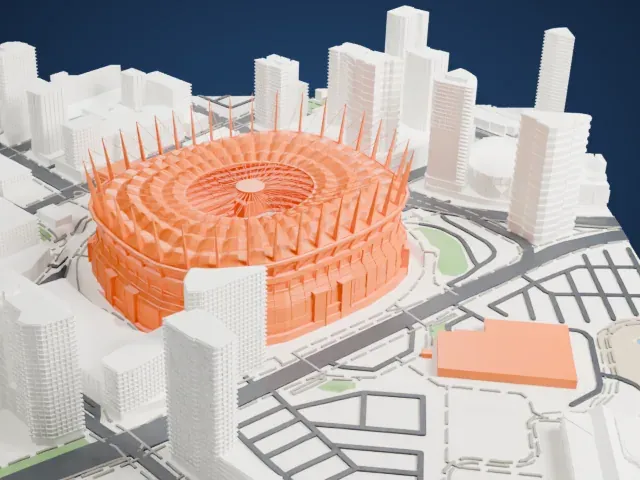
3D print the Richmond Olympic Oval
A free, printable model of the Richmond Olympic Oval, its long arched roof of wave-like ribs, and the river, park and buildings around it, generated from real map data in your browser.
Free, in your browser. Exports a slicer-ready 3MF.
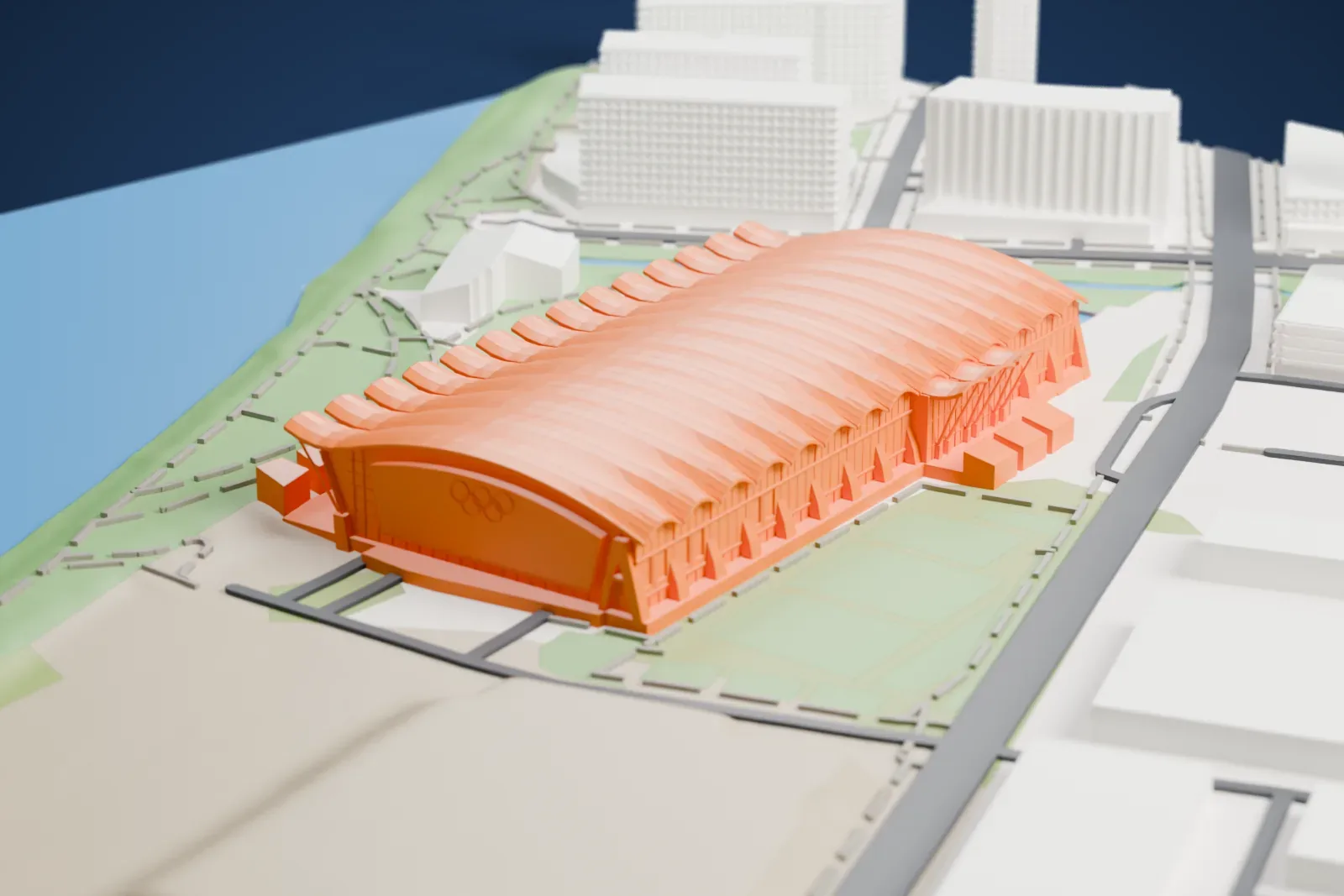
About the Richmond Olympic Oval
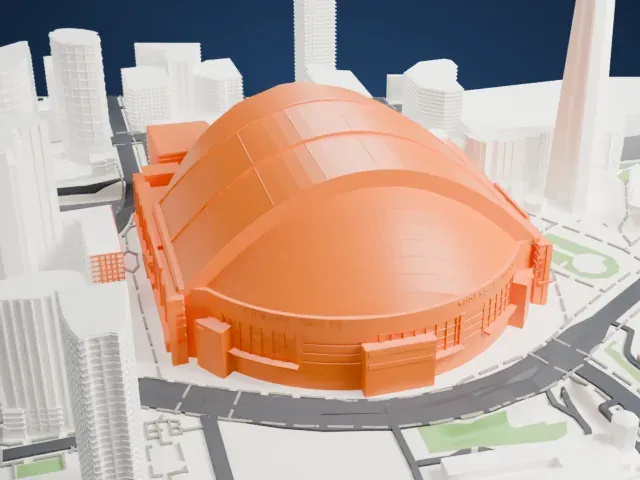
The Richmond Olympic Oval is an indoor arena for many sports in Richmond, British Columbia, Canada. It went up for the 2010 Winter Olympics, first configured as a speed skating rink, and it also hosted the 2009 world championships for single-distance speed skating. The venue was later reconfigured as a community multi-sport park. It holds two ice hockey rinks and two running tracks, as well as a rowing tank, a climbing wall and a flexible area for table tennis, indoor soccer, volleyball and basketball. CannonDesign designed it, and its elements are meant to resemble a heron.
The Olympic bid had placed the oval at Simon Fraser University in Burnaby, but Richmond was selected in 2004 instead, since the city agreed to pay all costs above $60 million. Construction began in 2006. At a cost of $178 million CAD, the oval opened on December 12, 2008, the final Olympic venue to be finished. Bob Johnston of CannonDesign, who had earlier worked on Olympic ovals in Calgary and Utah, was the main architect, and a feng shui consultant took part in the design.
The roof is made of 452 wood wave panels, designed, manufactured and erected by StructureCraft, and the building used pine beetle wood, 305 board-kilometers of it. The venue stands in a river delta on silt up to 300 meters (980 ft) deep, so the ground was compressed first, with two thousand columns of rock driven down 26 meters (85 ft) and 100,000 cubic meters of sand (3,500,000 cu ft) piled on the site. The river dike was raised from 3 meters (10 ft) to 6 meters (20 ft).
How it prints
Make this print opens the generator on a 600 m square around the landmark. Buildings print at close to true scale, so the landmark grows with the print size.
| Print size | Landmark height | Scale |
|---|---|---|
| 160 mm default | 9 mm | 1:3,750 |
| 200 mm | 11 mm | 1:3,000 |
| 256 mm | 14 mm | 1:2,344 |
-
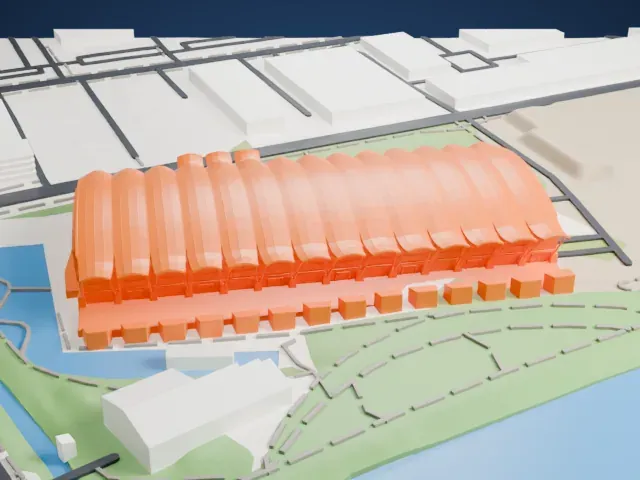 North
North
-
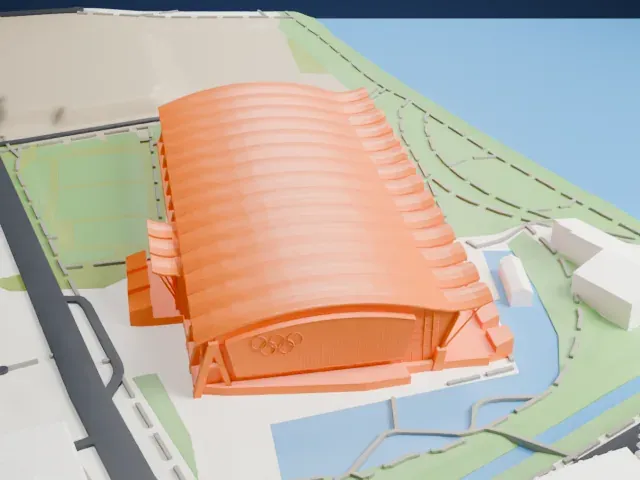 East
East
-
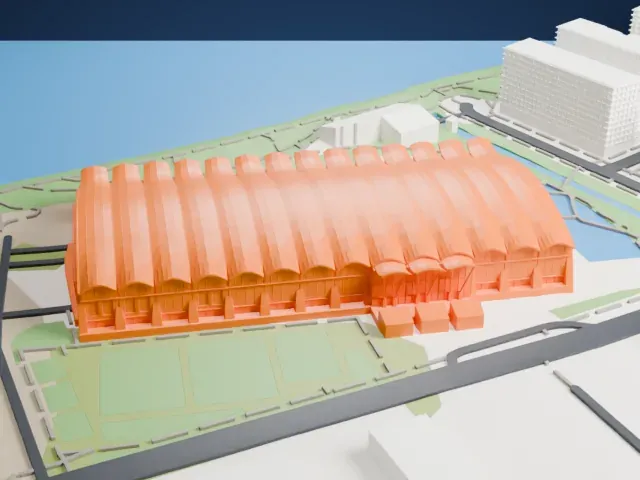 South
South
-
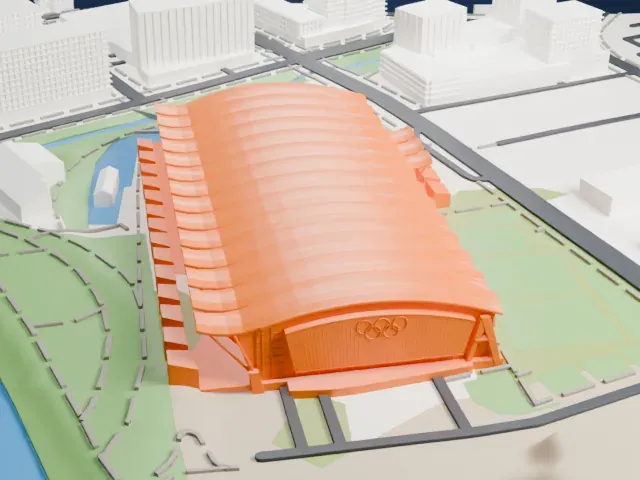 West
West
- A ribbed, wave-shaped roof
- The roof is a long arch of closely spaced wave-like ribs. Layers of 0.12–0.16 mm keep the ribs crisp, and Print friendly adapts them to the print scale.
- Rings on the end walls
- Small rings mark the two end walls. Full detail and a larger print keep these fine shapes, while Print friendly may simplify them.
- One piece with the ground
- The Richmond Olympic Oval is joined to the ground in the exported file, and the four-side check found no floating parts, so nothing needs gluing.
- Pick the detail for your nozzle
- In the Buildings settings, set Landmark detail to Print friendly to adapt thin parts and small details to the print scale. Full detail keeps every modeled feature, for larger prints or a finer nozzle.
- Colors
- Buildings, roads, water and ground arrive as separate filament slots in the 3MF. The Richmond Olympic Oval takes the building color.
- File format
- You get a 3MF for Bambu Studio, OrcaSlicer or PrusaSlicer. Any of them can save it as STL if you need one.
About this model
The Richmond Olympic Oval is one of more than 2,300 landmark models in Mini Skyline. They are made with AI, and each one is checked from four sides in its real surroundings before release. Everything around it is built from OpenStreetMap and Overture map data. If you would rather print the shape from map data, turn off Landmark models in the Buildings settings.
Common questions
Is there a Richmond Olympic Oval STL I can download?
Mini Skyline builds the file for you in your browser and exports 3MF, which every major slicer opens. If you need an STL, open the 3MF in your slicer and export it from there.
How big can I print it?
Any print size from 40 mm across. The Richmond Olympic Oval grows with the print: about 9 mm tall on the default 160 mm print. For a model larger than your printer bed, Project Mode splits the area into tiles.
Is it free?
Yes. Generation runs in your browser, with no account and nothing behind a paywall.