3D print Salt River Fields at Talking Stick
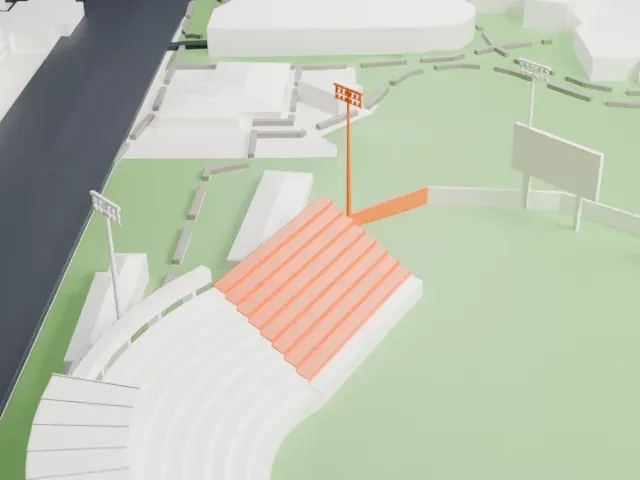
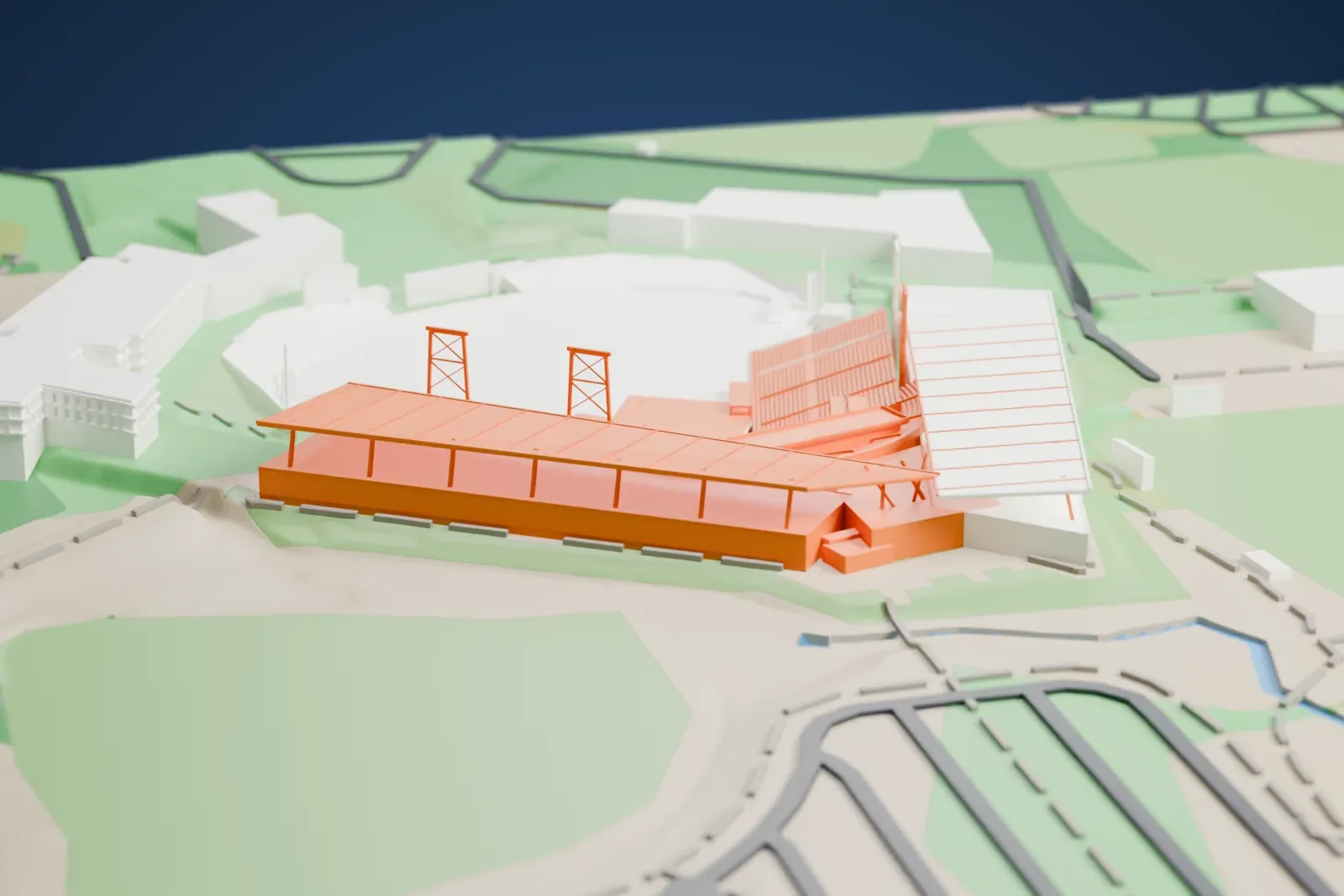
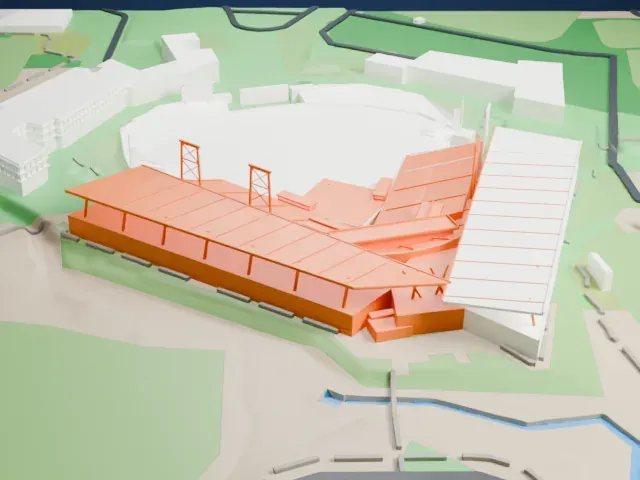
A free, printable model of Salt River Fields at Talking Stick, a baseball stadium with ridged roofs and light towers around a broad field, among green fields, generated from real map data in your browser.
Free, in your browser. Exports a slicer-ready 3MF.
About Salt River Fields at Talking Stick
Salt River Fields at Talking Stick, a stadium complex, stands on Salt River Pima–Maricopa Indian Community land near Scottsdale, Arizona, where the Pavilion Lakes Golf Club used to be. Arizona Diamondbacks and Colorado Rockies players do their Major League Baseball spring training here; for the Diamondbacks it replaced Tucson Electric Park, and for the Rockies it replaced Hi Corbett Field. It is the first MLB park on Native American Indian land.
The White Sox of Chicago relocated their spring training from Tucson to Phoenix in 2009, and the Diamondbacks and Rockies then wanted out of Tucson as well. Among several bidders, Salt River Pima–Maricopa Indian Community came out ahead after the teams committed to the facility for 20 years. Construction began on November 17, 2009, on a fast-tracked schedule meant to finish the stadium for the 2011 spring-training season. It was completed on time, and the first game, between the Diamondbacks and Rockies, was played on February 26, 2011. The Rockies won it 8–7 after 10 innings.
The grandstand has 7,000 fixed seats, and 4,000 lawn seats bring the estimated capacity to 11,000. Each team has a clubhouse of 85,000 square feet (7,900 m2) and six full-size practice fields, plus batting cages and two practice diamonds for infield work only. The Diamondbacks use the facilities along left field, and the Rockies those along right field. There are also two lit soccer fields and a man-made lake of three acres that holds 17,000 fish.
How it prints
Make this print opens the generator on a 600 m square around the landmark. Buildings print at close to true scale, so the landmark grows with the print size.
| Print size | Landmark height | Scale |
|---|---|---|
| 160 mm default | 10 mm | 1:3,750 |
| 200 mm | 12 mm | 1:3,000 |
| 256 mm | 16 mm | 1:2,344 |
-
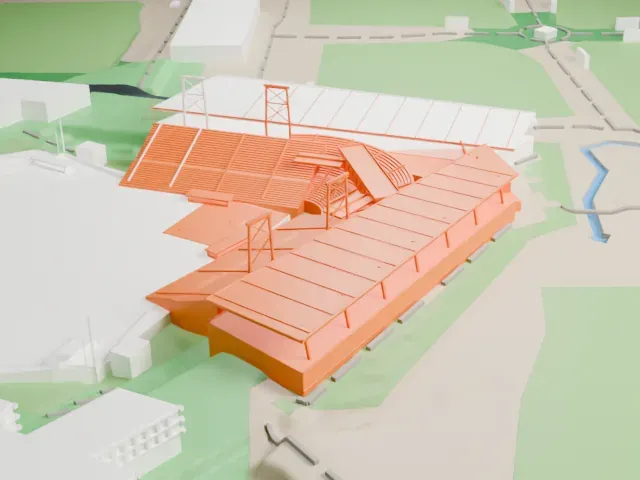 North
North
-
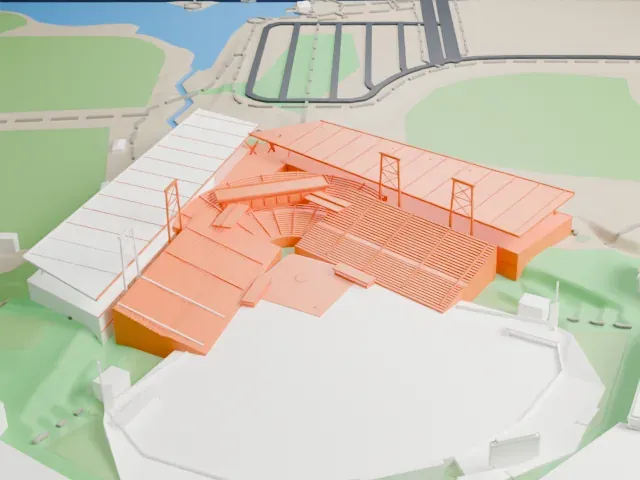 East
East
-
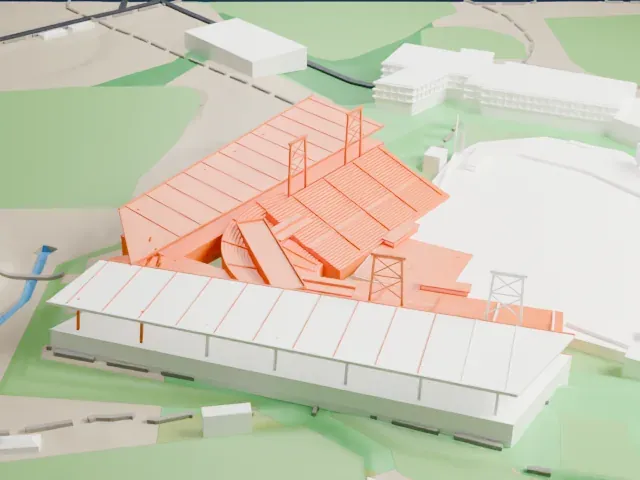 South
South
-
 West
West
- Ridged roofs over the stands
- The grandstand roofs have many fine ridges and thin supports. Layers of 0.12 to 0.16 mm keep them crisp, and a larger print keeps more of them.
- Slender light towers
- Frame-like light towers rise above the stands. Print friendly adapts these thin parts to the print scale; Full detail keeps them, and printing slowly helps them hold.
- One piece with the ground
- Salt River Fields at Talking Stick is joined to the ground in the exported file, and the four-side check found no floating parts, so nothing needs gluing.
- Pick the detail for your nozzle
- In the Buildings settings, set Landmark detail to Print friendly to adapt thin parts and small details to the print scale. Full detail keeps every modeled feature, for larger prints or a finer nozzle.
- Colors
- Buildings, roads, water and ground arrive as separate filament slots in the 3MF. Salt River Fields at Talking Stick takes the building color.
- File format
- You get a 3MF for Bambu Studio, OrcaSlicer or PrusaSlicer. Any of them can save it as STL if you need one.
About this model
Salt River Fields at Talking Stick is one of more than 2,300 landmark models in Mini Skyline. They are made with AI, and each one is checked from four sides in its real surroundings before release. Everything around it is built from OpenStreetMap and Overture map data. If you would rather print the shape from map data, turn off Landmark models in the Buildings settings.
Common questions
Is there a Salt River Fields at Talking Stick STL I can download?
Mini Skyline builds the file for you in your browser and exports 3MF, which every major slicer opens. If you need an STL, open the 3MF in your slicer and export it from there.
How big can I print it?
Any print size from 40 mm across. Salt River Fields at Talking Stick grows with the print: about 10 mm tall on the default 160 mm print. For a model larger than your printer bed, Project Mode splits the area into tiles.
Is it free?
Yes. Generation runs in your browser, with no account and nothing behind a paywall.