3D print Ernst-Happel-Stadion
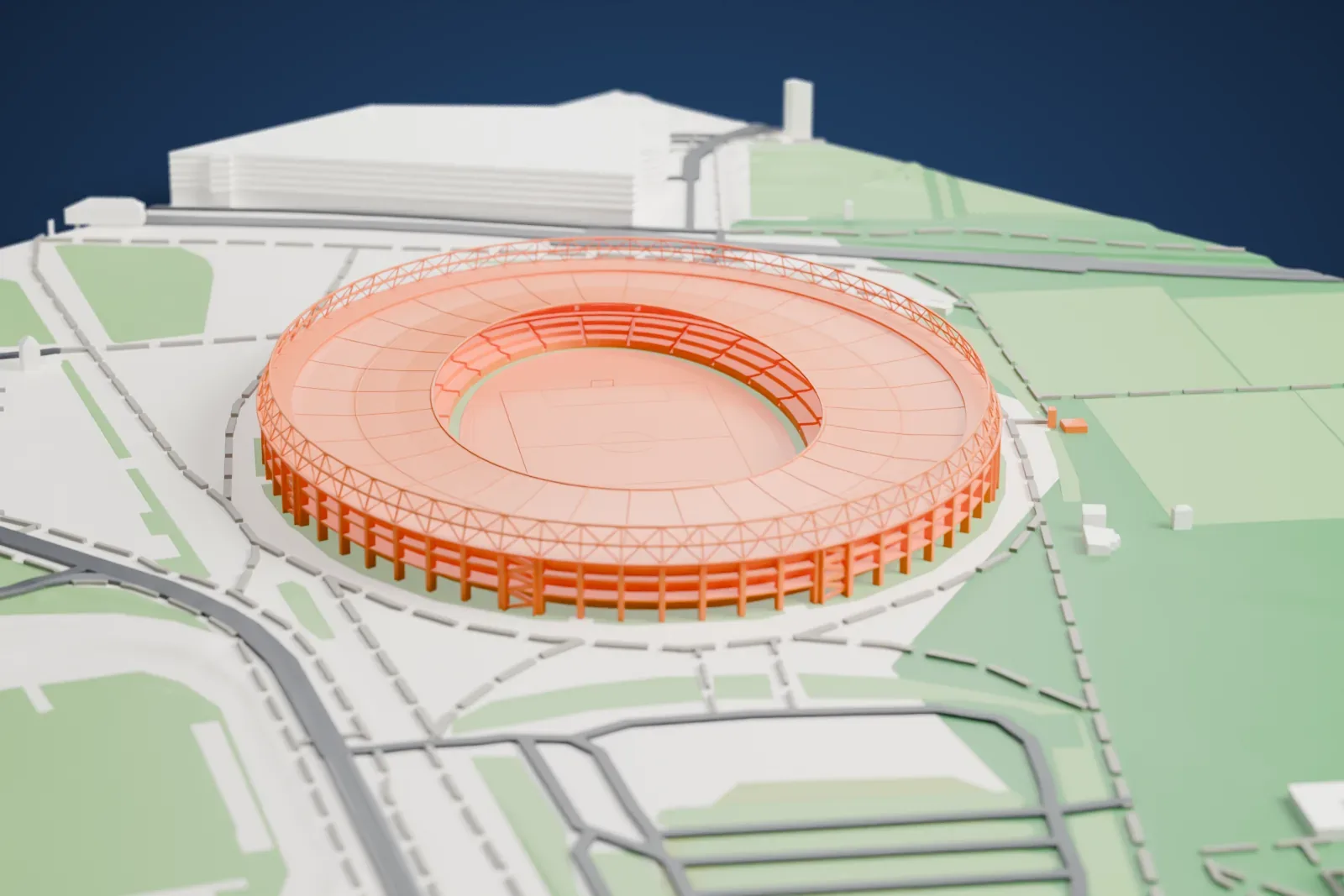
A free, printable model of Ernst-Happel-Stadion with the green fields, paths and roads around it in Vienna, generated from real map data in your browser.
-
 North
-
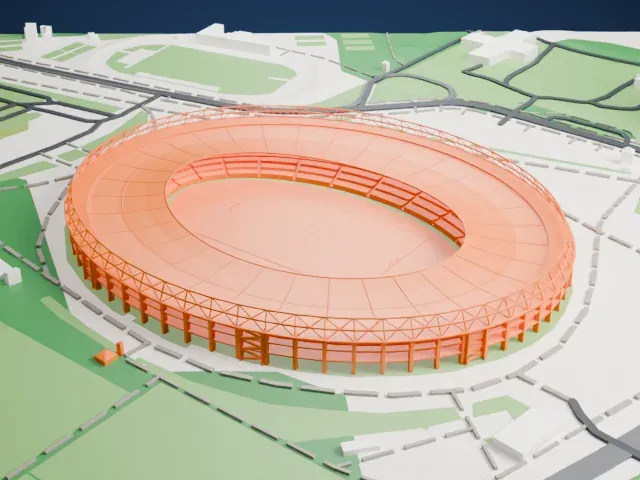 East
-
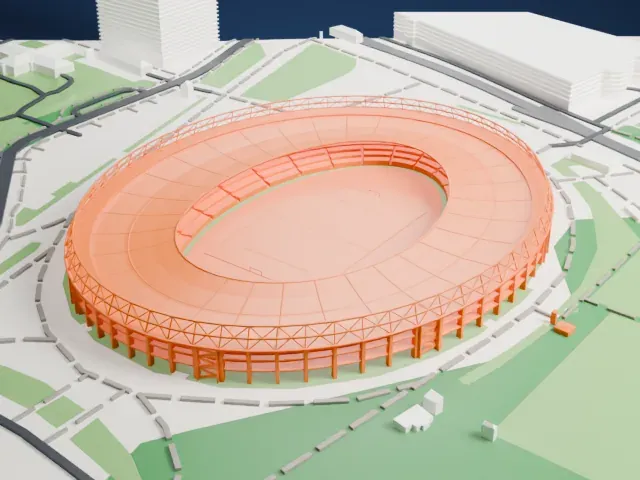 South
-
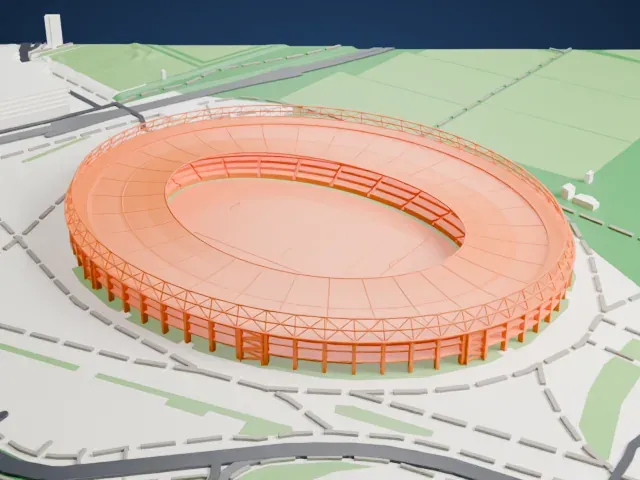 West
- On a 160 mm print
- 20 mm
- Scale
- 1:4,063
20 mm tall on a 160 mm print
Make this print opens the generator on a 650 m square around the landmark. Buildings print at close to true scale, so the landmark grows with the print size.
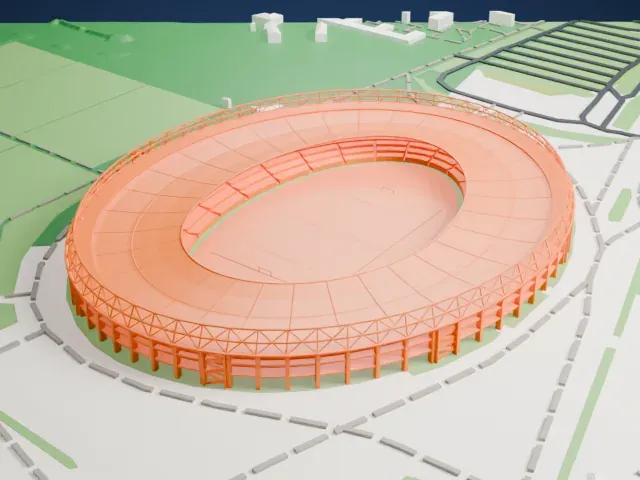
- A lattice ring on the roof edge
A ring of thin lattice trusses runs around the roof edge. Print friendly adapts these thin parts to the print scale, while Full detail keeps every member, which suits larger prints or a fine nozzle.
- A low, wide bowl with many columns
Rows of thin columns wrap the base of a low, wide bowl. A bigger print size keeps more of them, and layers of 0.12 to 0.16 mm keep the fine lines crisp.
- One piece with the ground
Ernst-Happel-Stadion is joined to the ground in the exported file, and the four-side check found no floating parts, so nothing needs gluing.
- Pick the detail for your nozzle
In the Buildings settings, set Landmark detail to Print friendly to adapt thin parts and small details to the print scale. Full detail keeps every modeled feature, for larger prints or a finer nozzle.
- Colors
Buildings, roads, water and ground arrive as separate filament slots in the 3MF. Ernst-Happel-Stadion takes the building color.
- File format
You get a 3MF for Bambu Studio, OrcaSlicer or PrusaSlicer. Any of them can save it as STL if you need one.
About Ernst-Happel-Stadion
Ernst-Happel-Stadion stands in Vienna's second district, Leopoldstadt, as a football stadium. Its 50,865 seats make it the largest stadium in Austria, and the Austria national football team plays there. It was called Praterstadion until 1992, when it was renamed in honor of the Austrian footballer Ernst Happel after his death.
Construction took 23 months, from 1929 to 1931, for the second Workers' Olympiad, and its foundation stone went in during November 1928, to mark the republic's tenth anniversary. The German architect Otto Ernst Schweizer designed it. At the time it counted as modern, especially by European standards, because spectators could leave in only 7 to 8 minutes. Schweizer also designed the adjacent Stadionbad.
The stadium hosted seven games at UEFA Euro 2008, among them the final, which Spain won against Germany. To prepare, extra rows of seats raised the capacity to 53,000, a heated pitch was fitted in the summer of 2005, and a link to the Vienna U-Bahn opened in May 2008. It was also the venue of the European Cup or UEFA Champions League final in 1964, 1987, 1990 and 1995, and of the 1970 final of the European Cup Winners' Cup, in which Manchester City beat Górnik Zabrze 2–1.
About this model
Ernst-Happel-Stadion is one of more than 4,300 landmark models in Mini Skyline. They are made with AI, and each one is checked from four sides in its real surroundings before release. Everything around it is built from OpenStreetMap and Overture map data. If you would rather print the shape from map data, turn off Landmark models in the Buildings settings.
Same skyline