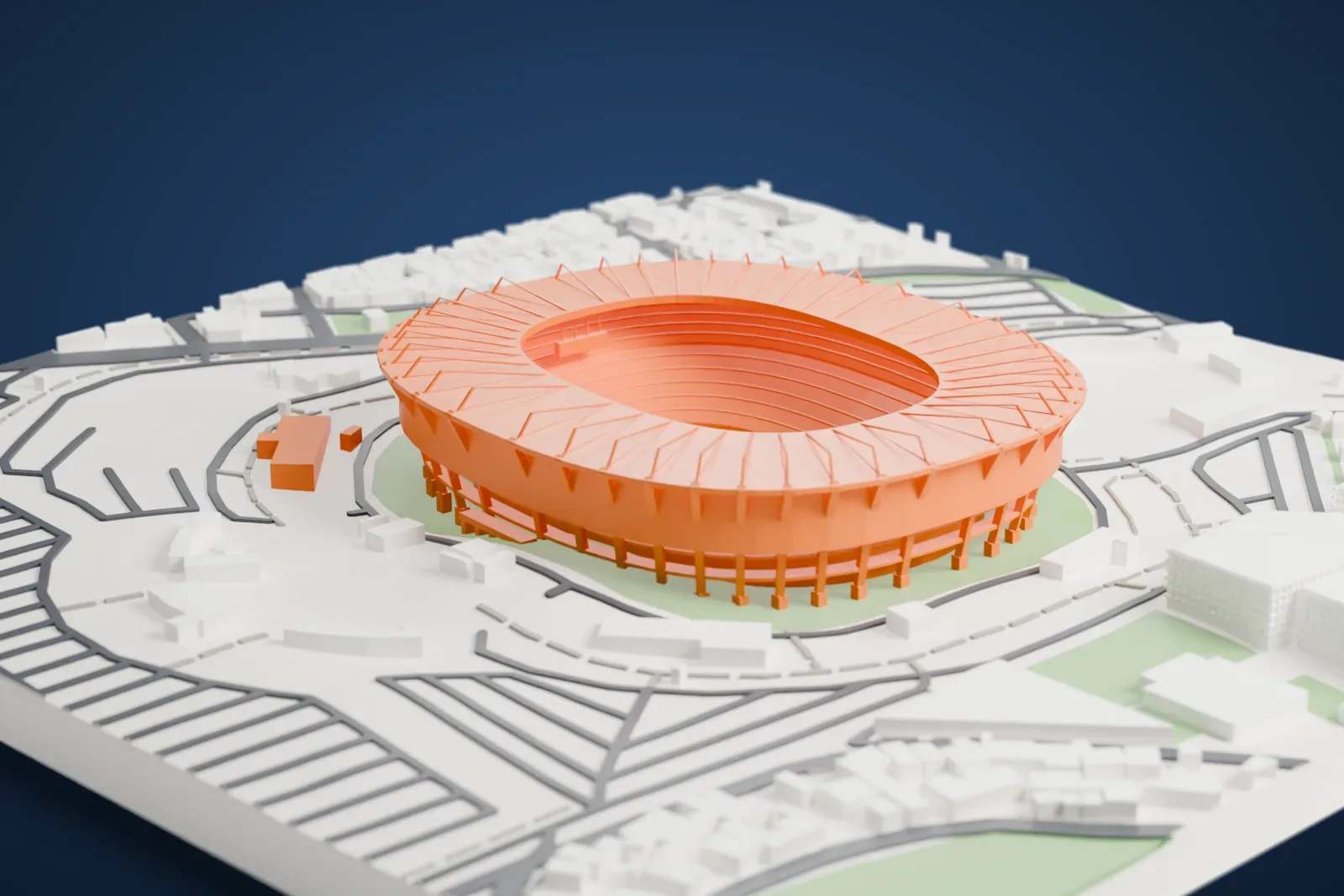
3D print Estadio Azteca
A free, printable model of Estadio Azteca and the roads and buildings around it, generated from real map data in your browser.
-
 North
-
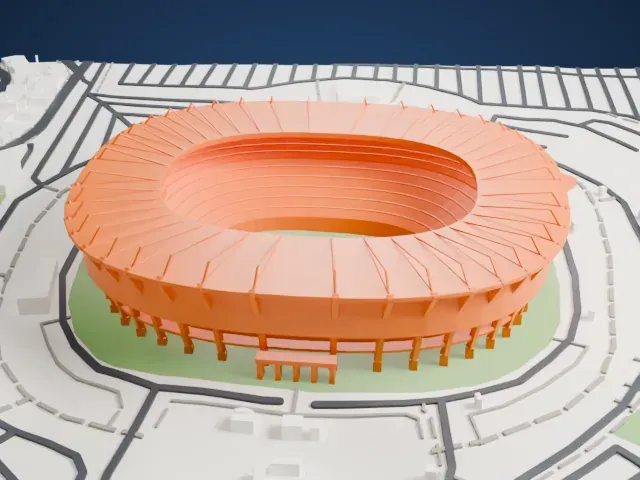 East
-
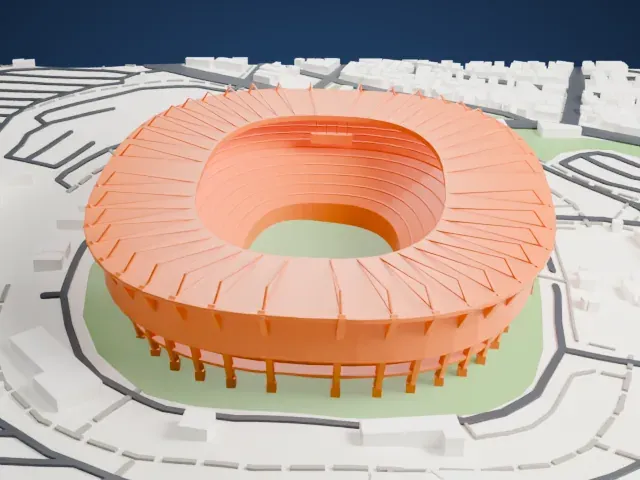 South
-
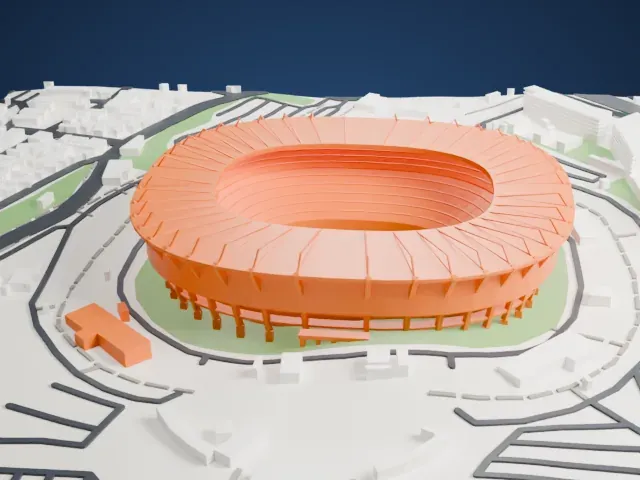 West
- On a 160 mm print
- 18 mm
- Scale
- 1:3,750
18 mm tall on a 160 mm print
Make this print opens the generator on a 600 m square around the landmark. Buildings print at close to true scale, so the landmark grows with the print size.
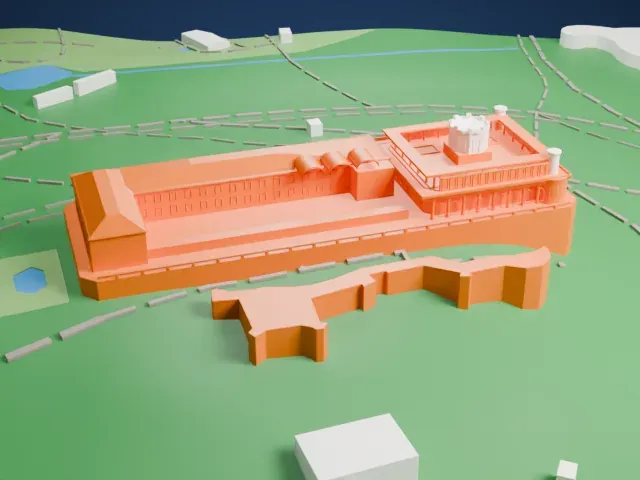
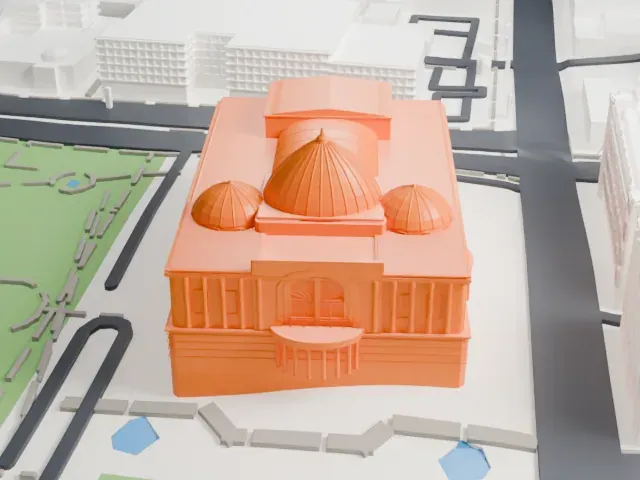
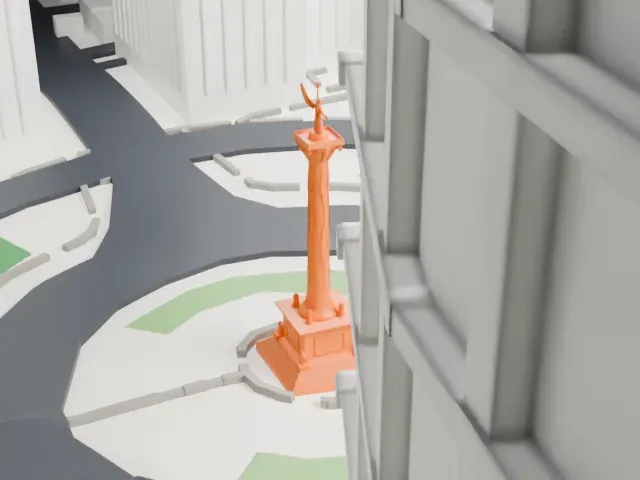
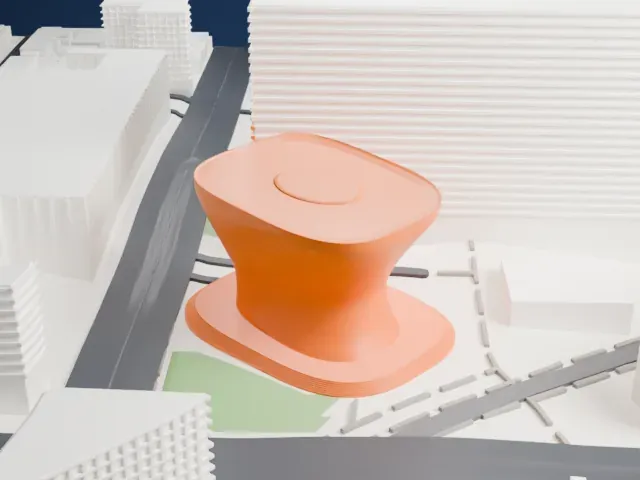
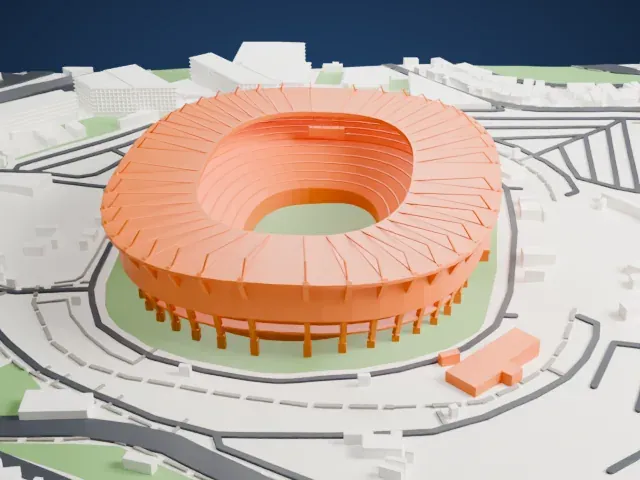
- Thin ribs across the roof ring
Many slim ribs run across the ring around the bowl. Print friendly adapts them to the print scale; Full detail keeps every rib on a larger print or with a fine nozzle.
- Slender columns around the base
A row of slim columns circles the lower stand. A larger print size and 0.12–0.16 mm layers keep these supports crisp.
- One piece with the ground
Estadio Azteca is joined to the ground in the exported file, and the four-side check found no floating parts, so nothing needs gluing.
- Pick the detail for your nozzle
In the Buildings settings, set Landmark detail to Print friendly to adapt thin parts and small details to the print scale. Full detail keeps every modeled feature, for larger prints or a finer nozzle.
- Colors
Buildings, roads, water and ground arrive as separate filament slots in the 3MF. Estadio Azteca takes the building color.
- File format
You get a 3MF for Bambu Studio, OrcaSlicer or PrusaSlicer. Any of them can save it as STL if you need one.
About Estadio Azteca
Estadio Azteca stands in Coyoacán, Mexico City; for sponsorship reasons it is officially named Estadio Banorte. Its elevation is 2,241 meters (7,352 ft), and it serves as the official home of Club América (Liga MX) and of the Mexico national team. The stadium holds 87,523 people, more than any other stadium in Latin America.
The architects were Rafael Mijares Alcérreca and Pedro Ramírez Vázquez. The stadium was conceived as a major venue under President Adolfo López Mateos, and the 1968 Summer Olympics were awarded to Mexico in 1963. Ground was broken in 1961. The first match, Club América against Torino F.C. on May 29, 1966, finished 2–2, with room for 107,494 spectators. A modern lighting system followed on June 5, 1966, with a night game between Valencia C.F. and Necaxa.
Nicknamed the Temple of Football and the Cathedral of Football, the stadium was the first to stage two FIFA World Cup finals. Brazil won the 1970 final over Italy, 4–1, and Argentina took the 1986 final against West Germany, 3–2. A 1970 semifinal in which Italy won 4–3 in extra time against West Germany, the Game of the Century, was played there too, and the stadium was the main venue for the 1968 Olympic football tournament and for the 1971 Women's World Cup.
About this model
Estadio Azteca is one of more than 4,300 landmark models in Mini Skyline. They are made with AI, and each one is checked from four sides in its real surroundings before release. Everything around it is built from OpenStreetMap and Overture map data. If you would rather print the shape from map data, turn off Landmark models in the Buildings settings.
Same skyline