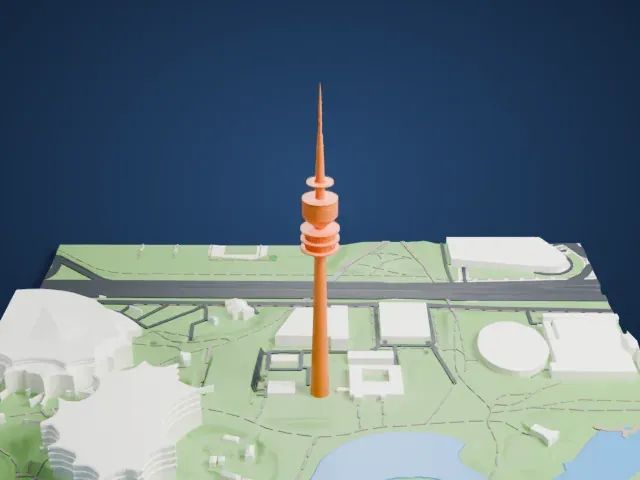
3D print Olympiastadion Munich
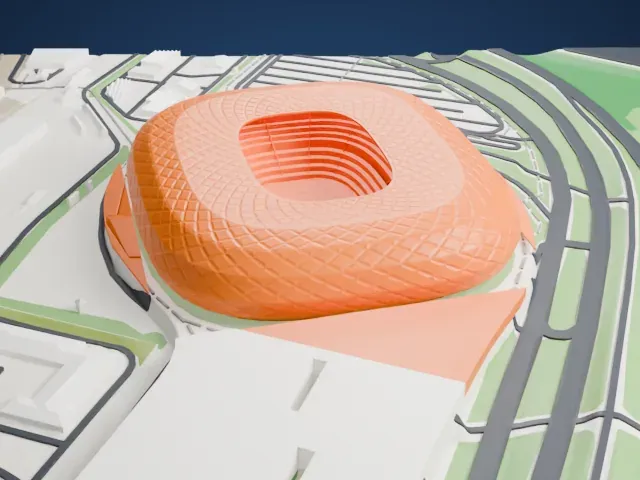
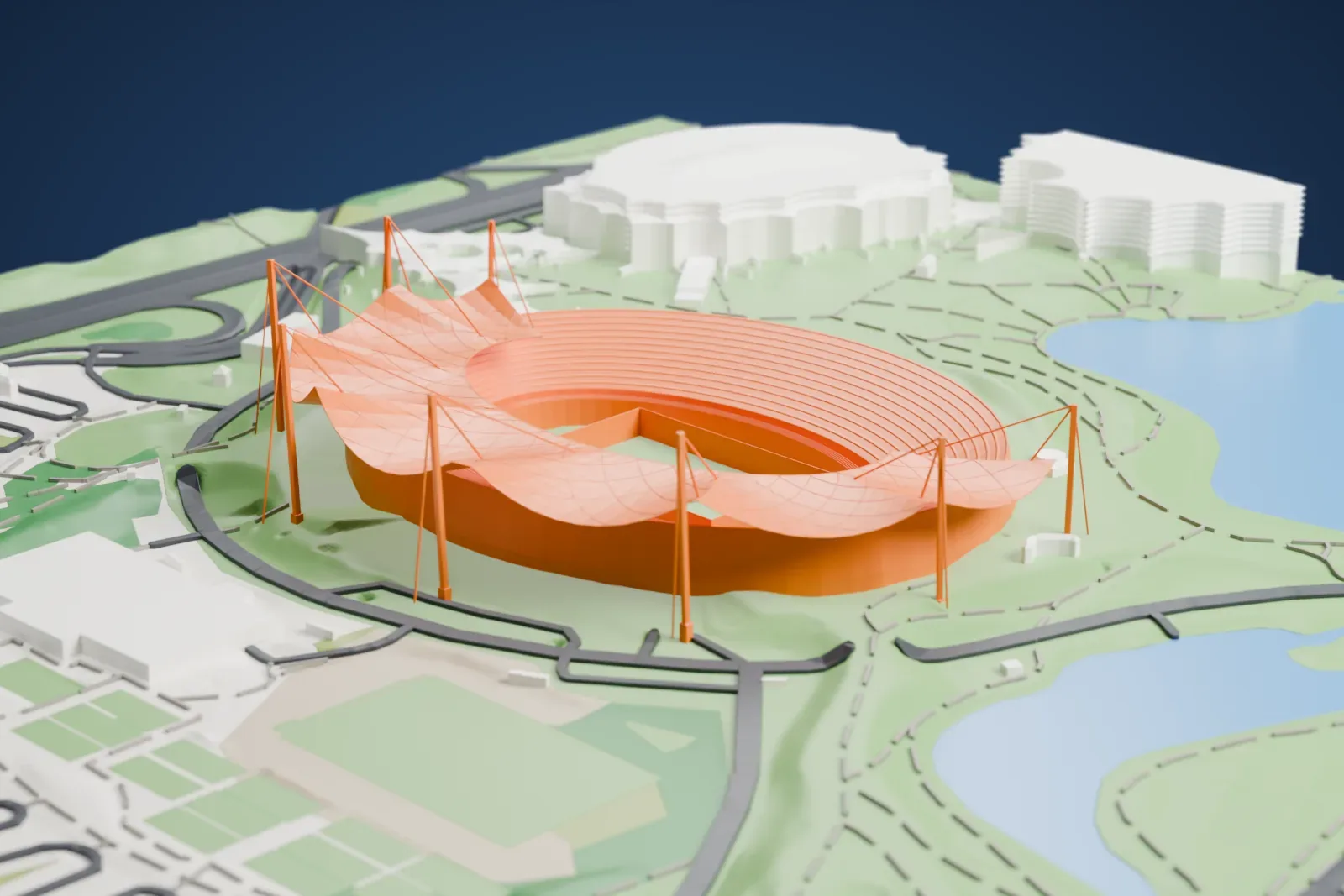
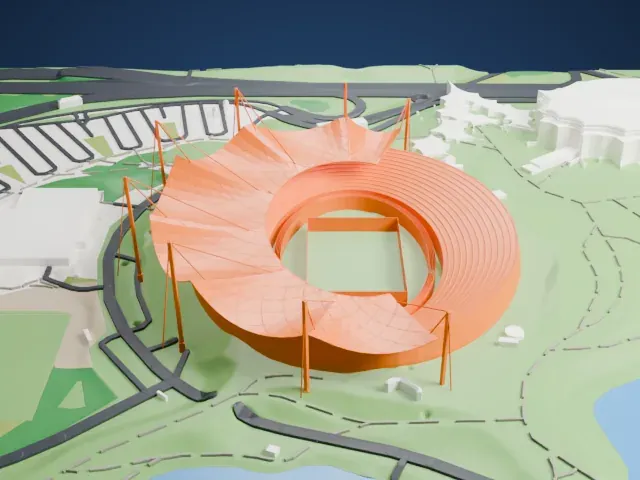
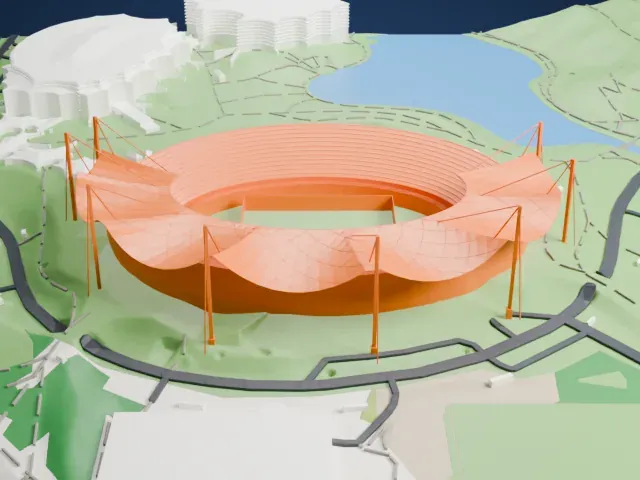
A free, printable model of the stadium's low oval bowl and its sweeping canopy held up by tall masts, set among parkland, water and parking lots, generated from real map data in your browser.
-
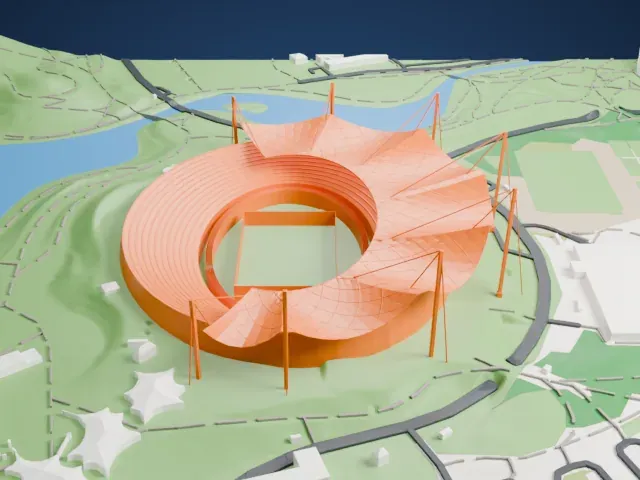 North
-
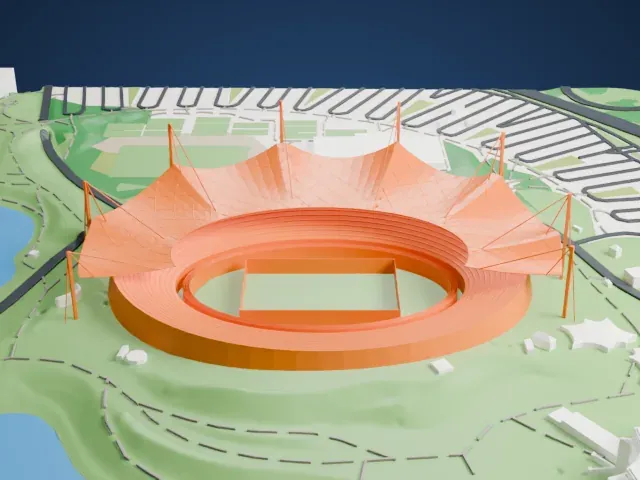 East
-
 South
-
 West
- On a 160 mm print
- 18 mm
- Scale
- 1:5,000
18 mm tall on a 160 mm print
Make this print opens the generator on a 800 m square around the landmark. Buildings print at close to true scale, so the landmark grows with the print size.
- Slender masts and cables
Thin masts rise around the stadium to hold up the canopy. Print friendly adapts these slim parts to your print scale; Full detail keeps them. Print slowly with good cooling so the tall tips form cleanly.
- Net-like canopy pattern
The sweeping canopy has a fine diamond pattern of lines. A larger print and layers of 0.12 to 0.16 mm keep the pattern readable.
- One piece with the ground
Olympiastadion Munich is joined to the ground in the exported file, and the four-side check found no floating parts, so nothing needs gluing.
- Pick the detail for your nozzle
In the Buildings settings, set Landmark detail to Print friendly to adapt thin parts and small details to the print scale. Full detail keeps every modeled feature, for larger prints or a finer nozzle.
- Colors
Buildings, roads, water and ground arrive as separate filament slots in the 3MF. Olympiastadion Munich takes the building color.
- File format
You get a 3MF for Bambu Studio, OrcaSlicer or PrusaSlicer. Any of them can save it as STL if you need one.
About Olympiastadion Munich
Olympiastadion is a stadium in Munich, Germany, at the center of Olympiapark München, in the north of the city. It was constructed to serve as the principal venue of the 1972 Summer Olympics, when 70,824 tickets, including unsaleable ones, were available for events in the stadium. It has also hosted the 1974 FIFA World Cup Final, which drew 75,200 spectators with up to 5,000 extra short-term stands, the UEFA Euro 1988 Final and the European Cup finals of 1979, 1993 and 1997. Its seated capacity is 63,118, and concerts can reach 77,337 depending on the configuration.
Günther Behnisch, a German architect, and the engineer Frei Otto designed the stadium, with help from John Argyris. Its lightweight tent construction was regarded as revolutionary at the time. The sweeping canopies, made of acrylic glass and held steady by steel cables, were the first of their kind on such a scale. The design echoed the skyline of the Alps and was meant as a counterpoint to the Berlin Games of 1936. Its see-through canopy stood for a new, democratic and optimistic West Germany, an idea echoed by the Games' motto, "The cheerful Games".
Until the Allianz Arena was built for the 2006 FIFA World Cup, Bayern Munich and 1860 Munich both called the stadium home. The site, the largely undeveloped Oberwiesenfeld, was picked to be the centerpiece of the Games, and Munich advertised them as "Olympia of the short ways". After World War II, debris from the city's wartime bombing was heaped up there, and the heap became the Olympic Mountain, deliberately given an oval shape so it could carry the stands of a stadium.
About this model
Olympiastadion Munich is one of more than 4,300 landmark models in Mini Skyline. They are made with AI, and each one is checked from four sides in its real surroundings before release. Everything around it is built from OpenStreetMap and Overture map data. If you would rather print the shape from map data, turn off Landmark models in the Buildings settings.
Same skyline