3D print the Pula Arena
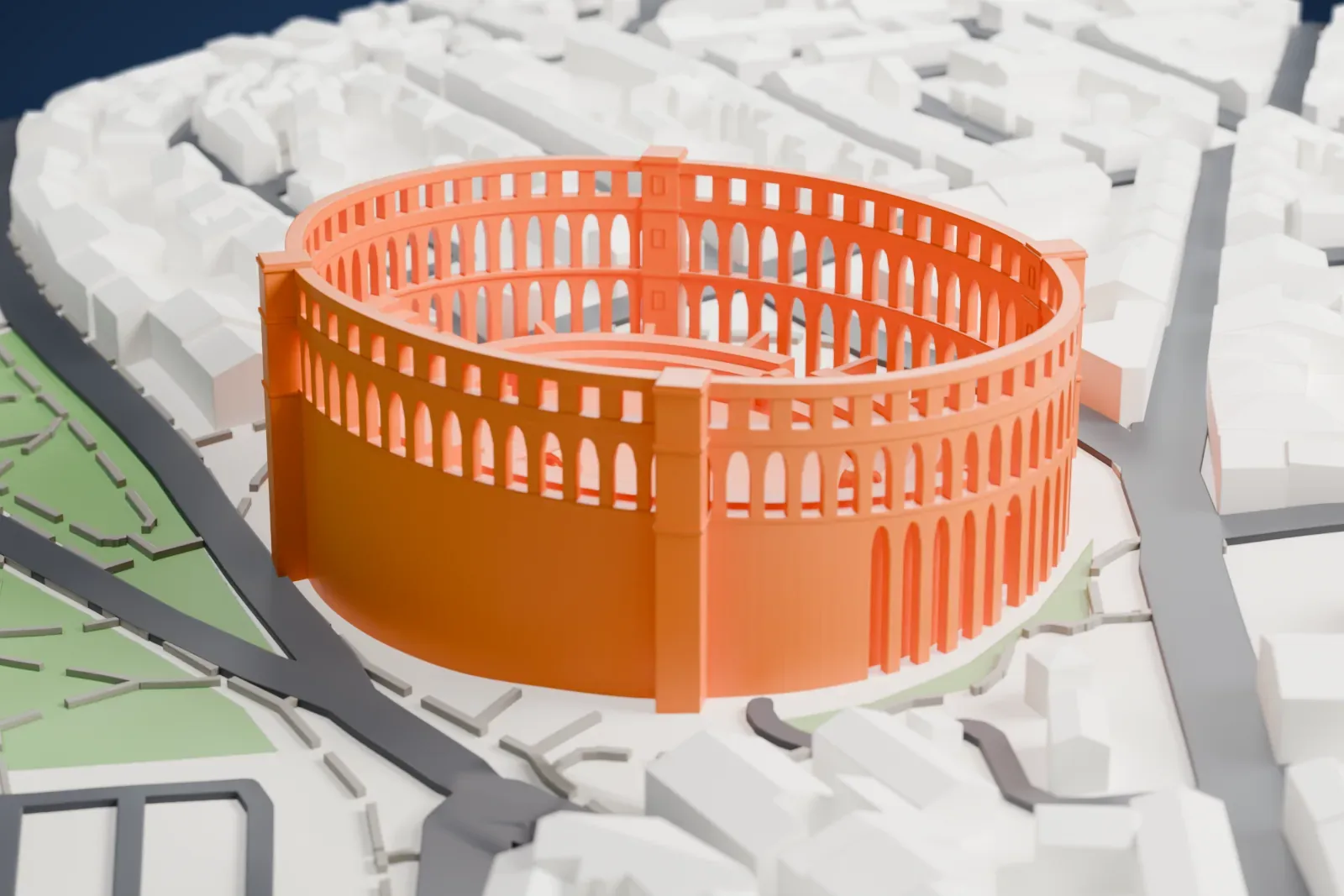
A free, printable model of the Pula Arena and the town streets, buildings and parkland around it, generated from real map data in your browser.
-
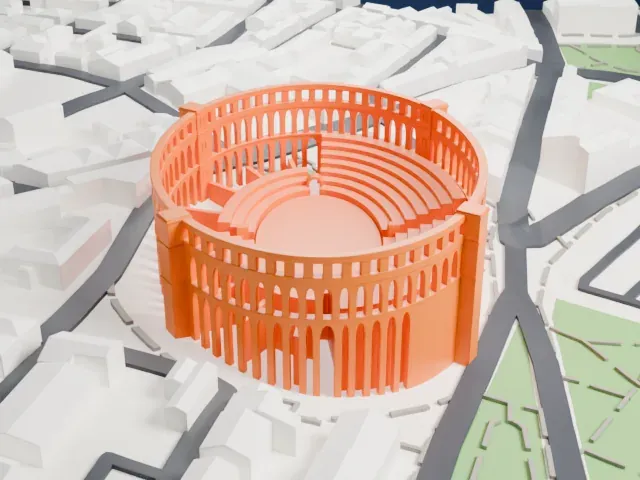 North
-
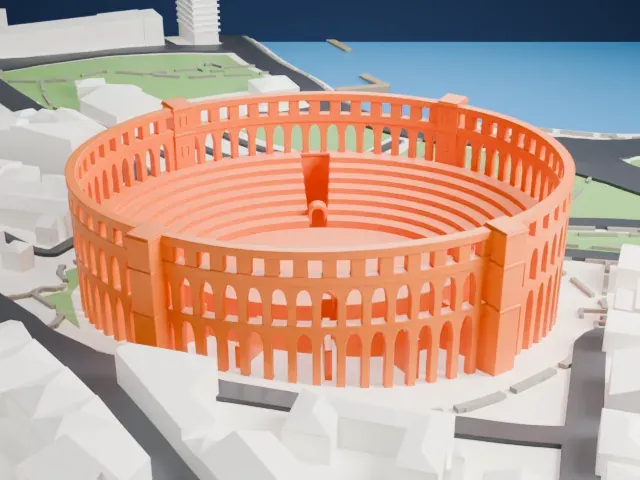 East
-
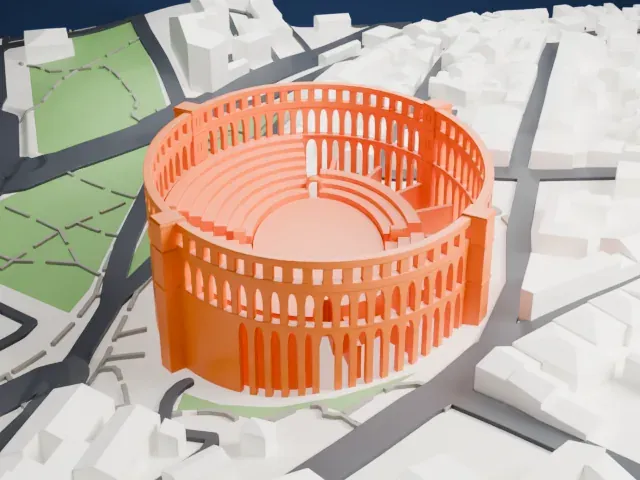 South
-
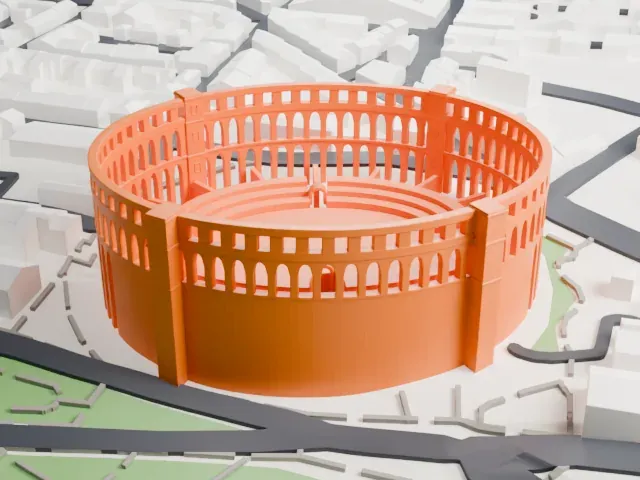 West
- On a 160 mm print
- 14 mm
- Scale
- 1:3,750
14 mm tall on a 160 mm print
Make this print opens the generator on a 600 m square around the landmark. Buildings print at close to true scale, so the landmark grows with the print size.
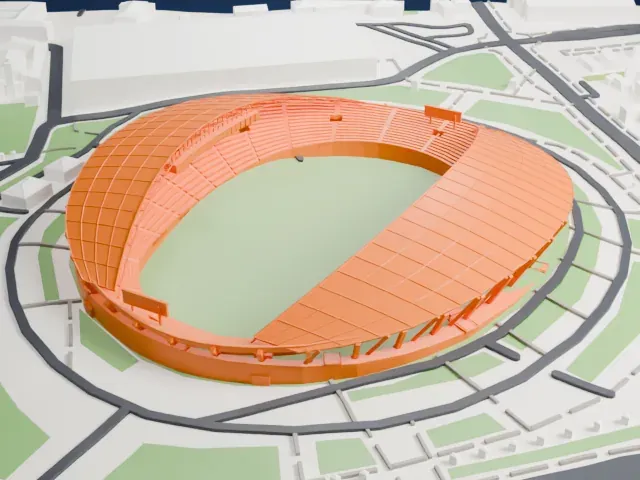
- Rows of slender arches
Two tiers of tall arches and a top row of small openings leave slim piers between them. Print friendly adapts these thin piers to the print scale; Full detail keeps every arch, which suits a larger print or a fine nozzle.
- Thin ring, stepped seating
The outer wall is a thin ring around the stepped seating inside. A larger print size and layers of 0.12 to 0.16 mm keep the steps and arches crisp.
- One piece with the ground
The Pula Arena is joined to the ground in the exported file, and the four-side check found no floating parts, so nothing needs gluing.
- Pick the detail for your nozzle
In the Buildings settings, set Landmark detail to Print friendly to adapt thin parts and small details to the print scale. Full detail keeps every modeled feature, for larger prints or a finer nozzle.
- Colors
Buildings, roads, water and ground arrive as separate filament slots in the 3MF. The Pula Arena takes the building color.
- File format
You get a 3MF for Bambu Studio, OrcaSlicer or PrusaSlicer. Any of them can save it as STL if you need one.
About the Pula Arena
The Pula Arena is a Roman amphitheater in Pula, Istria, Croatia. Construction is believed to have begun in the reign of Emperor Augustus, and it was later enlarged under Vespasian. Among the best-preserved Roman amphitheaters anywhere, it is also the only surviving one to keep its entire circular wall. Built outside the city walls, it once held up to 23,000 spectators for gladiator fights, animal hunts and other public entertainments. Its name comes from harena, the Latin word for the sand that covered the floor.
Local limestone forms the exterior wall. The elliptical building measures 132.45 by 105.10 m (434.5 by 344.8 ft) along its axes, and its height reaches 32 m at the highest point. Because it was built on a slope, the side facing the sea has three stories, while the other side has only two. The first two floors each have 72 arches, and the top floor has 64 rectangular openings. Four towers each held two cisterns of perfumed water for a fountain or for sprinkling the spectators.
In the 5th century Emperor Honorius banned gladiator combat there, and at about that time local people began to plunder the stone. The patriarch of Aquileia banned further removal of stone by the 13th century. Systematic preservation began in the 19th century, and the arena has since become a cultural venue, with events including the Pula Film Festival, concerts and opera performances.
About this model
The Pula Arena is one of more than 4,300 landmark models in Mini Skyline. They are made with AI, and each one is checked from four sides in its real surroundings before release. Everything around it is built from OpenStreetMap and Overture map data. If you would rather print the shape from map data, turn off Landmark models in the Buildings settings.
Keep exploring