3D print Amon G. Carter Stadium
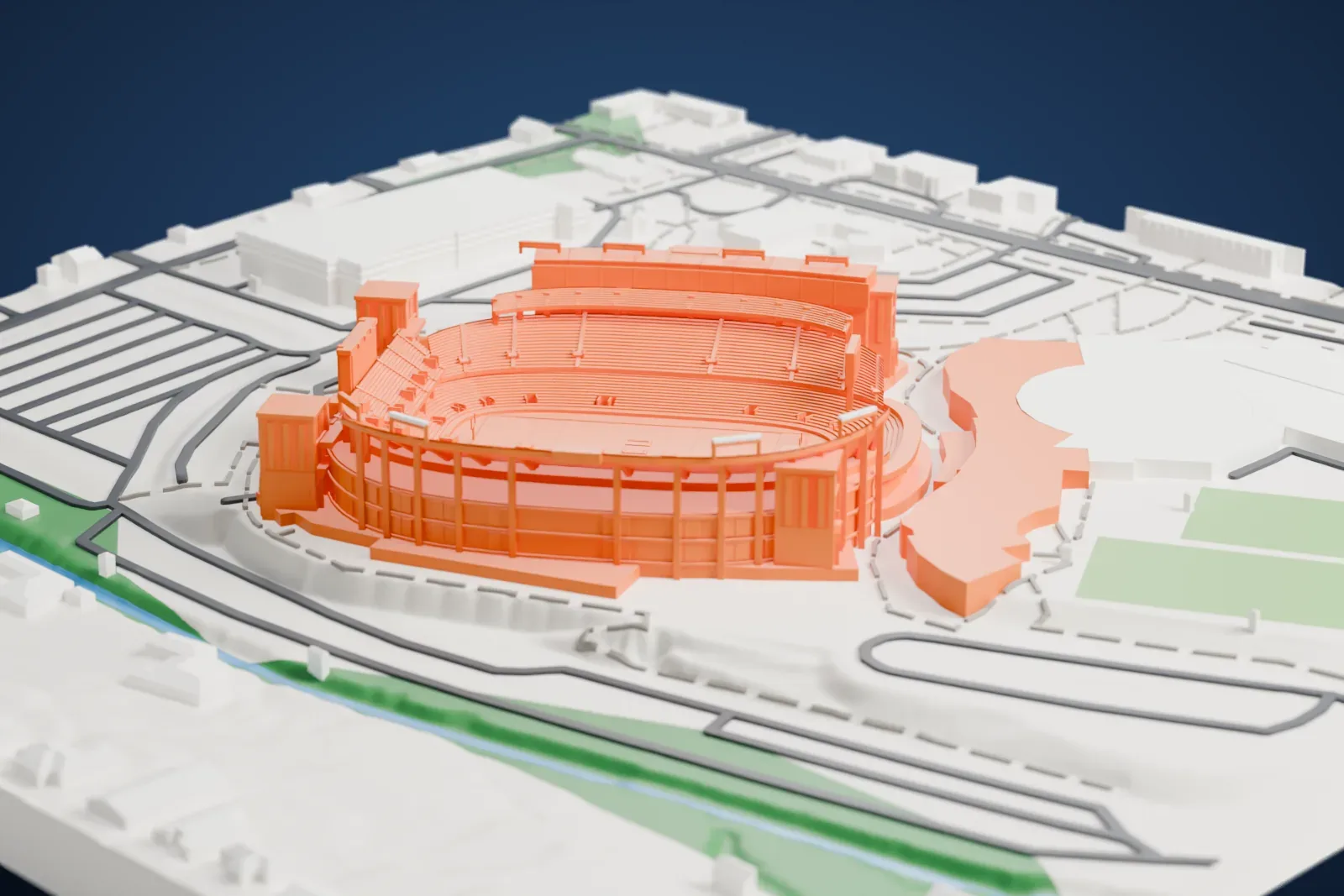
A free, printable model of Amon G. Carter Stadium and the roads, fields and buildings around it, generated from real map data in your browser.
Free, in your browser. Exports a slicer-ready 3MF.
About Amon G. Carter Stadium
Amon G. Carter Stadium is where the TCU Horned Frogs play their home football games, an open-air stadium at Texas Christian University (TCU), in the Texas city of Fort Worth. It is named for Amon G. Carter, a Fort Worth businessman, newspaper publisher and booster of the city. Among its nicknames are Hell's Half Acre, which refers to a site from Fort Worth's Wild West past that stood near the stadium, and "The Carter".
In 1928 TCU received a private gift from Amon G. Carter, who published the Fort Worth Star-Telegram. He turned to Andrew Poyar, a co-designer of Shields-Watkins Field at the University of Tennessee, for the blueprints. Construction ran from 1929 into 1930, and the first design seated 22,000 people. In its opening football game, on October 11, 1930, TCU beat the University of Arkansas. Head coach Dutch Meyer led the Horned Frogs to national championships in 1935 and 1938.
Between 2010 and 2012 the stadium went through a $164 million reconstruction, funded entirely by donor support, with no bonds or debt. Everything above ground level was rebuilt, and only the below-ground playing field and the lower seating bowl were kept. On December 5, 2010, the stands on the west side were imploded. A further $118 million expansion of the east side followed in 2019.
How it prints
Make this print opens the generator on a 600 m square around the landmark. Buildings print at close to true scale, so the landmark grows with the print size.
| Print size | Landmark height | Scale |
|---|---|---|
| 160 mm default | 14 mm | 1:3,750 |
| 200 mm | 18 mm | 1:3,000 |
| 256 mm | 23 mm | 1:2,344 |
-
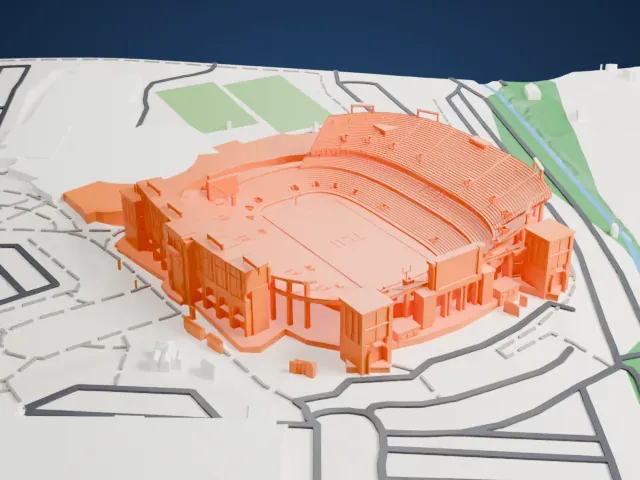 North
North
-
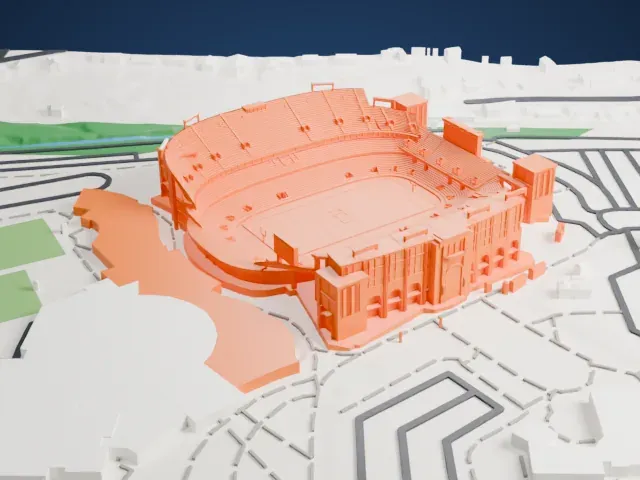 East
East
-
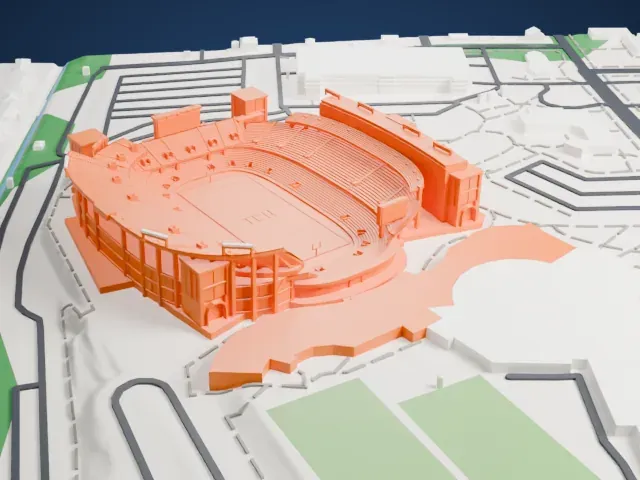 South
South
-
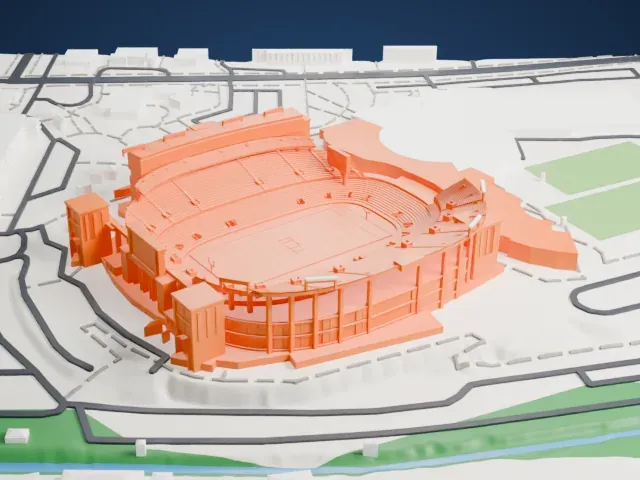 West
West
- Arched entrance fronts
- Arched doors and small windows mark the entrance fronts and corner towers. A bigger print keeps more of them; Print friendly adapts small details to the print scale, while Full detail keeps every one.
- Many tiers of seating
- The bowl is built from many thin stepped tiers. Layers of 0.12 to 0.16 mm keep the steps crisp, and a larger print shows more of the individual rows.
- One piece with the ground
- Amon G. Carter Stadium is joined to the ground in the exported file, and the four-side check found no floating parts, so nothing needs gluing.
- Pick the detail for your nozzle
- In the Buildings settings, set Landmark detail to Print friendly to adapt thin parts and small details to the print scale. Full detail keeps every modeled feature, for larger prints or a finer nozzle.
- Colors
- Buildings, roads, water and ground arrive as separate filament slots in the 3MF. Amon G. Carter Stadium takes the building color.
- File format
- You get a 3MF for Bambu Studio, OrcaSlicer or PrusaSlicer. Any of them can save it as STL if you need one.
About this model
Amon G. Carter Stadium is one of more than 2,300 landmark models in Mini Skyline. They are made with AI, and each one is checked from four sides in its real surroundings before release. Everything around it is built from OpenStreetMap and Overture map data. If you would rather print the shape from map data, turn off Landmark models in the Buildings settings.
Common questions
Is there an Amon G. Carter Stadium STL I can download?
Mini Skyline builds the file for you in your browser and exports 3MF, which every major slicer opens. If you need an STL, open the 3MF in your slicer and export it from there.
How big can I print it?
Any print size from 40 mm across. Amon G. Carter Stadium grows with the print: about 14 mm tall on the default 160 mm print. For a model larger than your printer bed, Project Mode splits the area into tiles.
Is it free?
Yes. Generation runs in your browser, with no account and nothing behind a paywall.