3D print De Kuip
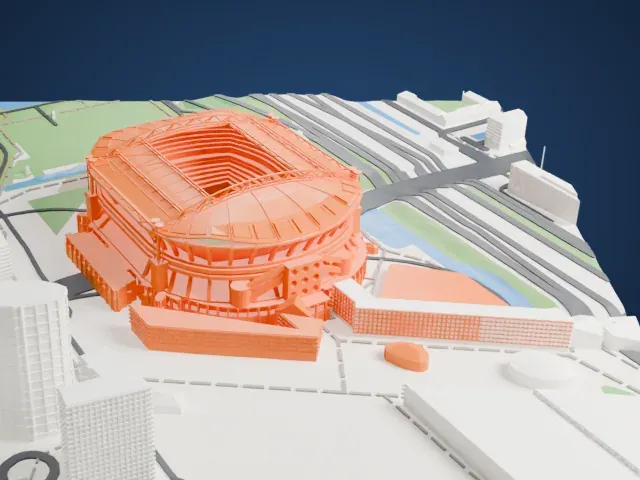
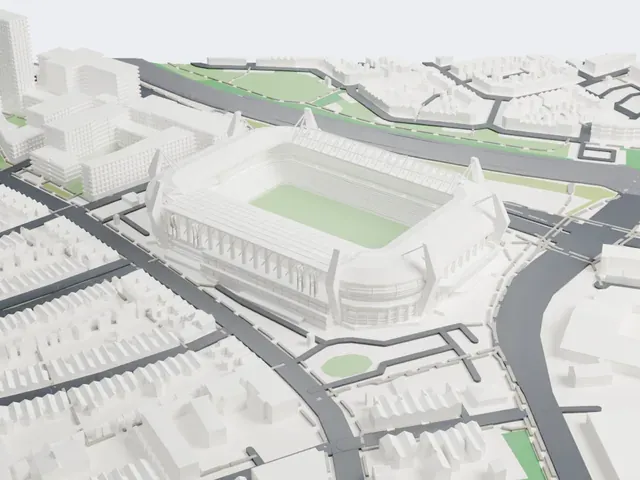
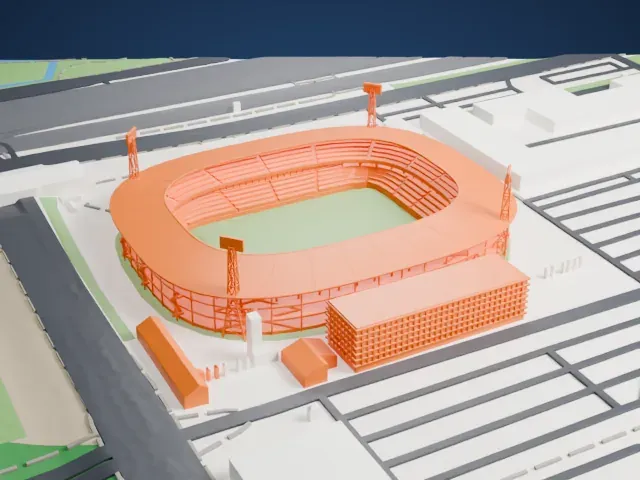
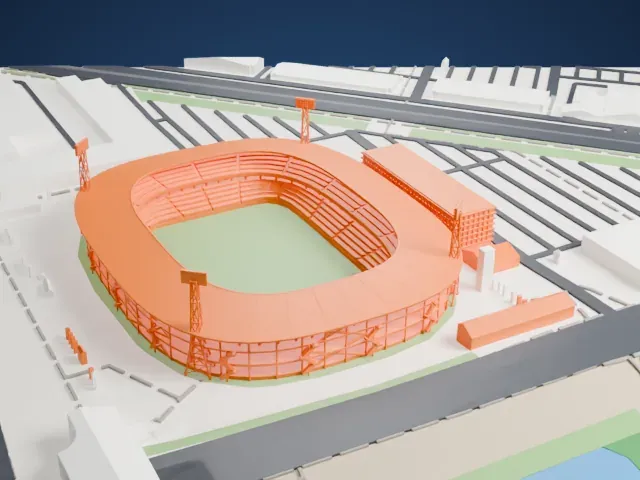
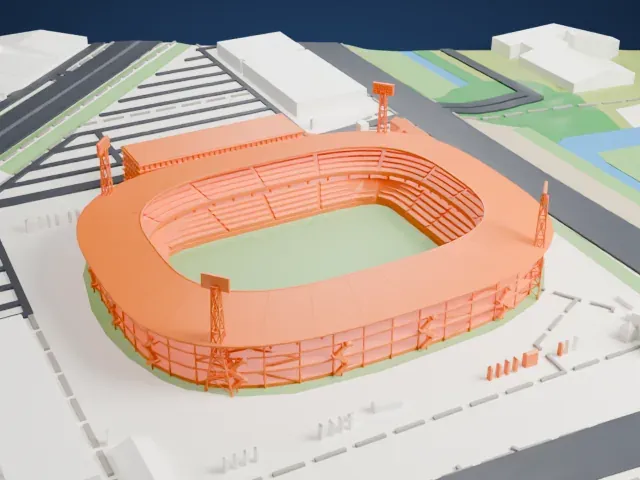
A free, printable model of De Kuip, an oval stadium with a continuous roof and four tall lattice masts, among roads and open ground, generated from real map data in your browser.
Free, in your browser. Exports a slicer-ready 3MF.
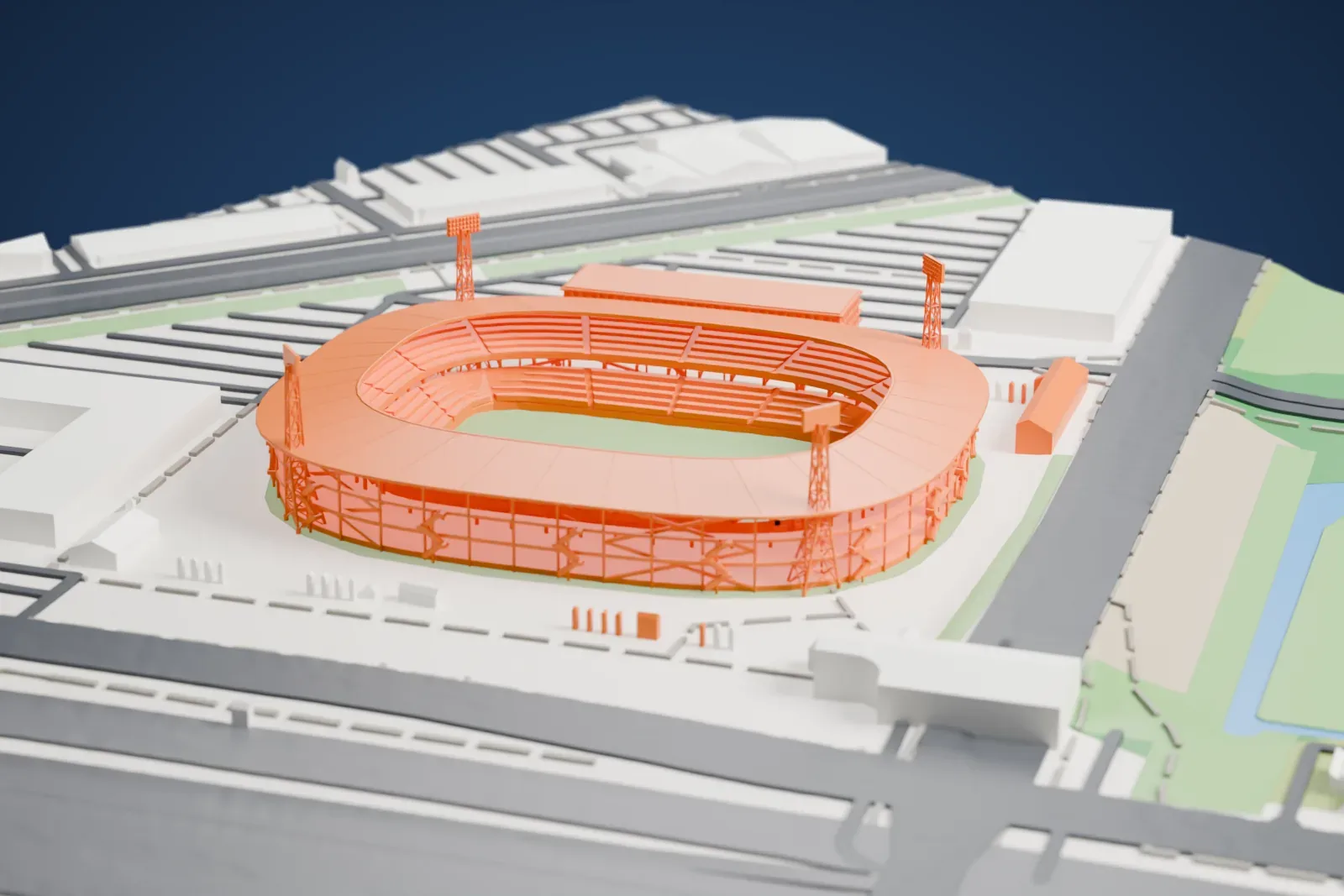
About De Kuip
De Kuip, officially Stadion Feijenoord, was completed in 1937. It is a stadium in Rotterdam in the Netherlands, and its nickname means the Tub. Its name comes from the Feijenoord district of Rotterdam and from the club of the same name, which later internationalized its name to Feyenoord in 1973. In the 1930s, Feyenoord's president Leen van Zandvliet wanted a completely new stadium with two free-hanging tiers and unobstructed views, unlike any other on the continent.
Leendert van der Vlugt and Johannes Brinkman, who had designed Rotterdam's Van Nelle factory, were commissioned to design the stadium using glass, concrete and steel, which were inexpensive at that time. Models of the day included Highbury, with double-deck West and East stands that were new at the time, and Yankee Stadium in New York. The original capacity was 64,000, and it was expanded to 69,000 in 1949. During World War II, German occupiers nearly dismantled the stadium for scrap.
In 1991 De Kuip became a Rotterdam monument. In 1994 it was extensively renovated: it became an all-seater with 51,117 seats, and a longer roof covers every seat. In 1963 the stadium staged the European Cup Winners' Cup final, in which Tottenham Hotspur beat Atlético Madrid 5–1, making Tottenham the first club from Britain to take a European trophy. A record ten European finals have been played there, and in 2000 it staged the Euro 2000 final, which France won 2–1 against Italy in extra time.
How it prints
Make this print opens the generator on a 600 m square around the landmark. Buildings print at close to true scale, so the landmark grows with the print size.
| Print size | Landmark height | Scale |
|---|---|---|
| 160 mm default | 15 mm | 1:3,750 |
| 200 mm | 18 mm | 1:3,000 |
| 256 mm | 23 mm | 1:2,344 |
-
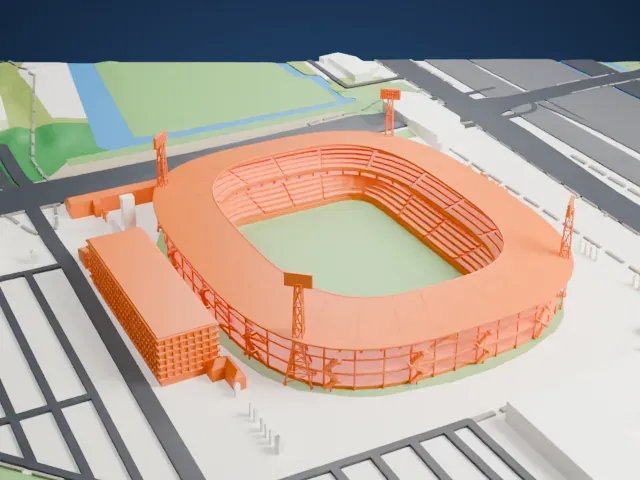 North
North
-
 East
East
-
 South
South
-
 West
West
- Lattice masts and bracing
- Four tall lattice masts and diagonal steel bracing are the thinnest parts of this model. Print friendly adapts them to your print scale; Full detail keeps them, best printed slowly with 0.12 to 0.16 mm layers.
- A roof around the bowl
- The roof rings the whole bowl, so the seating tiers inside show best from above and on a larger print.
- One piece with the ground
- De Kuip is joined to the ground in the exported file, and the four-side check found no floating parts, so nothing needs gluing.
- Pick the detail for your nozzle
- In the Buildings settings, set Landmark detail to Print friendly to adapt thin parts and small details to the print scale. Full detail keeps every modeled feature, for larger prints or a finer nozzle.
- Colors
- Buildings, roads, water and ground arrive as separate filament slots in the 3MF. De Kuip takes the building color.
- File format
- You get a 3MF for Bambu Studio, OrcaSlicer or PrusaSlicer. Any of them can save it as STL if you need one.
About this model
De Kuip is one of more than 2,300 landmark models in Mini Skyline. They are made with AI, and each one is checked from four sides in its real surroundings before release. Everything around it is built from OpenStreetMap and Overture map data. If you would rather print the shape from map data, turn off Landmark models in the Buildings settings.
Common questions
Is there a De Kuip STL I can download?
Mini Skyline builds the file for you in your browser and exports 3MF, which every major slicer opens. If you need an STL, open the 3MF in your slicer and export it from there.
How big can I print it?
Any print size from 40 mm across. De Kuip grows with the print: about 15 mm tall on the default 160 mm print. For a model larger than your printer bed, Project Mode splits the area into tiles.
Is it free?
Yes. Generation runs in your browser, with no account and nothing behind a paywall.