3D print Jordan–Hare Stadium
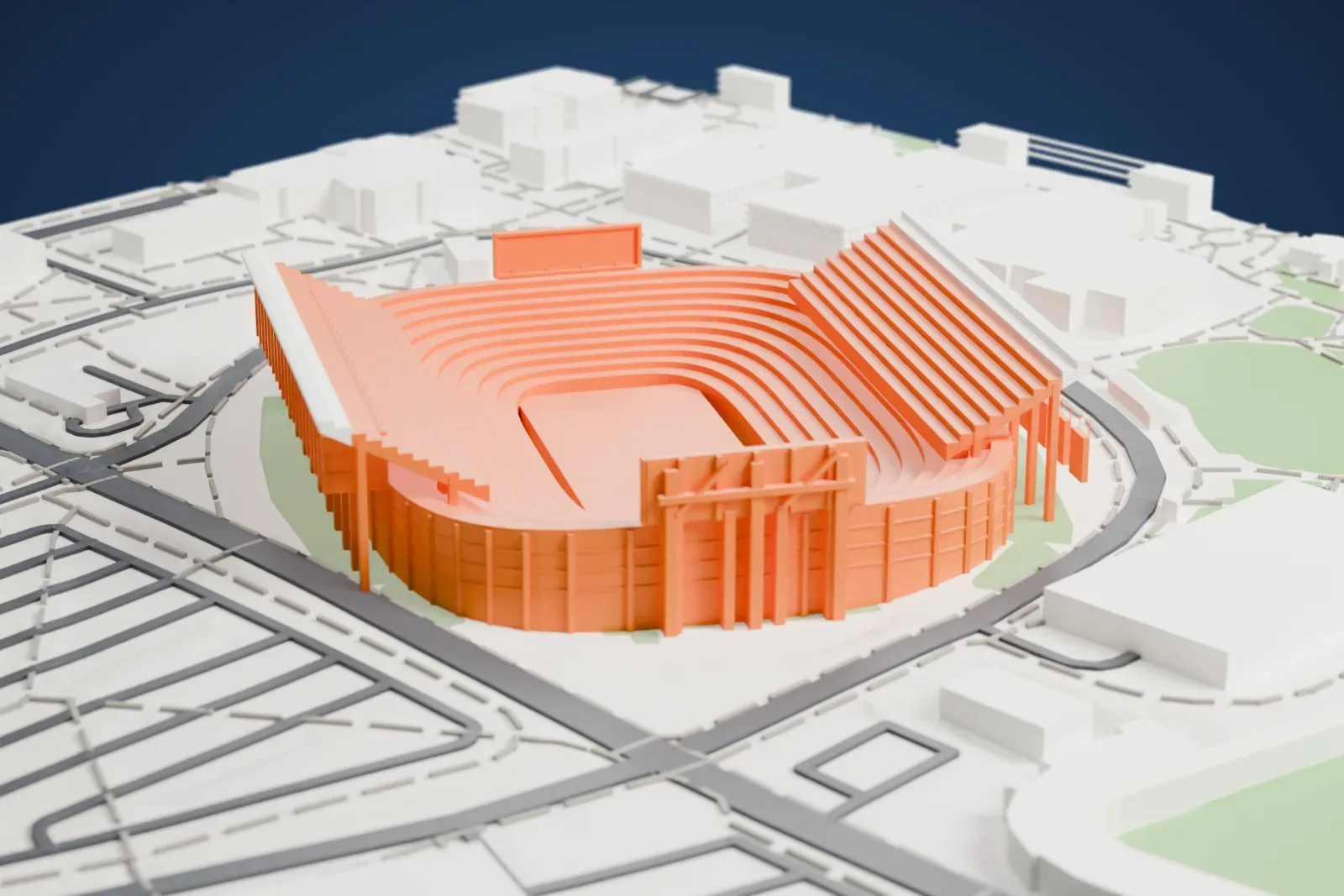
A free, printable model of Jordan–Hare Stadium and the buildings, roads and lawns around it, generated from real map data in your browser.
Free, in your browser. Exports a slicer-ready 3MF.
About Jordan–Hare Stadium
Auburn University's campus in Auburn, Alabama, is home to Jordan–Hare Stadium, where the Auburn Tigers football team mainly plays. The playing field became Pat Dye Field on November 19, 2005, honoring Pat Dye, a former Auburn coach and athletic director. The stadium's own namesakes are Ralph "Shug" Jordan, who won more games than any other Auburn head coach, and Cliff Hare, who belonged to the first Auburn football team and also served as President of the Southern Conference and as Dean of Auburn's School of Chemistry.
Auburn played home games at Drake Field until 1939; that bare-bones ground had 700 seats in temporary bleachers. The new stadium, called Auburn Stadium then, held its opening game on November 10, 1939, pitting freshmen teams from Auburn and Georgia Tech. Its dedication fell on November 30, 1939, Thanksgiving Day, before a first varsity game that ended 7–7 against the University of Florida. A 1949 expansion replaced the east side's wooden bleachers with permanent seats, lifting capacity up to 21,500, and the stadium took the name Cliff Hare Stadium.
Shug Jordan became head coach in 1951. When the stadium took his name in 1973, it was the first in the United States named after an active coach. Capacity more than tripled over his 25 years in three expansions. The stadium turned into a horseshoe in 1960 and a full bowl in 1970, and upper decks followed on the west side in 1980 and the east side in 1987. On December 2, 1989, in the first Iron Bowl played at Auburn, #11 Auburn beat undefeated, #2 Alabama 30–20.
How it prints
Make this print opens the generator on a 600 m square around the landmark. Buildings print at close to true scale, so the landmark grows with the print size.
| Print size | Landmark height | Scale |
|---|---|---|
| 160 mm default | 14 mm | 1:3,750 |
| 200 mm | 18 mm | 1:3,000 |
| 256 mm | 23 mm | 1:2,344 |
-
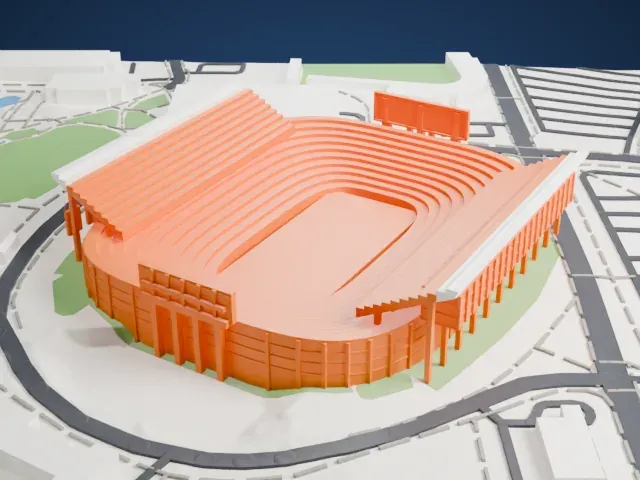 North
North
-
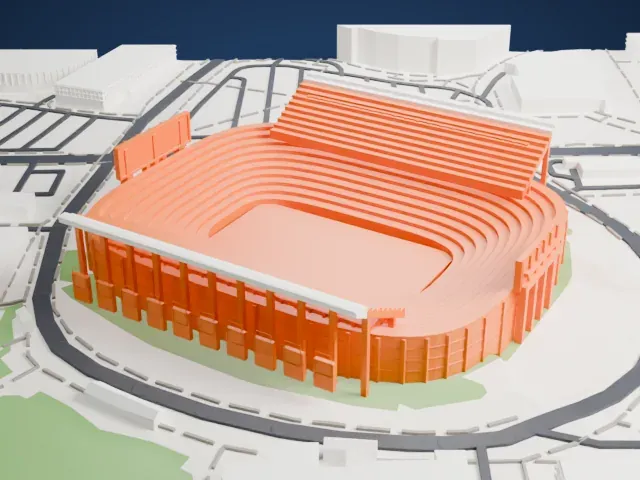 East
East
-
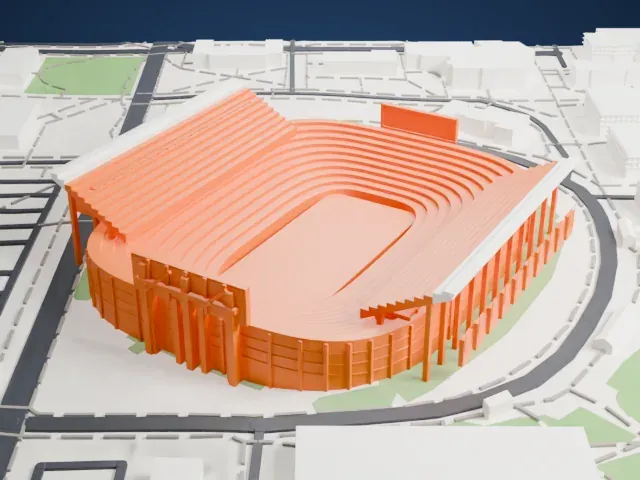 South
South
-
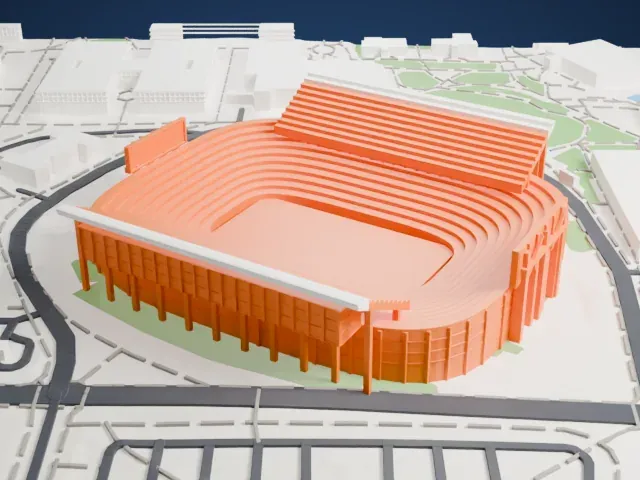 West
West
- Long stepped stands like thin beams
- The stands rise in long parallel steps that read as thin beams. Print friendly adapts them to the print scale; Full detail keeps them on a larger print, ideally with 0.12–0.16 mm layers.
- Slim columns around the outside
- A ring of slim columns circles the outer wall. A larger print size keeps them sturdier, and printing slowly helps the thin parts.
- Pick the detail for your nozzle
- In the Buildings settings, set Landmark detail to Print friendly to adapt thin parts and small details to the print scale. Full detail keeps every modeled feature, for larger prints or a finer nozzle.
- Colors
- Buildings, roads, water and ground arrive as separate filament slots in the 3MF. Jordan–Hare Stadium takes the building color.
- File format
- You get a 3MF for Bambu Studio, OrcaSlicer or PrusaSlicer. Any of them can save it as STL if you need one.
About this model
Jordan–Hare Stadium is one of more than 2,300 landmark models in Mini Skyline. They are made with AI, and each one is checked from four sides in its real surroundings before release. Everything around it is built from OpenStreetMap and Overture map data. If you would rather print the shape from map data, turn off Landmark models in the Buildings settings.
Common questions
Is there a Jordan–Hare Stadium STL I can download?
Mini Skyline builds the file for you in your browser and exports 3MF, which every major slicer opens. If you need an STL, open the 3MF in your slicer and export it from there.
How big can I print it?
Any print size from 40 mm across. Jordan–Hare Stadium grows with the print: about 14 mm tall on the default 160 mm print. For a model larger than your printer bed, Project Mode splits the area into tiles.
Is it free?
Yes. Generation runs in your browser, with no account and nothing behind a paywall.