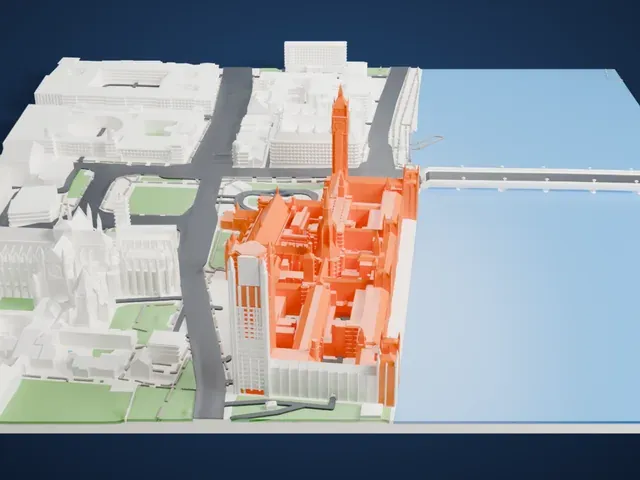
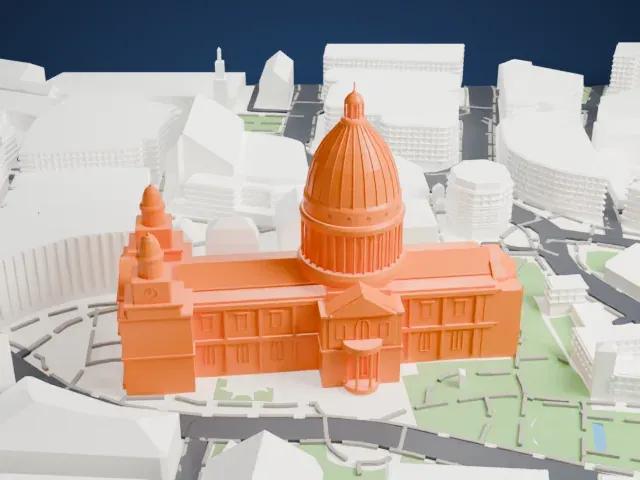
3D print the Natural History Museum
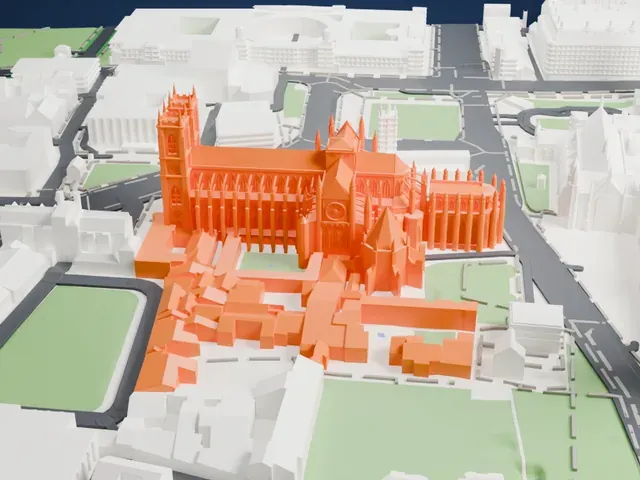
A free, printable model of the Natural History Museum, with its pointed towers and long wings, and the dense city blocks and streets around it, generated from real map data in your browser.
Free, in your browser. Exports a slicer-ready 3MF.
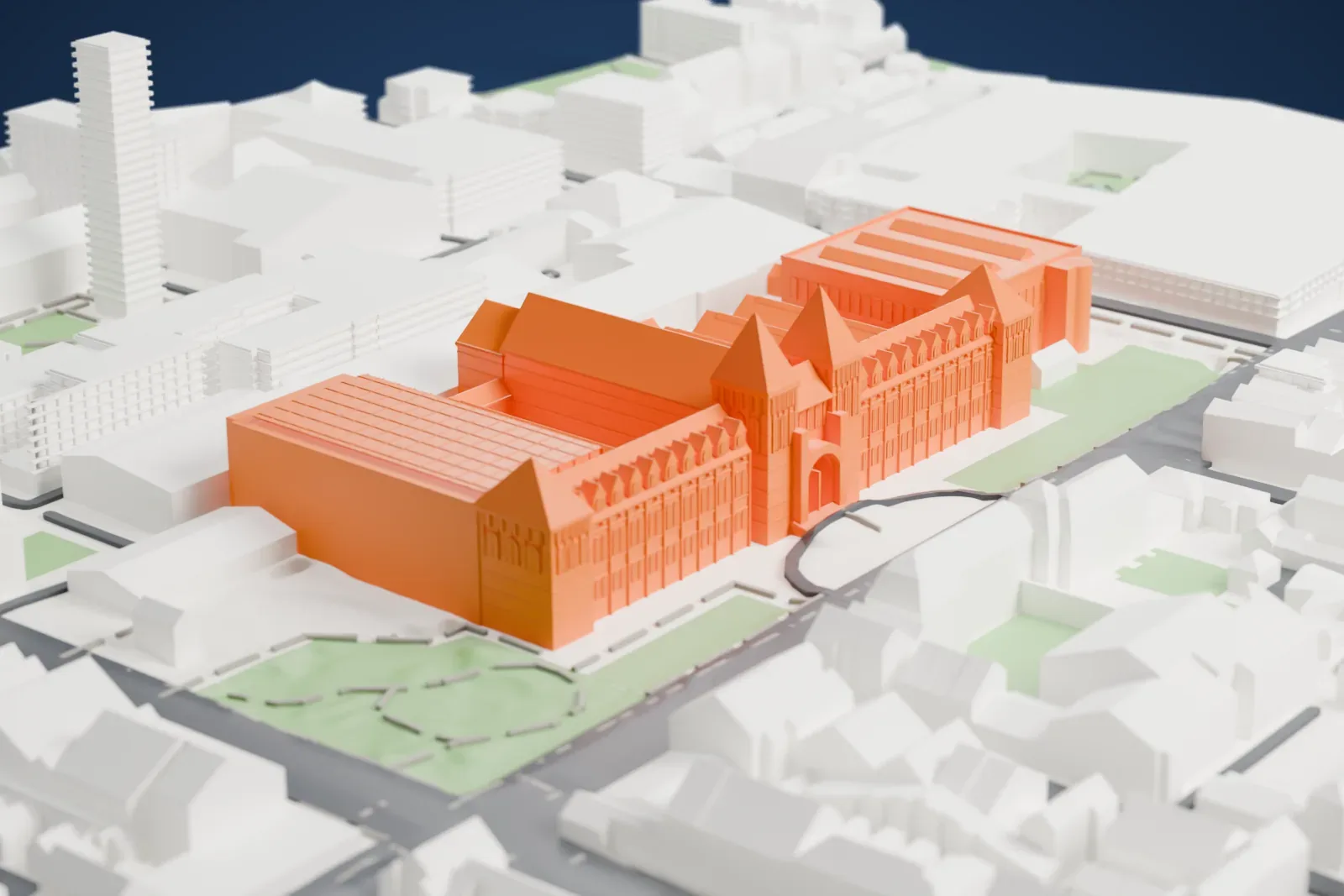
About the Natural History Museum
London's Natural History Museum displays a vast range of specimens from many branches of natural history. Exhibition Road in South Kensington has three major museums, which are this one, the Victoria and Albert Museum and the Science Museum. Its main frontage is on Cromwell Road. Its life and earth science specimens total some 80 million items across five principal collections: botany, entomology, mineralogy, paleontology and zoology. People sometimes call its ornate architecture a cathedral of nature, and the museum is especially famous for its dinosaur skeletons.
The collection's foundation was the holdings of Sir Hans Sloane (1660–1753), a doctor from Ulster, who agreed to sell them to the British Government for far less than they were worth; a lottery funded the purchase. In 1856 Richard Owen became Superintendent of the British Museum's natural history departments and saw that they needed a separate building. Civil engineer Captain Francis Fowke won the design competition but died in December 1865, and Alfred Waterhouse, hired in February 1866, took over the scheme, substantially revised it and gave the facades his own idiosyncratic Romanesque style. Construction ran from 1873 to 1880, and the museum opened on April 18, 1881.
Extensive architectural terracotta tiling by Gibbs and Canning of Tamworth covers the interiors and exteriors and was used to withstand the soot-laden air of Victorian London. The tiles and bricks carry relief sculptures of plants and animals: living species in the west wing, extinct ones in the east, a separation requested by Owen. The central axis lines up with Imperial College London's tower and, farther north, the Royal Albert Hall and the Albert Memorial, all part of the complex informally called Albertopolis.
How it prints
Make this print opens the generator on a 650 m square around the landmark. Buildings print at close to true scale, so the landmark grows with the print size.
| Print size | Landmark height | Scale |
|---|---|---|
| 160 mm default | 15 mm | 1:4,063 |
| 200 mm | 19 mm | 1:3,250 |
| 256 mm | 24 mm | 1:2,539 |
-
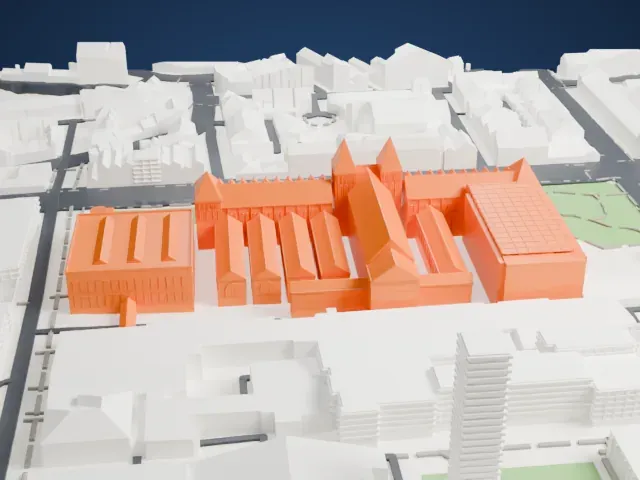 North
North
-
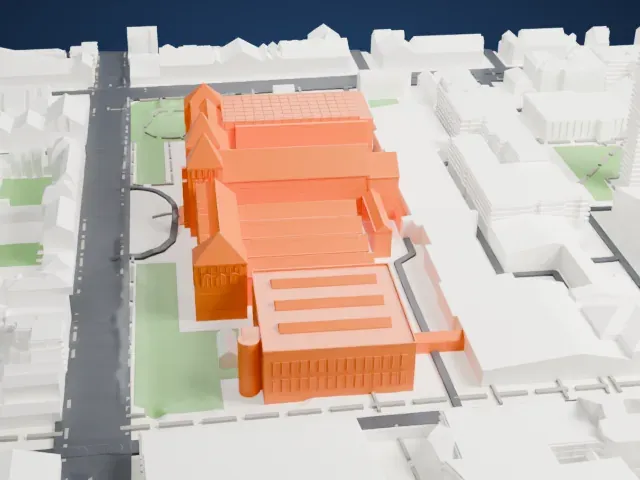 East
East
-
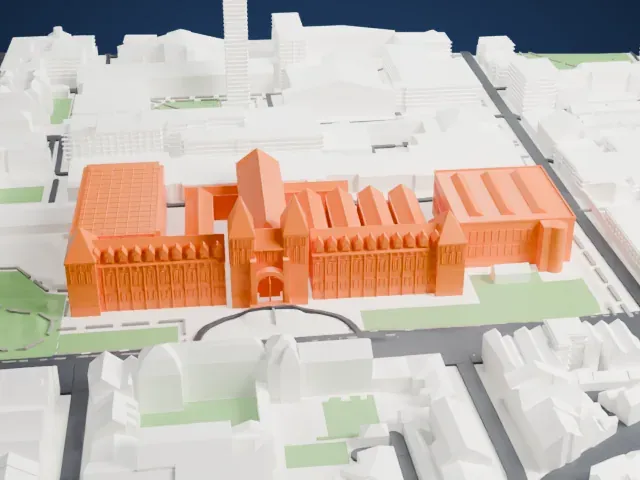 South
South
-
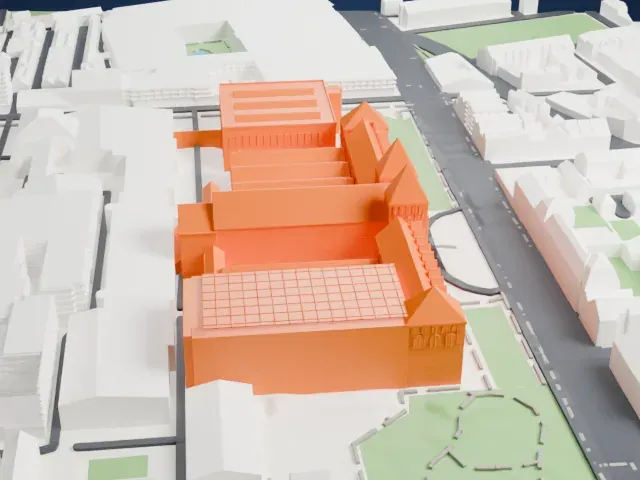 West
West
- Pointed towers and steep gables
- Two pointed towers and many steep gables crown the roofline. Print friendly adapts the thin tips to the print scale; Full detail keeps them on a larger print, ideally with 0.12–0.16 mm layers.
- Fine roof grids on long wings
- Several wide roofs carry fine grid lines. A larger print size and 0.12–0.16 mm layers help the grids stay crisp.
- One piece with the ground
- The Natural History Museum is joined to the ground in the exported file, and the four-side check found no floating parts, so nothing needs gluing.
- Pick the detail for your nozzle
- In the Buildings settings, set Landmark detail to Print friendly to adapt thin parts and small details to the print scale. Full detail keeps every modeled feature, for larger prints or a finer nozzle.
- Colors
- Buildings, roads, water and ground arrive as separate filament slots in the 3MF. The Natural History Museum takes the building color.
- File format
- You get a 3MF for Bambu Studio, OrcaSlicer or PrusaSlicer. Any of them can save it as STL if you need one.
About this model
The Natural History Museum is one of more than 2,300 landmark models in Mini Skyline. They are made with AI, and each one is checked from four sides in its real surroundings before release. Everything around it is built from OpenStreetMap and Overture map data. If you would rather print the shape from map data, turn off Landmark models in the Buildings settings.
Common questions
Is there a Natural History Museum STL I can download?
Mini Skyline builds the file for you in your browser and exports 3MF, which every major slicer opens. If you need an STL, open the 3MF in your slicer and export it from there.
How big can I print it?
Any print size from 40 mm across. The Natural History Museum grows with the print: about 15 mm tall on the default 160 mm print. For a model larger than your printer bed, Project Mode splits the area into tiles.
Is it free?
Yes. Generation runs in your browser, with no account and nothing behind a paywall.