3D print Notre Dame Stadium
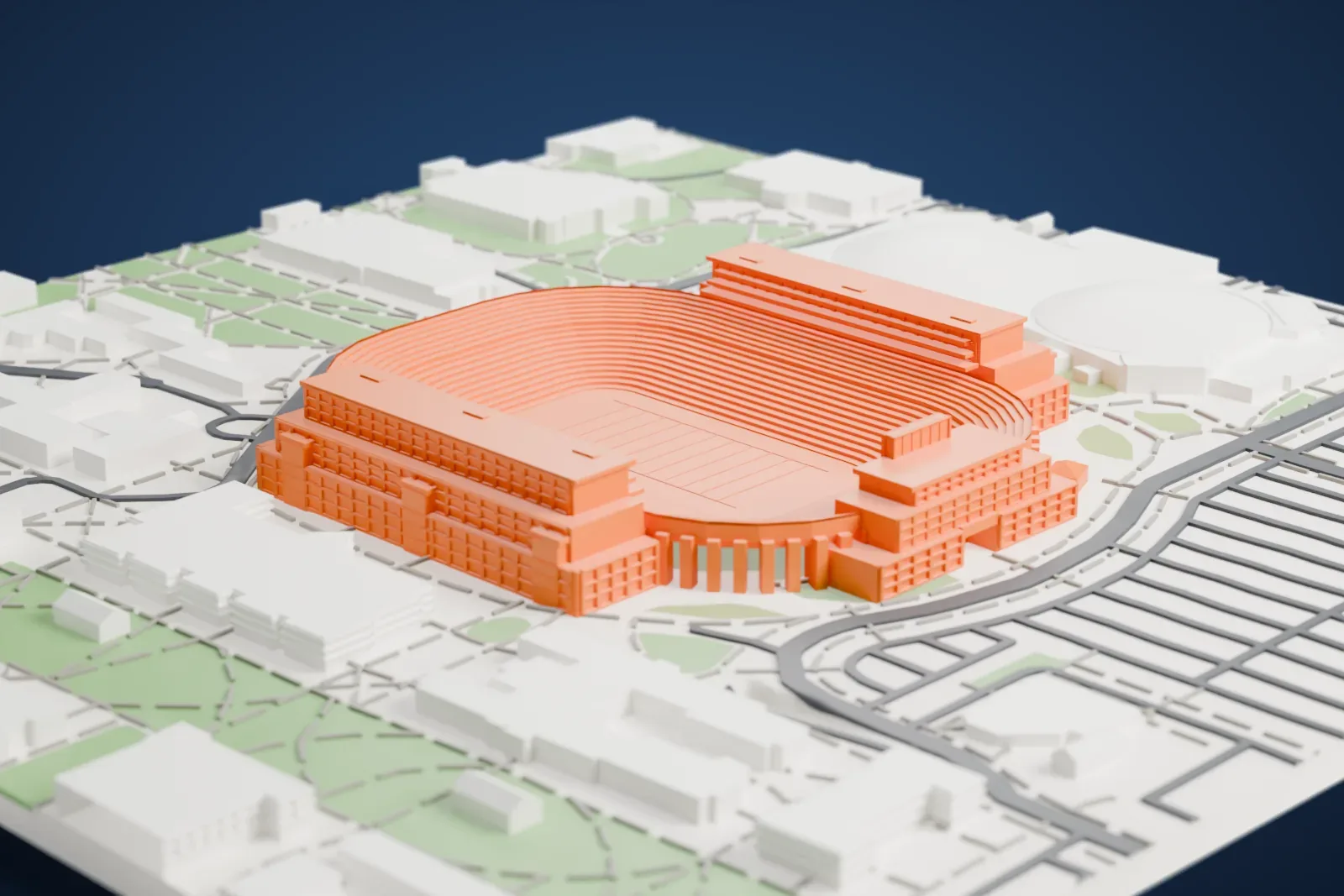
A free, printable model of Notre Dame Stadium's oval bowl and end buildings, with the lawns, footpaths, roads and buildings around it, generated from real map data in your browser.
Free, in your browser. Exports a slicer-ready 3MF.
About Notre Dame Stadium
Notre Dame Stadium, in South Bend, Indiana, is an open-air football venue and the home field of Notre Dame's Fighting Irish football team. Knute Rockne, a coach regarded as one of the greatest in college football history, guided its construction in 1930, which gave the stadium the nickname "The House that Rockne Built". Before that, the Fighting Irish played at Cartier Field. Rockne helped shape the design, keeping the gap between the field and the stands as small as possible. Osborn Engineering of Cleveland, chosen because of its design work on Yankee Stadium and Fenway Park, began the plans in 1929.
Above-ground construction started on April 2, 1930, after an unusually cold fall and winter, and the stadium went up in about six months. More than two million bricks went into its walls. The Irish played their first game there on October 4, 1930, beating SMU 20–14, and the official dedication was held against Navy on October 11. The stadium is patterned, on a smaller scale, after Michigan Stadium, with the tunnel in a different place.
From 1994 to 1997 a renovation put in an upper bowl, with more than 20,000 extra seats, which lifted the capacity beyond 80,000. The Campus Crossroads project of 2014 renovated the stadium for about $400 million and attached three buildings: the Duncan Student Center, O'Neill Hall and Corbett Family Hall. It also cut the seat count to 77,622. The playing surface changed to artificial turf that year, after 84 seasons on grass. A view of the Touchdown Jesus mural is part of what makes it famous.
How it prints
Make this print opens the generator on a 650 m square around the landmark. Buildings print at close to true scale, so the landmark grows with the print size.
| Print size | Landmark height | Scale |
|---|---|---|
| 160 mm default | 12 mm | 1:4,063 |
| 200 mm | 15 mm | 1:3,250 |
| 256 mm | 19 mm | 1:2,539 |
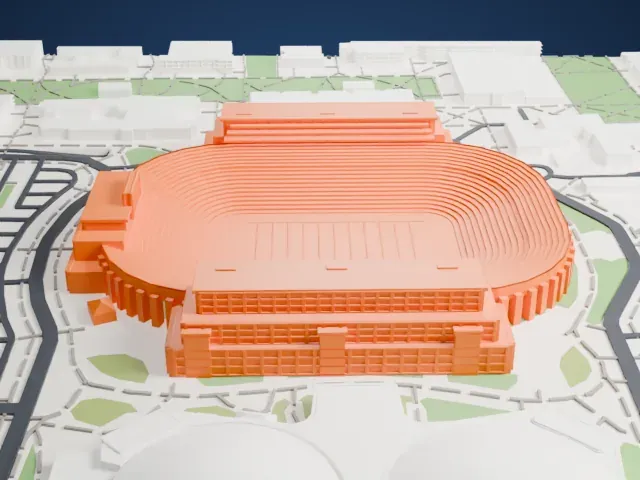
-
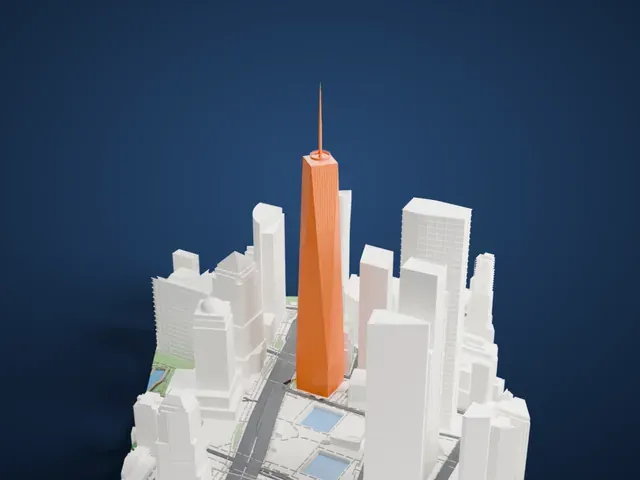
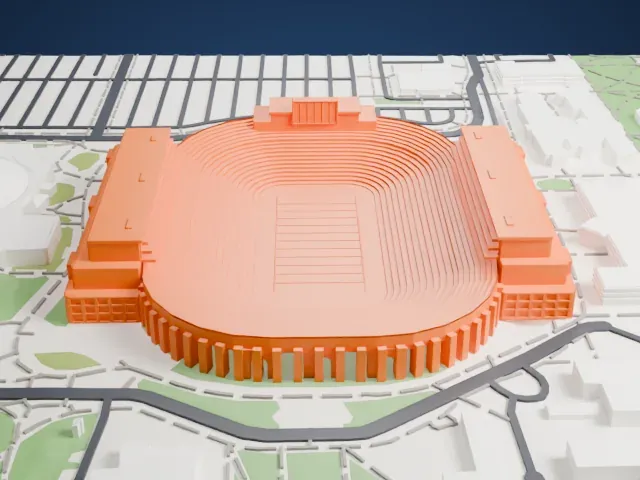 North
North
-
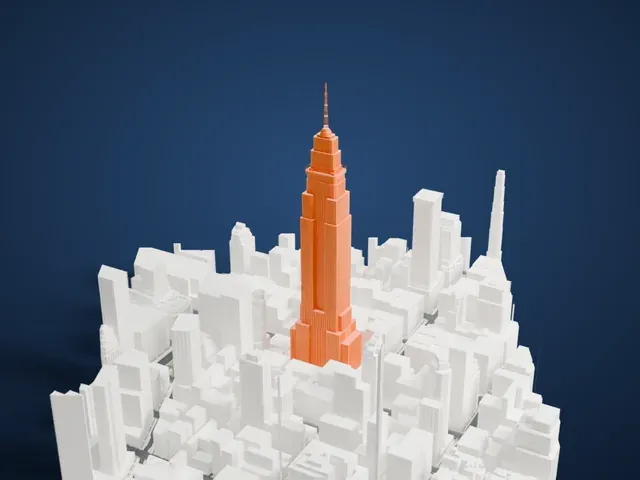
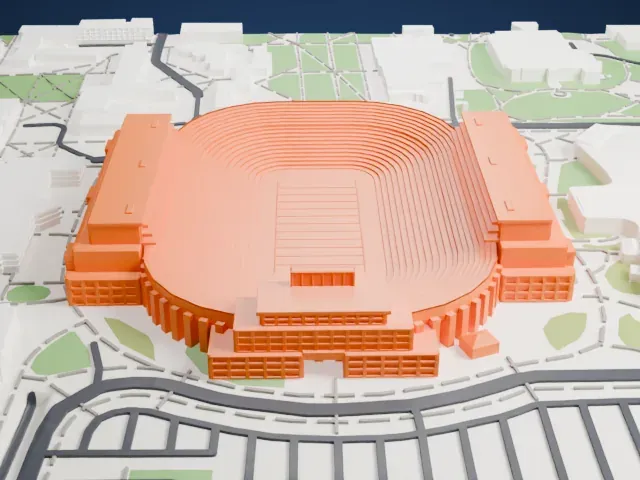
 East
East
-
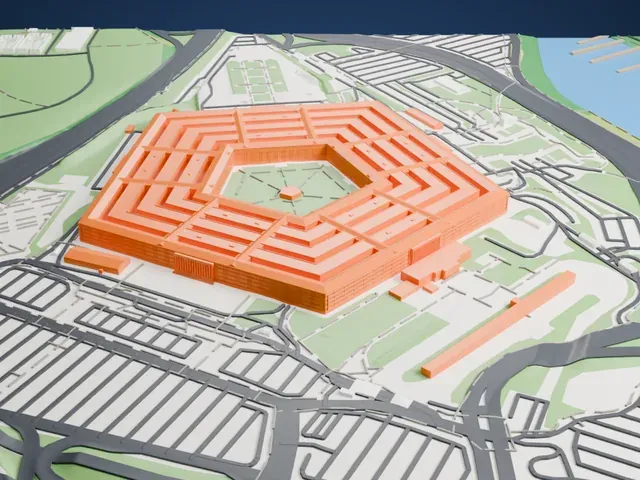
 South
South
-
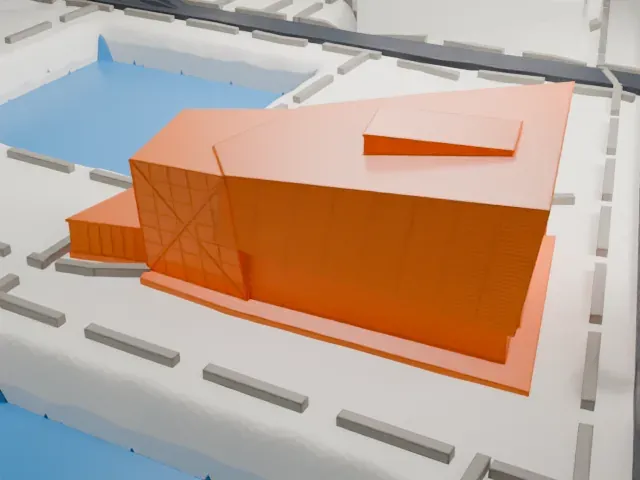
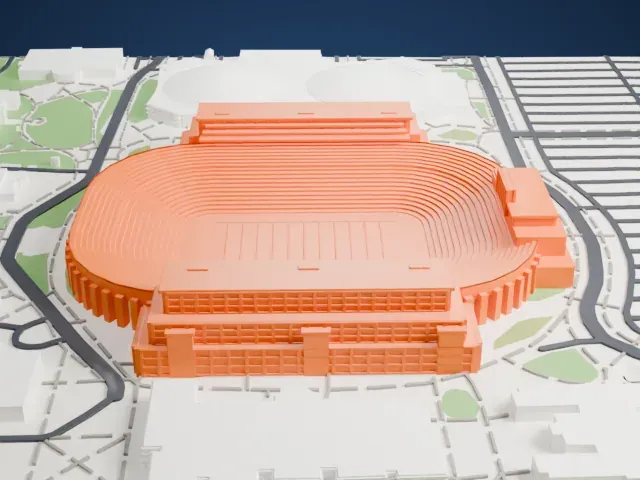 West
West
- Stacked seating rows
- The bowl is built from many thin rows. Print friendly adapts them to your print scale; Full detail keeps each row, best for a larger print or a fine nozzle.
- Flat roofs with small details
- The end buildings and the press box have flat roofs with small rooftop details. A larger print keeps more of them, and layers of 0.12 to 0.16 mm keep their edges crisp.
- One piece with the ground
- Notre Dame Stadium is joined to the ground in the exported file, and the four-side check found no floating parts, so nothing needs gluing.
- Pick the detail for your nozzle
- In the Buildings settings, set Landmark detail to Print friendly to adapt thin parts and small details to the print scale. Full detail keeps every modeled feature, for larger prints or a finer nozzle.
- Colors
- Buildings, roads, water and ground arrive as separate filament slots in the 3MF. Notre Dame Stadium takes the building color.
- File format
- You get a 3MF for Bambu Studio, OrcaSlicer or PrusaSlicer. Any of them can save it as STL if you need one.
About this model
Notre Dame Stadium is one of more than 2,300 landmark models in Mini Skyline. They are made with AI, and each one is checked from four sides in its real surroundings before release. Everything around it is built from OpenStreetMap and Overture map data. If you would rather print the shape from map data, turn off Landmark models in the Buildings settings.
Common questions
Is there a Notre Dame Stadium STL I can download?
Mini Skyline builds the file for you in your browser and exports 3MF, which every major slicer opens. If you need an STL, open the 3MF in your slicer and export it from there.
How big can I print it?
Any print size from 40 mm across. Notre Dame Stadium grows with the print: about 12 mm tall on the default 160 mm print. For a model larger than your printer bed, Project Mode splits the area into tiles.
Is it free?
Yes. Generation runs in your browser, with no account and nothing behind a paywall.