3D print De Vijverberg
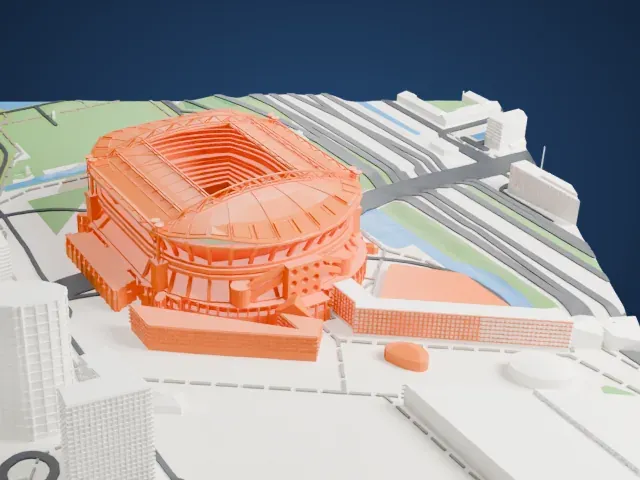
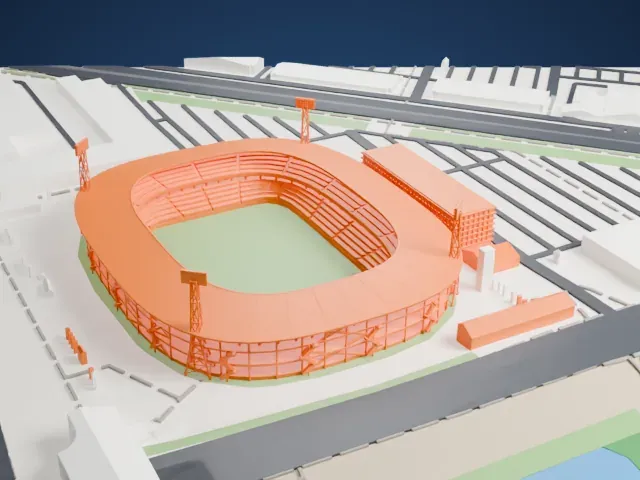
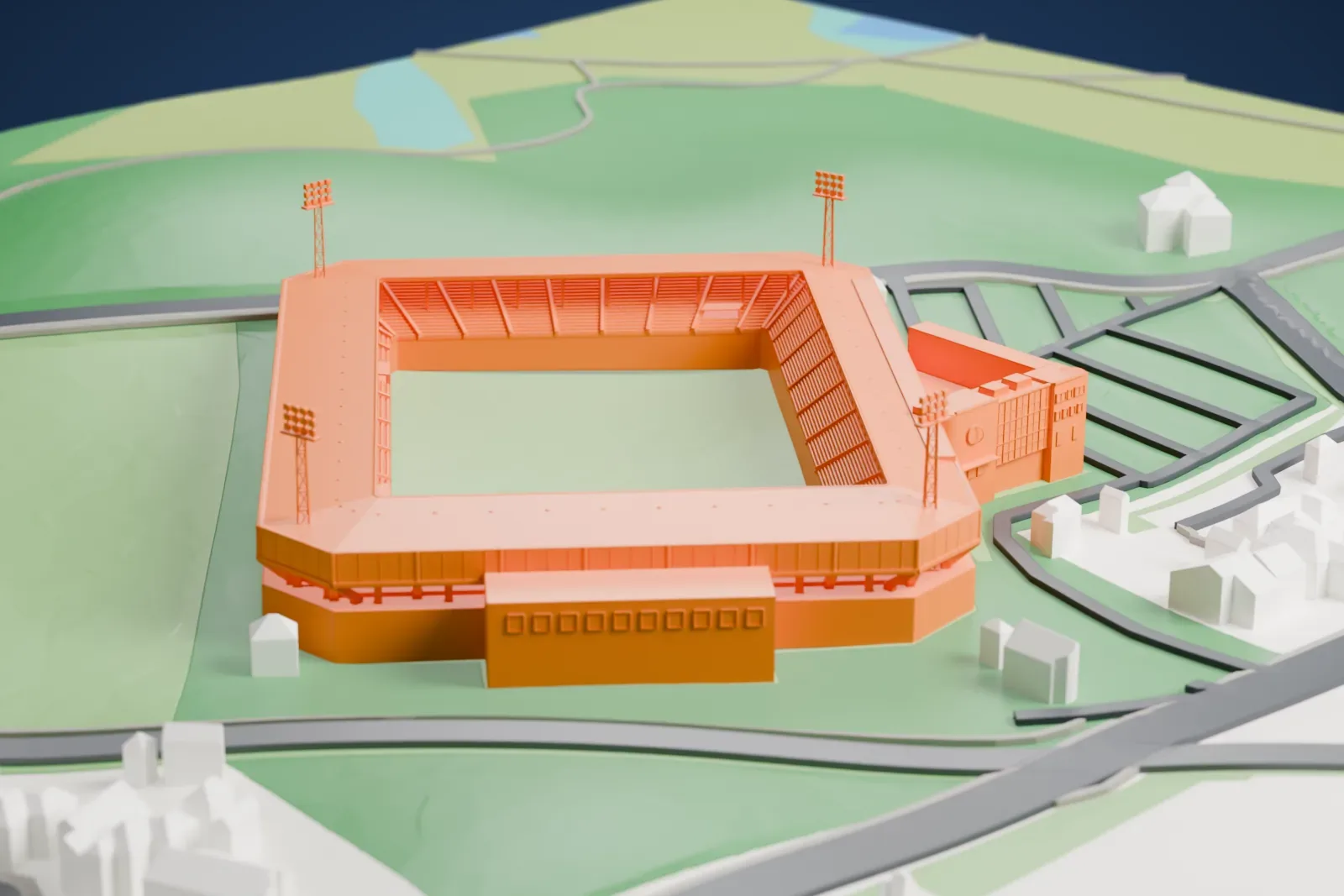
A free, printable model of Stadion De Vijverberg in Doetinchem, with its roofed stands and four floodlight towers, and the surrounding streets and fields, generated from real map data in your browser.
-
 North
-
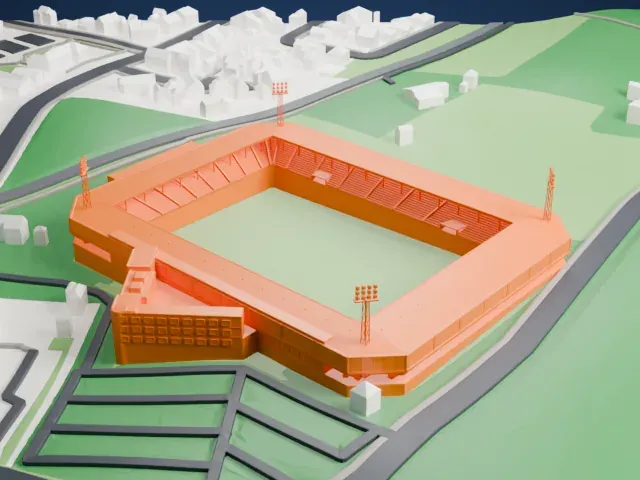 East
-
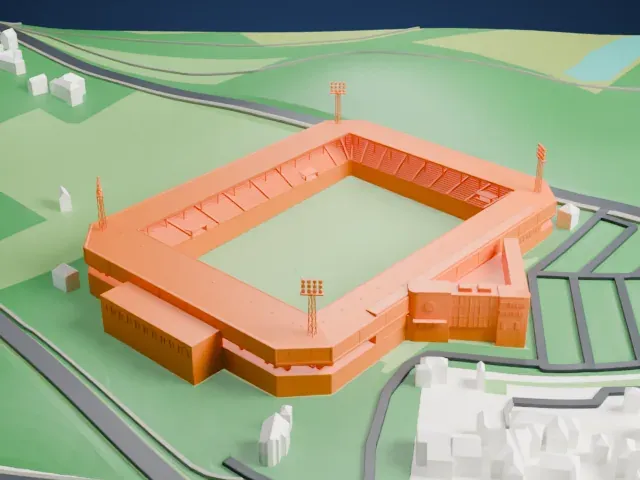 South
-
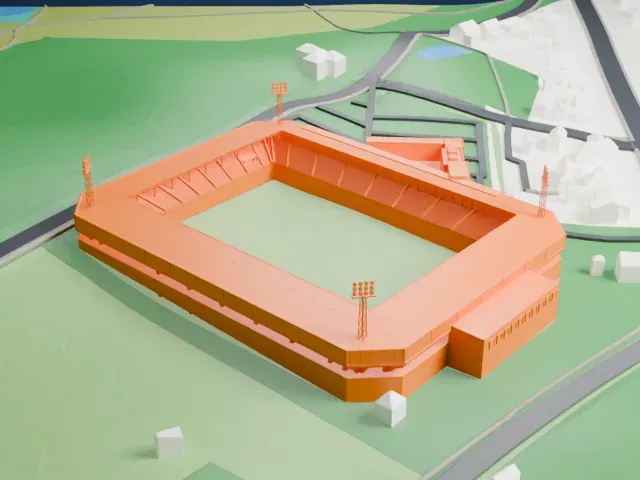 West
The model you print
De Vijverberg in 3D
The landmark on its own, at its size on a 160 mm print. Print friendly thickens thin parts for a 0.4 mm nozzle; Full detail keeps every part.
- On a 160 mm print
- 11 mm
- Scale
- 1:3,750
11 mm tall on a 160 mm print
Make this print opens the generator on a 600 m square around the landmark. Buildings print at close to true scale, so the landmark grows with the print size.
- Slim lattice floodlight towers
Four thin lattice floodlight towers stand around the ground. Print friendly adapts thin parts like these to your print scale; a larger print or Full detail keeps them as modeled.
- Slanted roof supports
Slanted supports run under the roof around the pitch. A layer height of 0.12–0.16 mm keeps these thin parts crisp.
- One piece with the ground
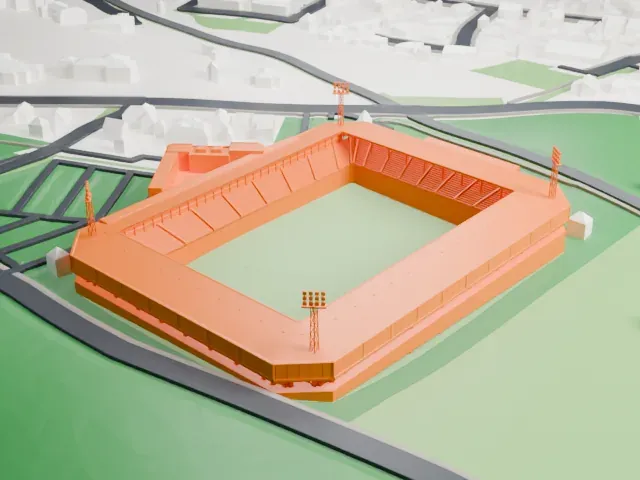
De Vijverberg is joined to the ground in the exported file, and the four-side check found no floating parts, so nothing needs gluing.
- Pick the detail for your nozzle
In the Buildings settings, set Landmark detail to Print friendly to adapt thin parts and small details to the print scale. Full detail keeps every modeled feature, for larger prints or a finer nozzle.
- Colors
Buildings, roads, water and ground arrive as separate filament slots in the 3MF. De Vijverberg takes the building color.
- File format
You get a 3MF for Bambu Studio, OrcaSlicer or PrusaSlicer. Any of them can save it as STL if you need one.
About De Vijverberg
Stadion De Vijverberg, which means The Pond Hill in English, is a football stadium in Doetinchem, Netherlands, with 12,600 seats. It opened on September 4, 1954. Its name comes from a hotel of the same name that once stood on the stadium's site. The ponds on that spot had to be filled in, and that is how the name Vijverberg arose.
In 1970 the ground was renovated: three stands, named Vijverberg, Groenendaal and Spinnekop, plus the floodlight installation were built. Roofs were put over the stands in the late eighties, and a radical renovation began in the summer of 1998. The ground once had a railway station of its own, which closed in 2005.
The Spinnekop stand takes its name from the famous Spion Kop. When seats were installed there, one of its characteristic features was lost, so De Graafschap decided in 2008 to remove the seats again. In 2012 the club's board considered switching to artificial turf, but a large supporters' group protested fiercely, saying the Superboeren should keep playing in the mud.
About this model
De Vijverberg is one of more than 4,900 landmark models in Mini Skyline. They are made with AI, and each one is checked from four sides in its real surroundings before release. Everything around it is built from OpenStreetMap and Overture map data. If you would rather print the shape from map data, turn off Landmark models in the Buildings settings.
Keep exploring