3D print Esbjerg Stadium
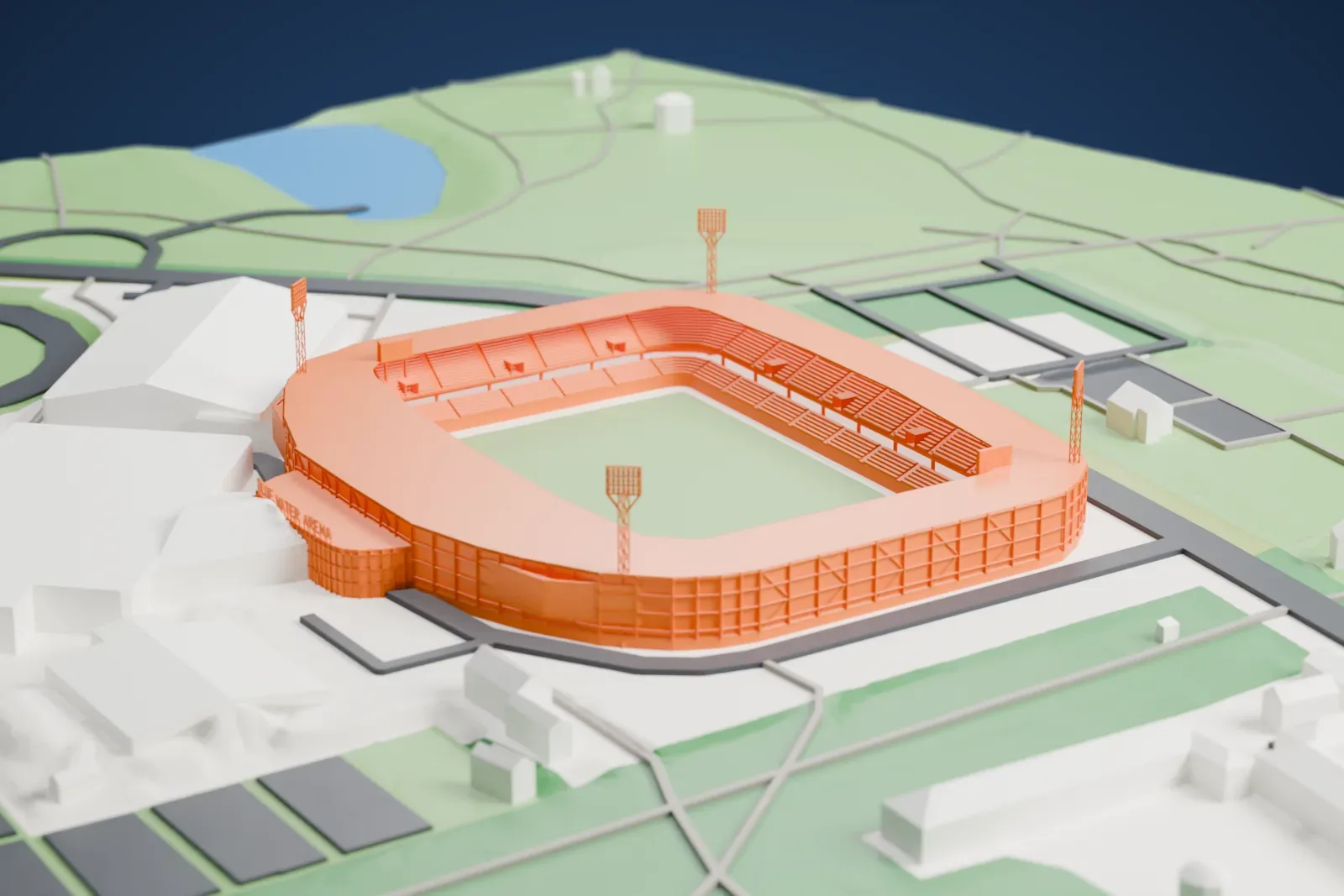
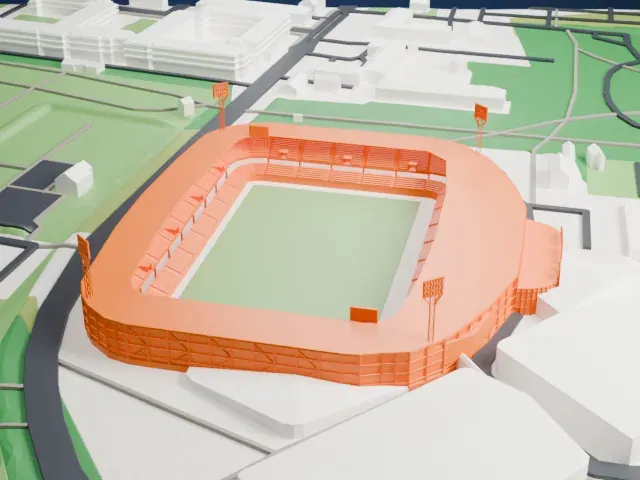
A free, printable model of Esbjerg Stadium, its roofed stands, floodlight masts and pitch, and the surrounding sports grounds and buildings, generated from real map data in your browser.
-
 North
-
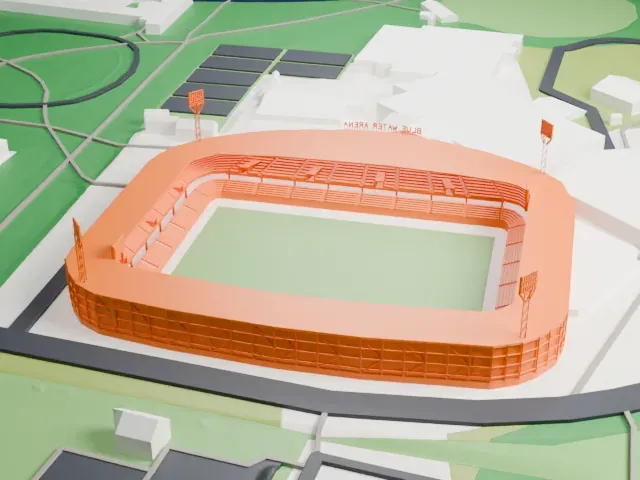 East
-
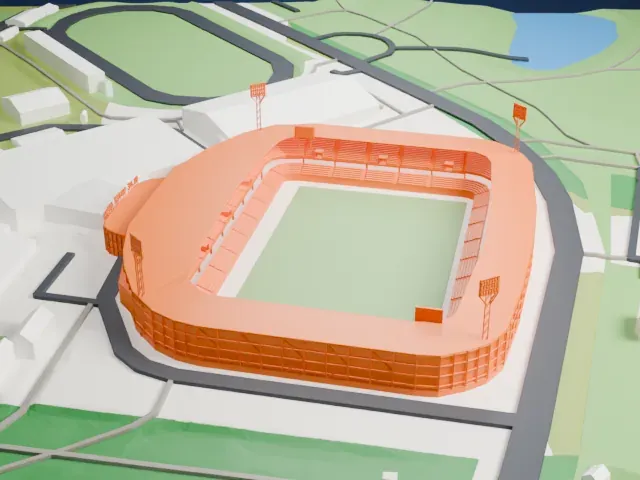 South
-
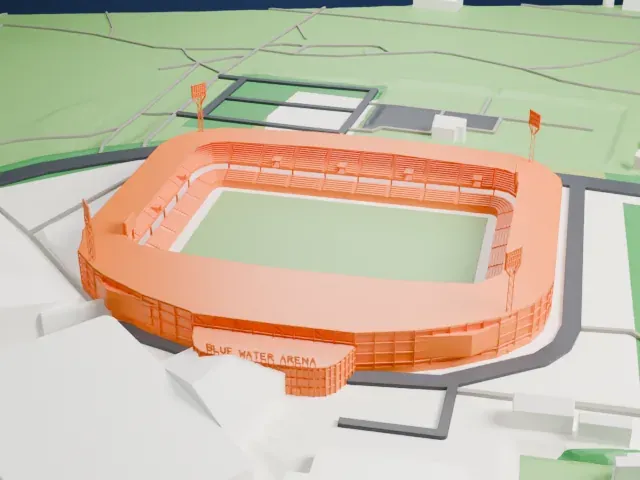 West
The model you print
Esbjerg Stadium in 3D
The landmark on its own, at its size on a 160 mm print. Print friendly thickens thin parts for a 0.4 mm nozzle; Full detail keeps every part.
- On a 160 mm print
- 10 mm
- Scale
- 1:3,750
10 mm tall on a 160 mm print
Make this print opens the generator on a 600 m square around the landmark. Buildings print at close to true scale, so the landmark grows with the print size.
- Slender floodlight masts
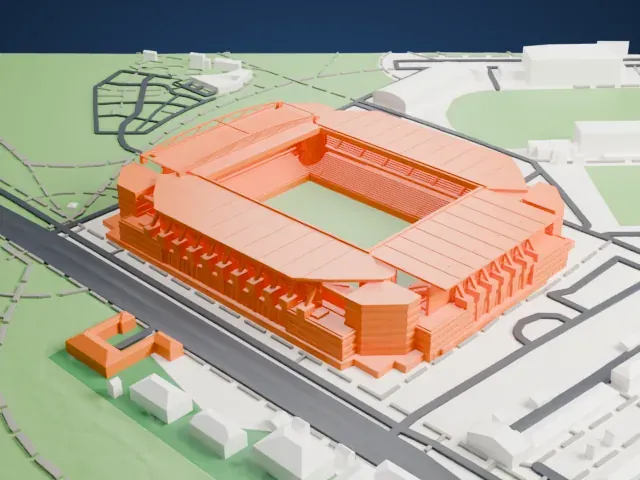
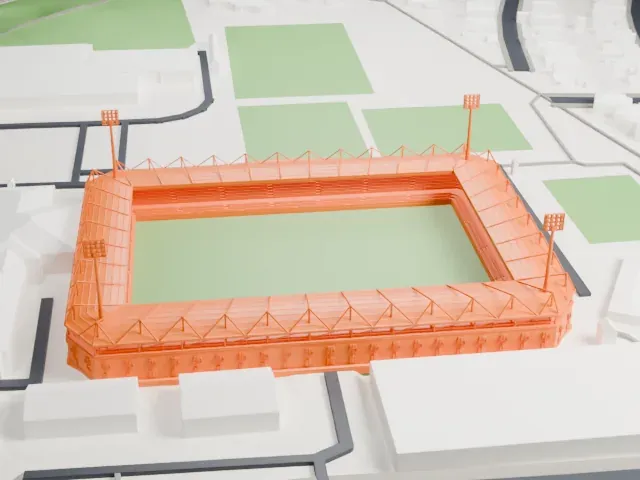
Four tall, thin floodlight masts stand around the bowl. Print slowly with good cooling, and use Print friendly unless you print larger, where Full detail keeps every mast.
- Roof ring and fine bracing
A continuous roof wraps the stands, and the outer wall shows thin diagonal bracing. A layer height of 0.12–0.16 mm keeps those lines crisp.
- One piece with the ground
Esbjerg Stadium is joined to the ground in the exported file, and the four-side check found no floating parts, so nothing needs gluing.
- Pick the detail for your nozzle
In the Buildings settings, set Landmark detail to Print friendly to adapt thin parts and small details to the print scale. Full detail keeps every modeled feature, for larger prints or a finer nozzle.
- Colors
Buildings, roads, water and ground arrive as separate filament slots in the 3MF. Esbjerg Stadium takes the building color.
- File format
You get a 3MF for Bambu Studio, OrcaSlicer or PrusaSlicer. Any of them can save it as STL if you need one.
About Esbjerg Stadium
Esbjerg Stadium sits inside Esbjerg Idrætspark in Esbjerg, Denmark, and is sometimes called the Blue Water Arena, a name tied to sponsorship. Esbjerg fB plays its home matches here. The ground can take 17,442 spectators, with 11,286 of those in seats. Friis & Moltke are listed as the architect, Grontmij as the structural engineer and Esbjerg Municipality as the owner.
The park was founded in 1926, and its football pitch, which came with a running track and space for several athletics events, opened on September 22, 1929. In 1948 the nearby Esbjerg Atletikstadion was built. Rebuilding of the football stadium began in 1951 but halted when the municipality ran out of funds. A new grandstand went up in 1955, and the new stadium was inaugurated that year. In 1999 it hosted the football tournament of the European Youth Olympic Festival, and the Danish national team has used it as a home ground twice.
About this model
Esbjerg Stadium is one of more than 4,900 landmark models in Mini Skyline. They are made with AI, and each one is checked from four sides in its real surroundings before release. Everything around it is built from OpenStreetMap and Overture map data. If you would rather print the shape from map data, turn off Landmark models in the Buildings settings.
Keep exploring