3D print Estadio BBVA
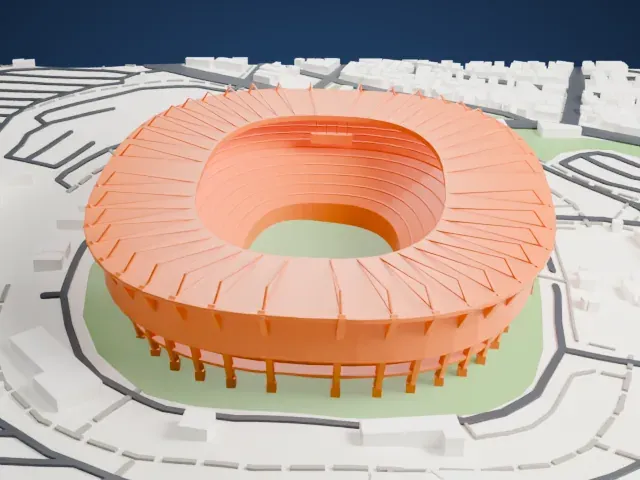
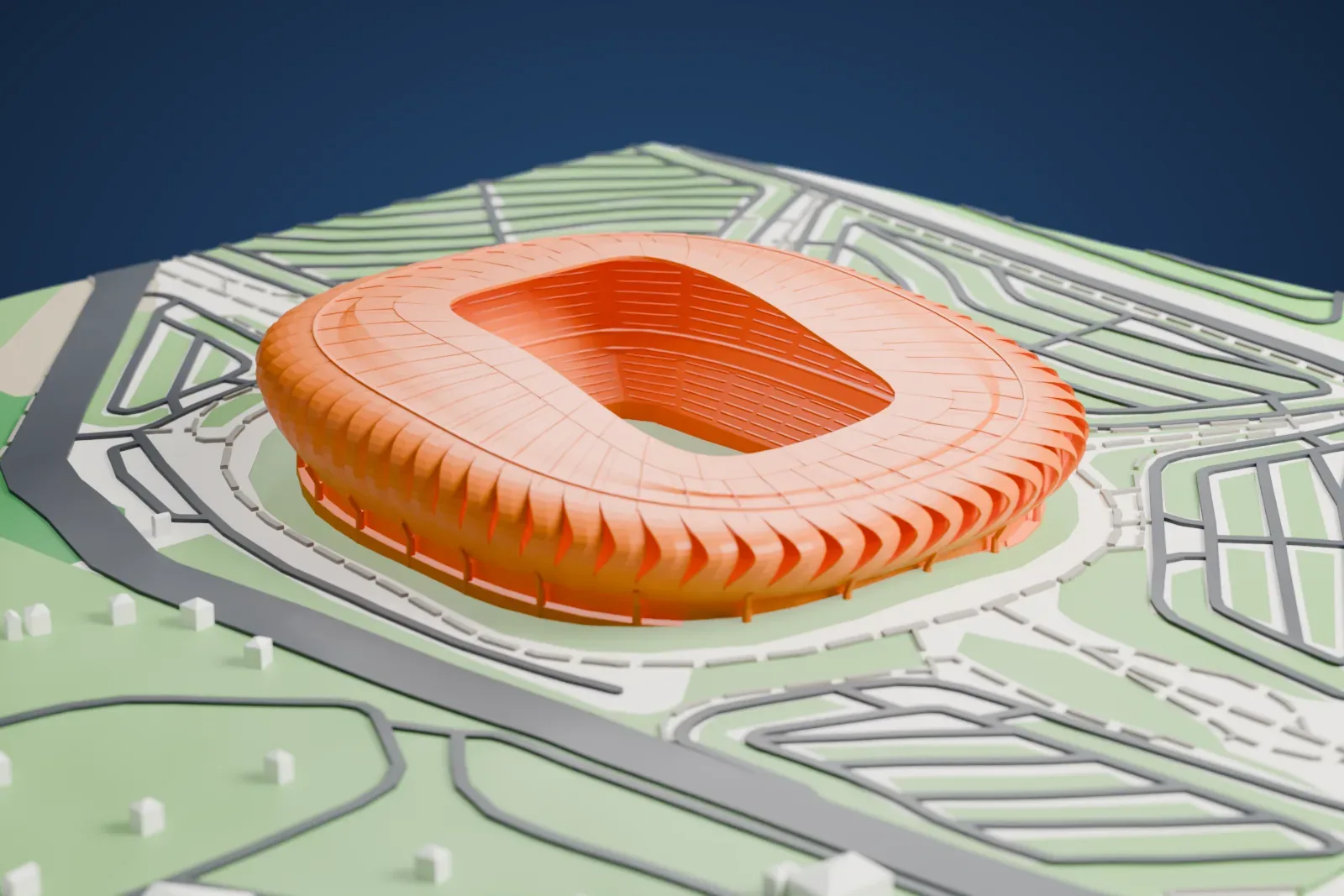
A free, printable model of the stadium and the curving roads, green areas and a stretch of water around it, generated from real map data in your browser.
-
 North
-
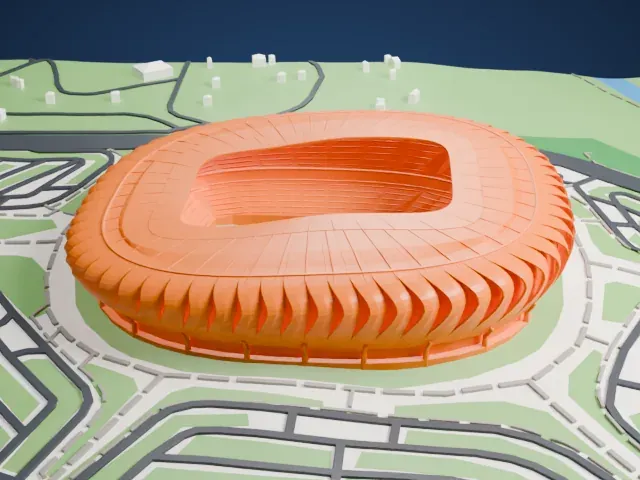 East
-
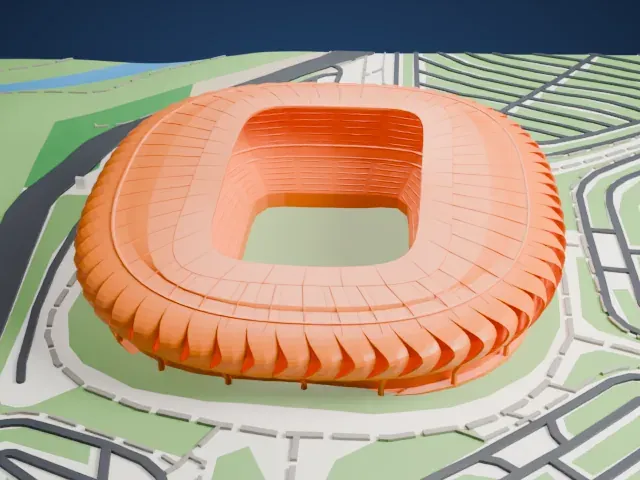 South
-
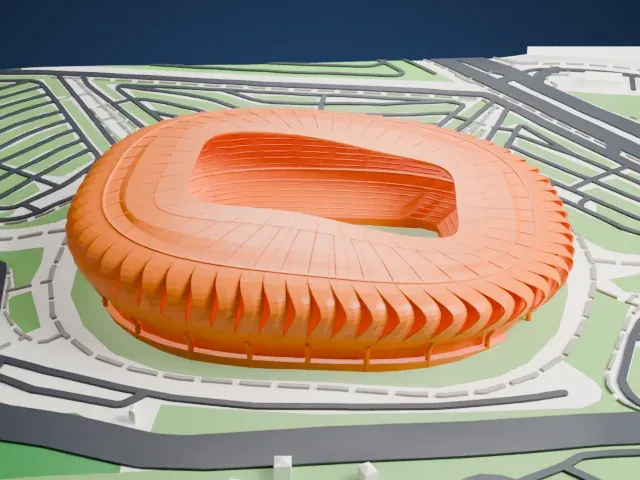 West
- On a 160 mm print
- 15 mm
- Scale
- 1:3,750
15 mm tall on a 160 mm print
Make this print opens the generator on a 600 m square around the landmark. Buildings print at close to true scale, so the landmark grows with the print size.
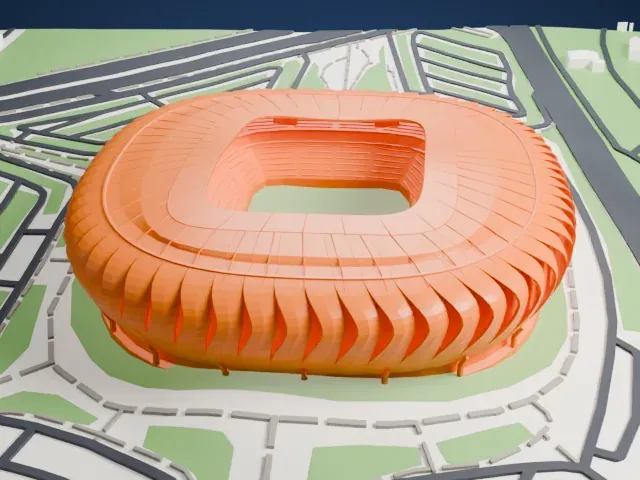
- A skin of thin curved ribs
The outer wall is covered in many thin, curved ribs. Print friendly adapts them to the print scale; Full detail and a bigger print size keep more of them.
- A wide roof ring
The roof forms a wide ring around the open pitch. Layers of 0.12 to 0.16 mm keep its sloped surface smooth.
- One piece with the ground
Estadio BBVA is joined to the ground in the exported file, and the four-side check found no floating parts, so nothing needs gluing.
- Pick the detail for your nozzle
In the Buildings settings, set Landmark detail to Print friendly to adapt thin parts and small details to the print scale. Full detail keeps every modeled feature, for larger prints or a finer nozzle.
- Colors
Buildings, roads, water and ground arrive as separate filament slots in the 3MF. Estadio BBVA takes the building color.
- File format
You get a 3MF for Bambu Studio, OrcaSlicer or PrusaSlicer. Any of them can save it as STL if you need one.
About Estadio BBVA
Estadio BBVA is a football stadium in Guadalupe, a suburb to the east of Monterrey in Nuevo León, Mexico. It was formerly known as Estadio BBVA Bancomer, and its name comes from the Spanish bank BBVA, specifically its Mexican branch BBVA Mexico. Nicknamed El Gigante de Acero, meaning The steel giant, it took over from the Estadio Tecnológico as C.F. Monterrey's home, after the club had spent 63 years at that venue. At its inauguration on August 2, 2015, Monterrey beat Benfica 3–0 in the Eusébio Cup's eighth edition.
C.F. Monterrey's owner FEMSA developed the stadium, and the architecture firm Populous designed it together with the Mexican firm VFO. Construction ran from August 2011 to July 2015. It opened with a capacity of 51,000, and more seats brought that to 53,500 in 2016. Costing US$200 million, it ranked as Mexico's most expensive stadium when built. The stands slope at 34 degrees, and the gap between the pitch and the seats is the minimum FIFA allows, keeping fans close to the action.
Estadio BBVA holds a silver certification for sustainable design under Leadership in Energy and Environmental Design rules, and it was North America's first football stadium with it. More than a third of the land is green space, which filters rainwater and helps recharge aquifers. The prominent peak Cerro de la Silla can be seen to the south-southeast, and its summit is 1,820 m (5,970 ft) in elevation.
About this model
Estadio BBVA is one of more than 4,300 landmark models in Mini Skyline. They are made with AI, and each one is checked from four sides in its real surroundings before release. Everything around it is built from OpenStreetMap and Overture map data. If you would rather print the shape from map data, turn off Landmark models in the Buildings settings.
Keep exploring