3D print Estádio do Dragão
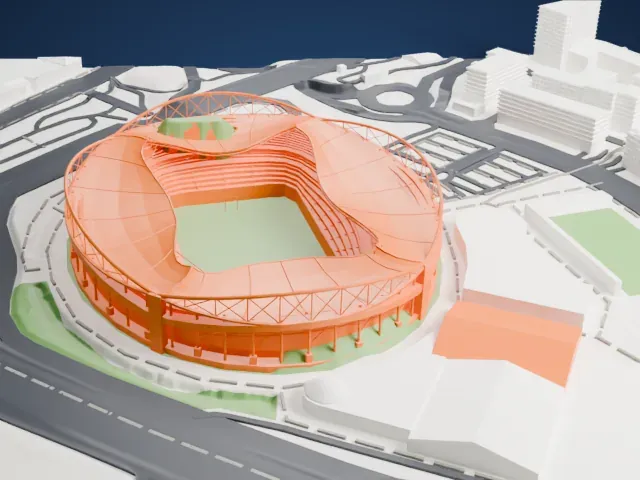
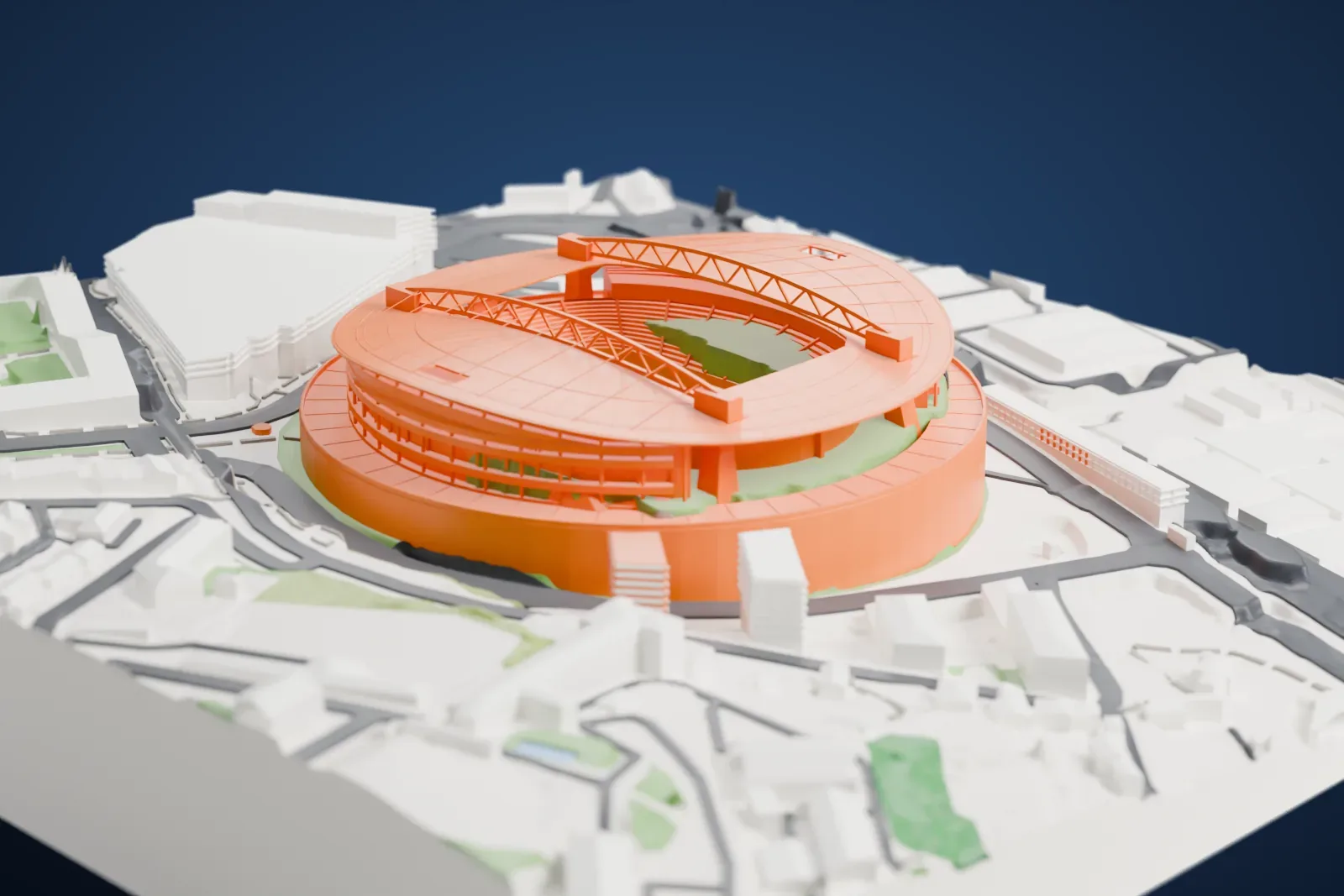
A free, printable model of the oval stadium with its wide roof ring and cross trusses, with the roads, buildings and sloping ground around it, generated from real map data in your browser.
-
 North
-
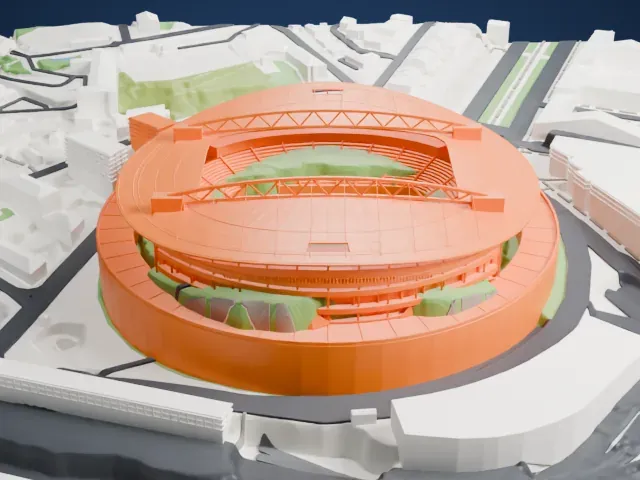 East
-
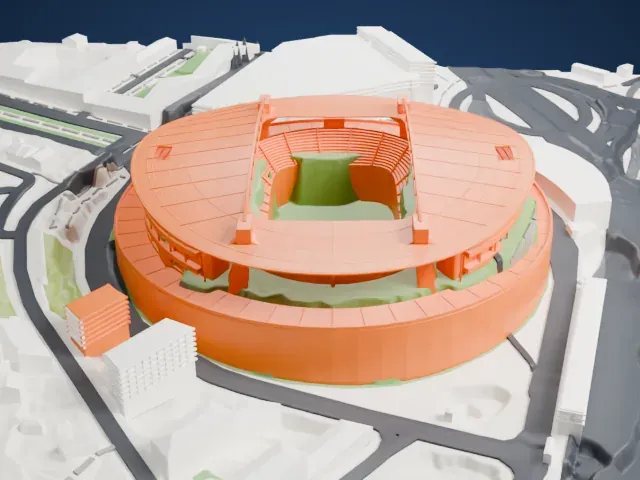 South
-
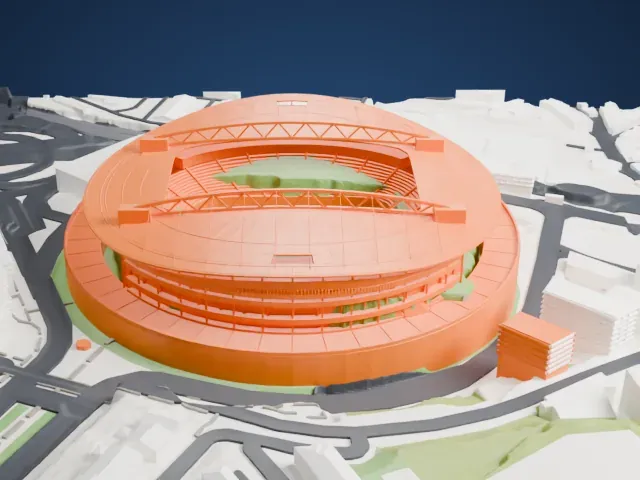 West
- On a 160 mm print
- 22 mm
- Scale
- 1:4,063
22 mm tall on a 160 mm print
Make this print opens the generator on a 650 m square around the landmark. Buildings print at close to true scale, so the landmark grows with the print size.
- Roof trusses and pylons
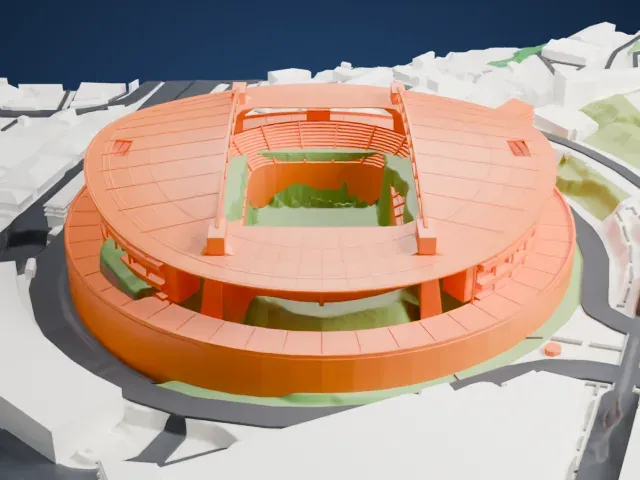
Slim trusses and tall, narrow pylons cross the top of the stands. Print friendly adapts these thin parts to your print scale; Full detail keeps them. Print slowly with good cooling for the tall tips.
- Wide roof ring with fine lines
The broad oval roof is marked with fine radial and ring lines. Layers of 0.12 to 0.16 mm keep them crisp, and a larger print shows more of the pattern.
- One piece with the ground
Estádio do Dragão is joined to the ground in the exported file, and the four-side check found no floating parts, so nothing needs gluing.
- Pick the detail for your nozzle
In the Buildings settings, set Landmark detail to Print friendly to adapt thin parts and small details to the print scale. Full detail keeps every modeled feature, for larger prints or a finer nozzle.
- Colors
Buildings, roads, water and ground arrive as separate filament slots in the 3MF. Estádio do Dragão takes the building color.
- File format
You get a 3MF for Bambu Studio, OrcaSlicer or PrusaSlicer. Any of them can save it as STL if you need one.
About Estádio do Dragão
The all-seater Estádio do Dragão ("Dragon Stadium" in English) stands in Porto, Portugal. FC Porto has played its home matches there since 2003. Its seating capacity of 50,033 makes it Portugal's third-largest football stadium. Manuel Salgado designed it, Somague built it, and it cost €125 million. It replaced the club's old ground, the Estádio das Antas, and was also built to be among the stadiums hosting matches at the UEFA Euro 2004 final tournament.
Building began in late 2001 and ended in November 2003, some months later than expected. In February 2002, after Porto's mayor, Rui Rio, objected to the plan's upscale housing and shopping, FC Porto's chairman, Jorge Nuno Pinto da Costa, halted all building until a consensus was reached. Its inauguration took place on November 16, 2003, in a friendly against Barcelona, with Lionel Messi, then 16, making his debut for the visiting side. Porto won 2–0, and the attendance of 52,004 set a record. Severe turf problems sent Porto back to its former ground until fresh turf had been planted by mid-February 2004.
The club unveiled the name Estádio do Dragão, explaining that the dragon appears in the club's symbol and the city's coat of arms. Its frame is built from 21,000 m2 of azulejos. At UEFA Euro 2004 the stadium staged the opener, in which Portugal, the hosts, met Greece, who went on to win the tournament, plus three group stage matches, a quarterfinal and a semifinal. It also staged matches at the 2019 UEFA Nations League Finals and hosted the 2021 UEFA Champions League Final, where Chelsea FC beat Manchester City 1–0 with a goal by Kai Havertz.
About this model
Estádio do Dragão is one of more than 4,300 landmark models in Mini Skyline. They are made with AI, and each one is checked from four sides in its real surroundings before release. Everything around it is built from OpenStreetMap and Overture map data. If you would rather print the shape from map data, turn off Landmark models in the Buildings settings.
Keep exploring