3D print the American Museum of Natural History
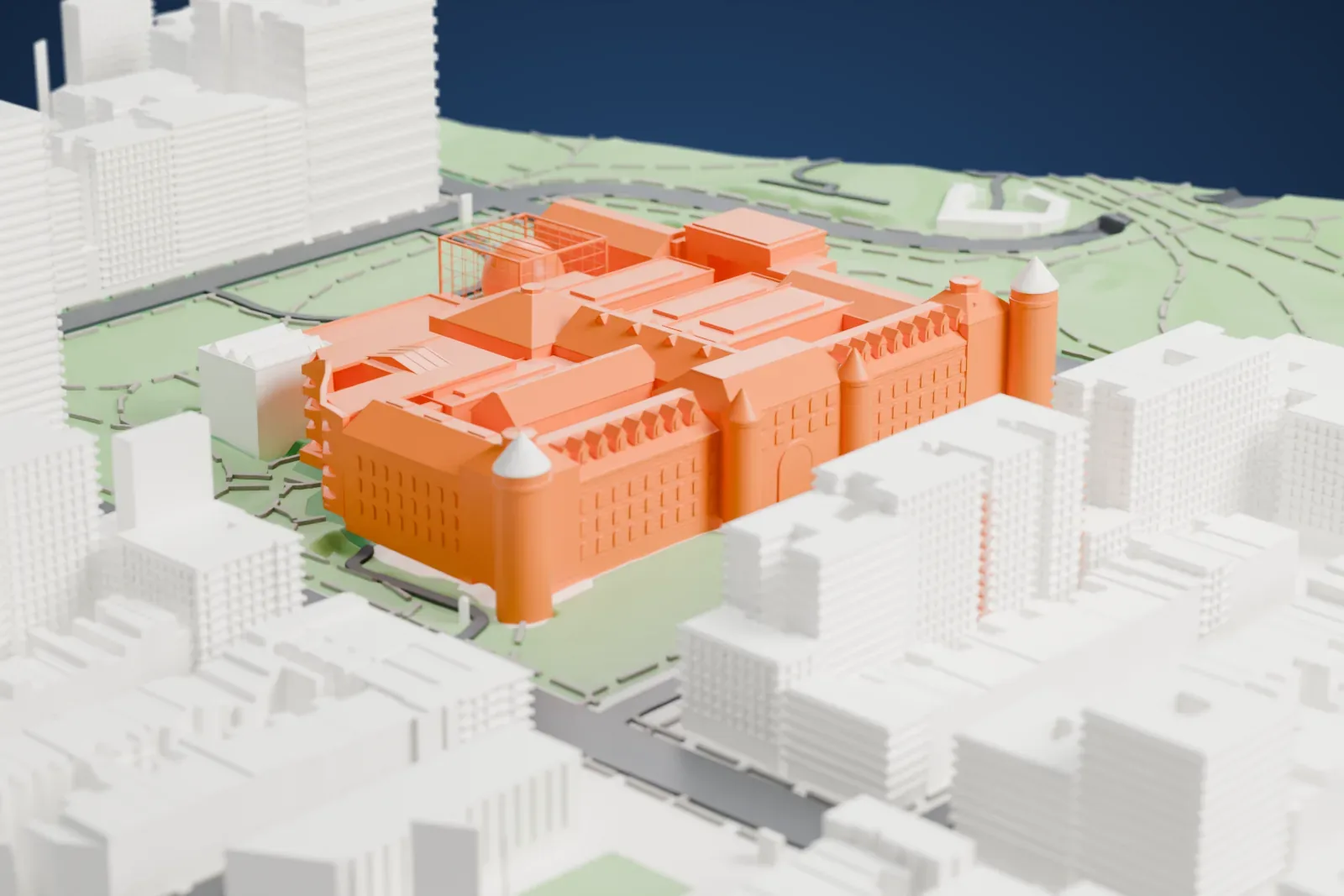
A free, printable model of the museum's connected buildings, with the green park and tall city buildings around them, generated from real map data in your browser.
Free, in your browser. Exports a slicer-ready 3MF.
About the American Museum of Natural History
The American Museum of Natural History, shortened to AMNH, is a museum of natural history on Manhattan's Upper West Side, in New York City. It is in Theodore Roosevelt Park, on the opposite side of the street from Central Park. The complex has 21 interconnected buildings with 45 permanent exhibition halls, plus a planetarium and a library, and it occupies more than 232,258 m2 (2,500,000 ft2). Its collections hold about 32 million specimens, and only a small fraction of them can be on display at once.
Albert S. Bickmore, a naturalist, devised the idea in 1861. Noting that numerous natural history museums in Europe stood in populous cities, he wrote that New York, the city of greatest wealth, was probably the best location for such a museum for the whole country. Calls for one grew when Barnum's American Museum was destroyed by fire in 1868. John David Wolfe became its first president when the legislation creating the museum was signed on April 6, 1869, and the museum opened in the Arsenal in Central Park on May 22, 1871.
Calvert Vaux and J. Wrey Mould designed the museum's first purpose-built building in Theodore Roosevelt Park, which opened on December 22, 1877. President Rutherford B. Hayes attended the opening ceremony. Later additions include the museum's Rose Center for Earth and Space, added in 2000, and a pavilion at the main entrance, named for Theodore Roosevelt, added in 1936.
How it prints
Make this print opens the generator on a 600 m square around the landmark. Buildings print at close to true scale, so the landmark grows with the print size.
| Print size | Landmark height | Scale |
|---|---|---|
| 160 mm default | 14 mm | 1:3,750 |
| 200 mm | 18 mm | 1:3,000 |
| 256 mm | 23 mm | 1:2,344 |
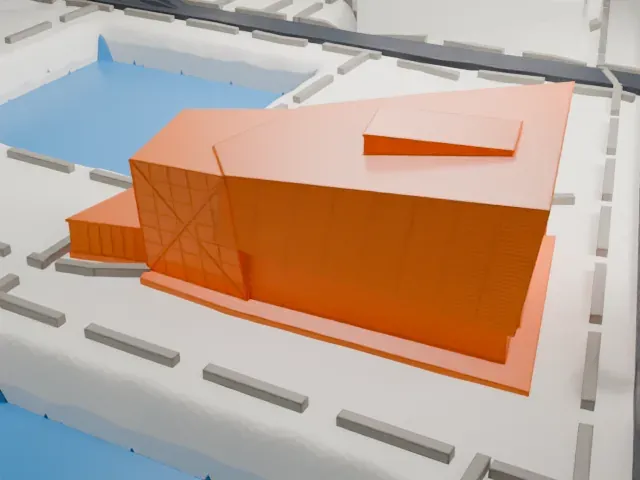
-
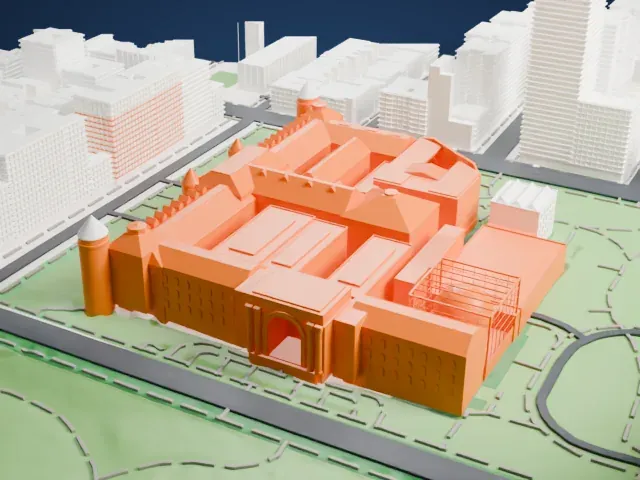
 North
North
-
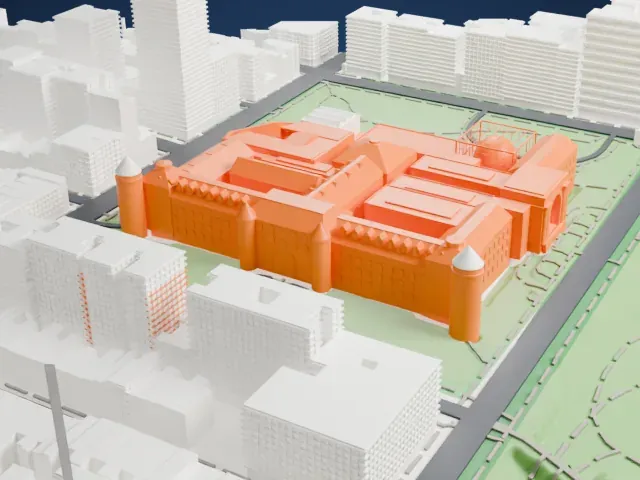
 East
East
-
 South
South
-
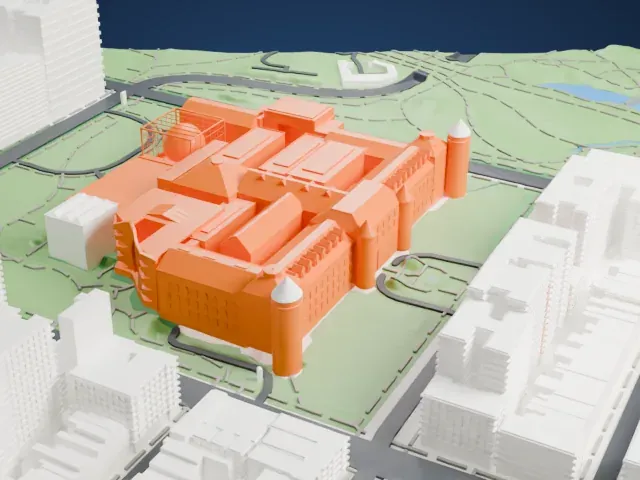 West
West
- Round towers and a lattice cube
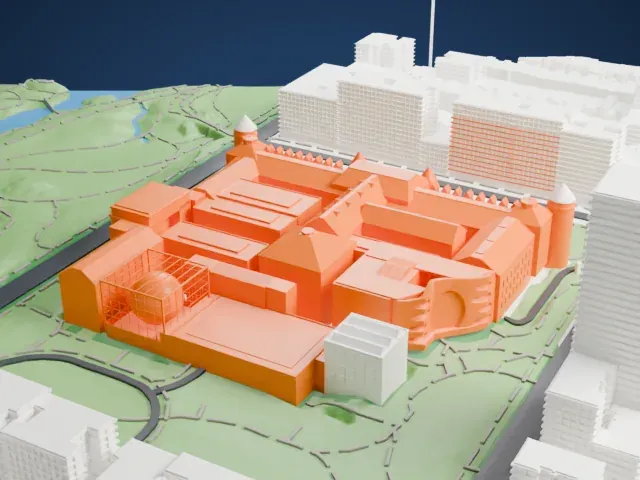
- The museum has round corner towers, arched entrances and a lattice cube holding a sphere. Print friendly adapts the thin and small parts to your print scale; Full detail keeps them, best on a larger print.
- Wide, low complex
- The museum is wide and low beside tall neighbors, so a larger print keeps its arches, towers and roof details easier to read.
- One piece with the ground
- The American Museum of Natural History is joined to the ground in the exported file, and the four-side check found no floating parts, so nothing needs gluing.
- Pick the detail for your nozzle
- In the Buildings settings, set Landmark detail to Print friendly to adapt thin parts and small details to the print scale. Full detail keeps every modeled feature, for larger prints or a finer nozzle.
- Colors
- Buildings, roads, water and ground arrive as separate filament slots in the 3MF. The American Museum of Natural History takes the building color.
- File format
- You get a 3MF for Bambu Studio, OrcaSlicer or PrusaSlicer. Any of them can save it as STL if you need one.
About this model
The American Museum of Natural History is one of more than 2,300 landmark models in Mini Skyline. They are made with AI, and each one is checked from four sides in its real surroundings before release. Everything around it is built from OpenStreetMap and Overture map data. If you would rather print the shape from map data, turn off Landmark models in the Buildings settings.
Common questions
Is there an American Museum of Natural History STL I can download?
Mini Skyline builds the file for you in your browser and exports 3MF, which every major slicer opens. If you need an STL, open the 3MF in your slicer and export it from there.
How big can I print it?
Any print size from 40 mm across. The American Museum of Natural History grows with the print: about 14 mm tall on the default 160 mm print. For a model larger than your printer bed, Project Mode splits the area into tiles.
Is it free?
Yes. Generation runs in your browser, with no account and nothing behind a paywall.