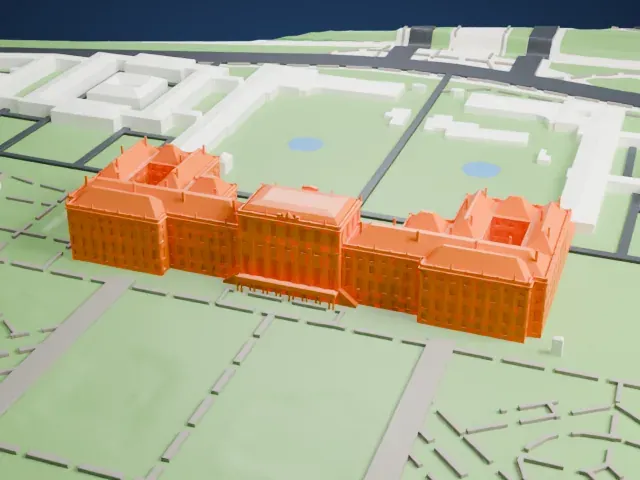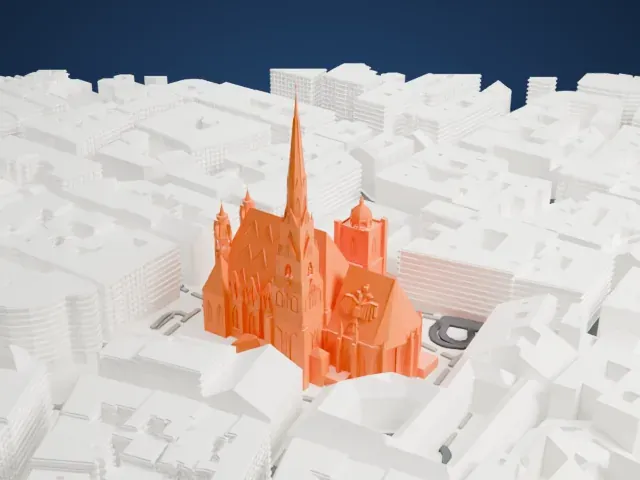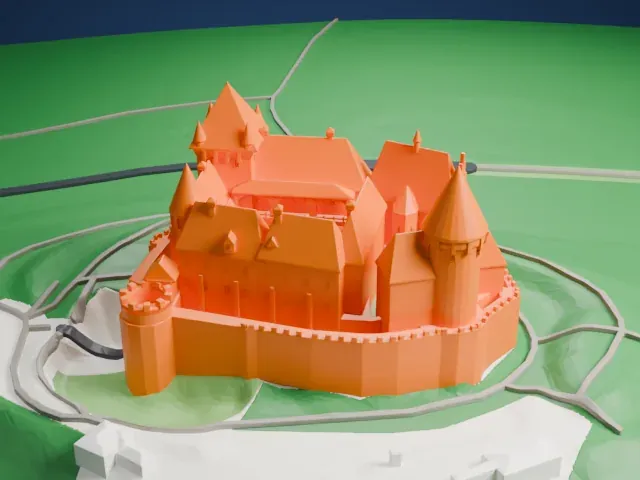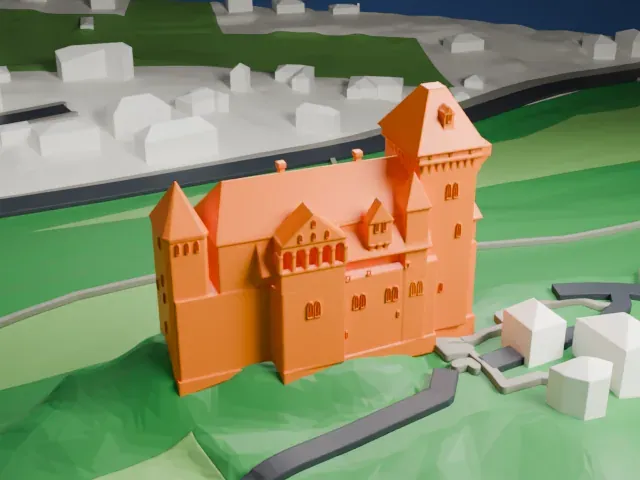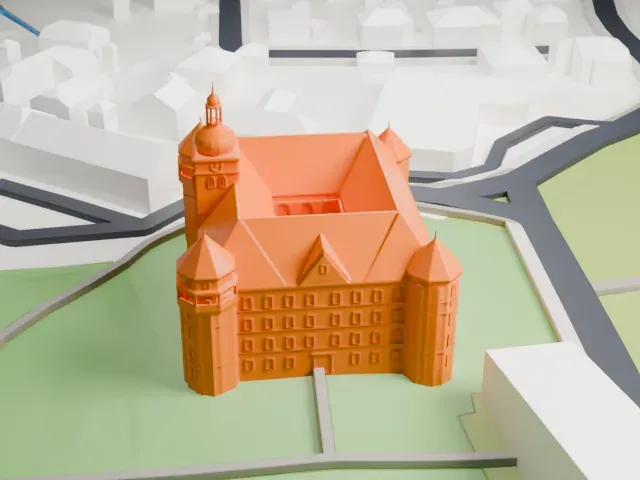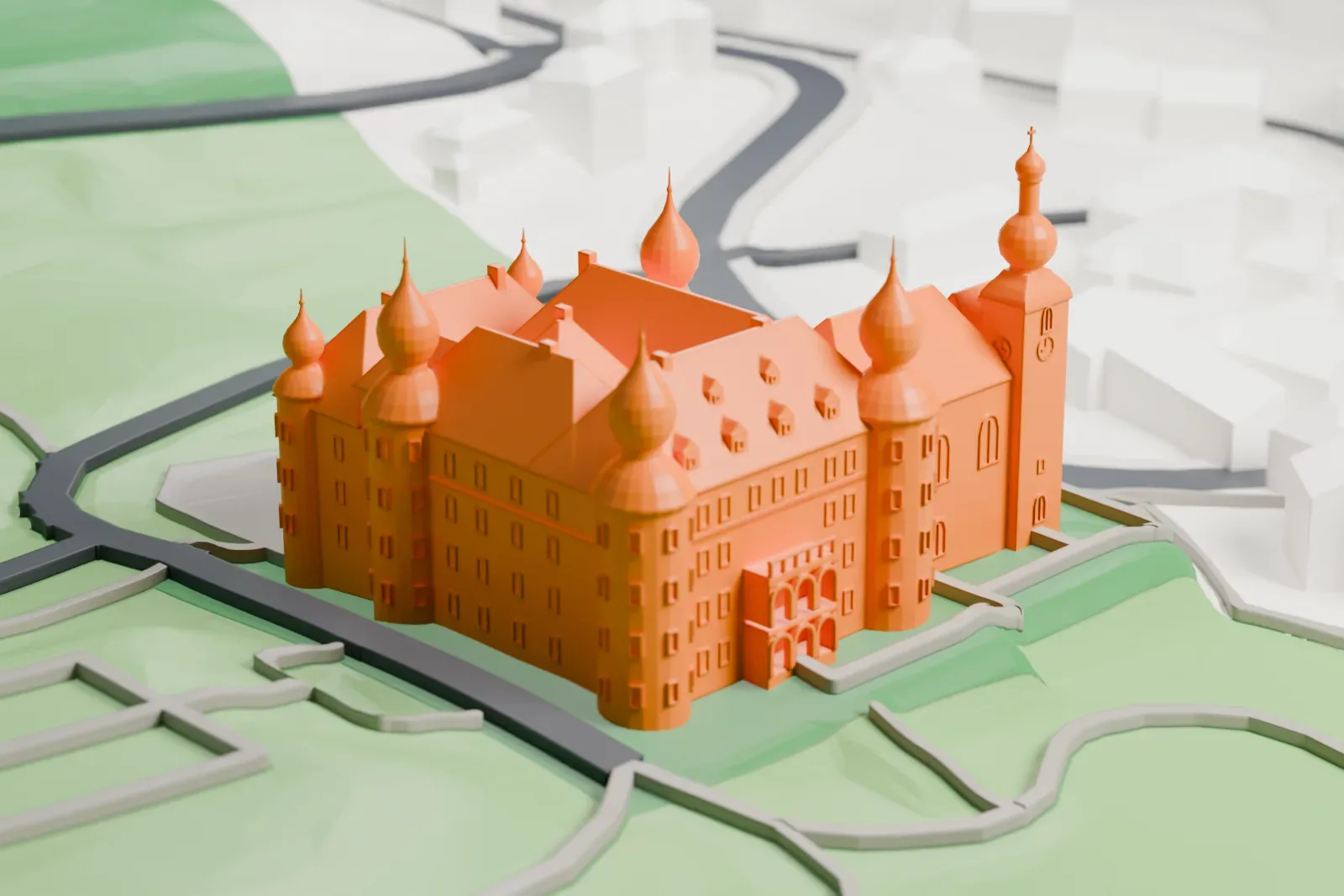
Artstetten Castle in 3D
Artstetten Castle appears in city models you make here; its design may still be protected, so it isn't offered as a separate download.
-
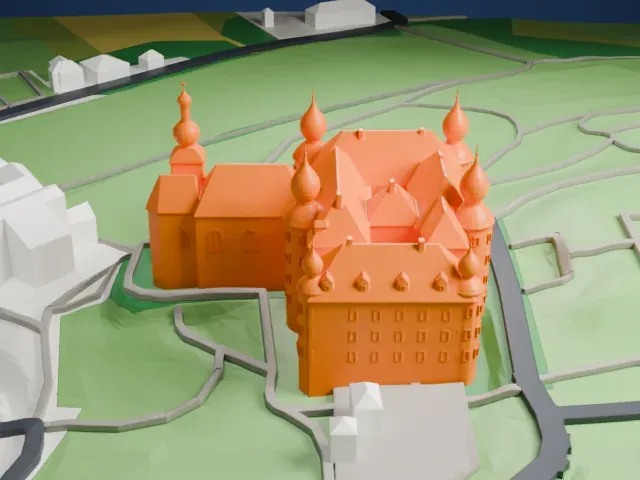 North
-
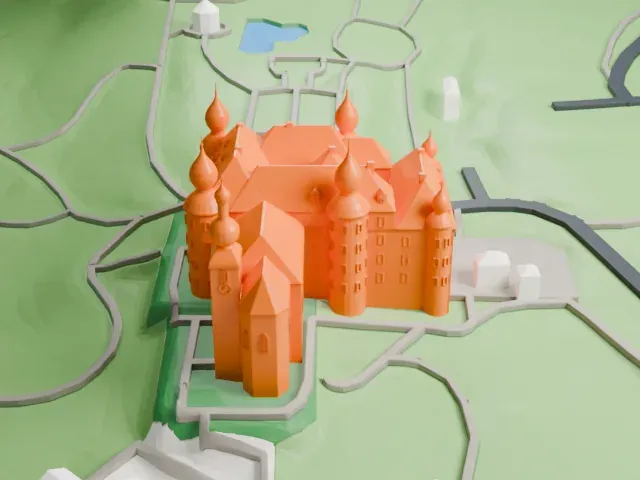 East
-
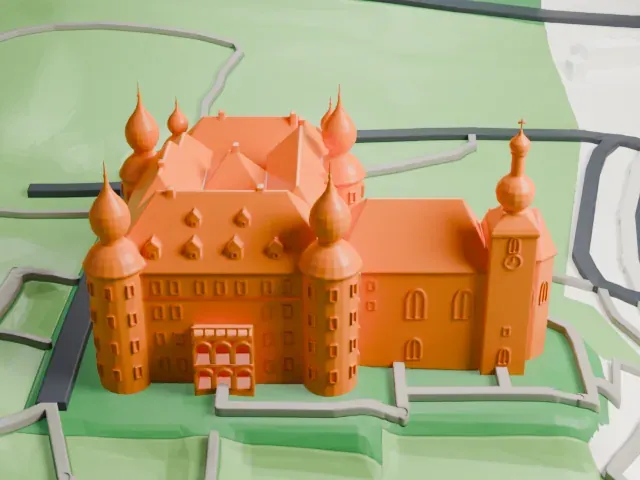 South
-
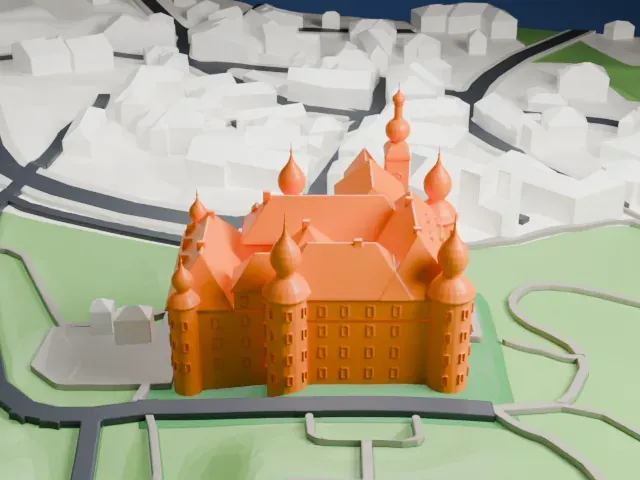 West
Copyright notice
The design of Artstetten Castle may still be protected by copyright. It appears in the city models you make here, but it is not offered as a separate model.
- On a 160 mm print
- 11 mm
- Scale
- 1:3,750
11 mm tall on a 160 mm print
Make this print opens the generator on a 600 m square around the landmark. Buildings print at close to true scale, so the landmark grows with the print size.
- Onion domes and thin spires
The towers end in onion-shaped domes with slim spires, and the clock tower carries a small cross. Print friendly adapts these thin tips to the print scale; Full detail keeps them on a larger print.
- Dormers and small windows
The roofs have rows of small dormer windows. A larger print size and a 0.12-0.16 mm layer height keep these small details crisp.
- One piece with the ground
Artstetten Castle is joined to the ground in the exported file, and the four-side check found no floating parts, so nothing needs gluing.
- Pick the detail for your nozzle
In the Buildings settings, set Landmark detail to Print friendly to adapt thin parts and small details to the print scale. Full detail keeps every modeled feature, for larger prints or a finer nozzle.
- Colors
Buildings, roads, water and ground arrive as separate filament slots in the 3MF. Artstetten Castle takes the building color.
- File format
You get a 3MF for Bambu Studio, OrcaSlicer or PrusaSlicer. Any of them can save it as STL if you need one.
About Artstetten Castle
Artstetten Castle (Schloss Artstetten in German) is a historic castle in the municipality of Artstetten-Pöbring, in Lower Austria, close to the Wachau valley. Archduke Franz Ferdinand of Austria is buried here with his wife Sophie, Duchess of Hohenberg. Both were assassinated in 1914, and their deaths were the immediate trigger of World War I.
Many families owned the castle over the centuries until Emperor Francis I of Austria bought it in 1823. Archduke Franz Karl became owner in 1852. In 1861 he handed it to Archduke Karl Ludwig, his third son. In 1889 it went to Franz Ferdinand, who carried out extensive renovations. Members of the Habsburg dynasty used it as a summer residence. Emperor Franz Joseph I would not allow the couple to be placed in the Imperial Crypt at the Capuchin Church in Vienna, because of their morganatic marriage, so they rest at Artstetten. Inside is a museum named for the archduke, the Archduke Franz Ferdinand Museum.
After Czechoslovakia confiscated Konopiště Castle in 1921, Artstetten became the primary residence of the Hohenberg family. After the 1938 Anschluss, Nazi Germany took the castle and sent the Hohenbergs to Dachau concentration camp because of their anti-Nazi views. In 1949 the family got the castle back from the Republic of Austria. Visitors can see parts of the castle. It also appears on a 10 euro collectors' coin minted on October 13, 2004, which shows it standing above the Danube River.
About this model
Artstetten Castle is one of more than 6,500 landmark models in Mini Skyline. They are made with AI, and each one is checked in its real surroundings before release. Each model is written as code from public descriptions, plans, photographs and aerial views used only as references; no image or third-party model is copied into it. Everything around it is built from OpenStreetMap and Overture map data. Rights in the building itself, its name and any brands on it are not granted by Mini Skyline; clear them separately before you sell prints. If you would rather print the shape from map data, turn off Landmark models in the Buildings settings.
Mini Skyline is not affiliated with, or endorsed by, the owners of this building or its names and marks.
Keep exploring