3D print the BT Tower
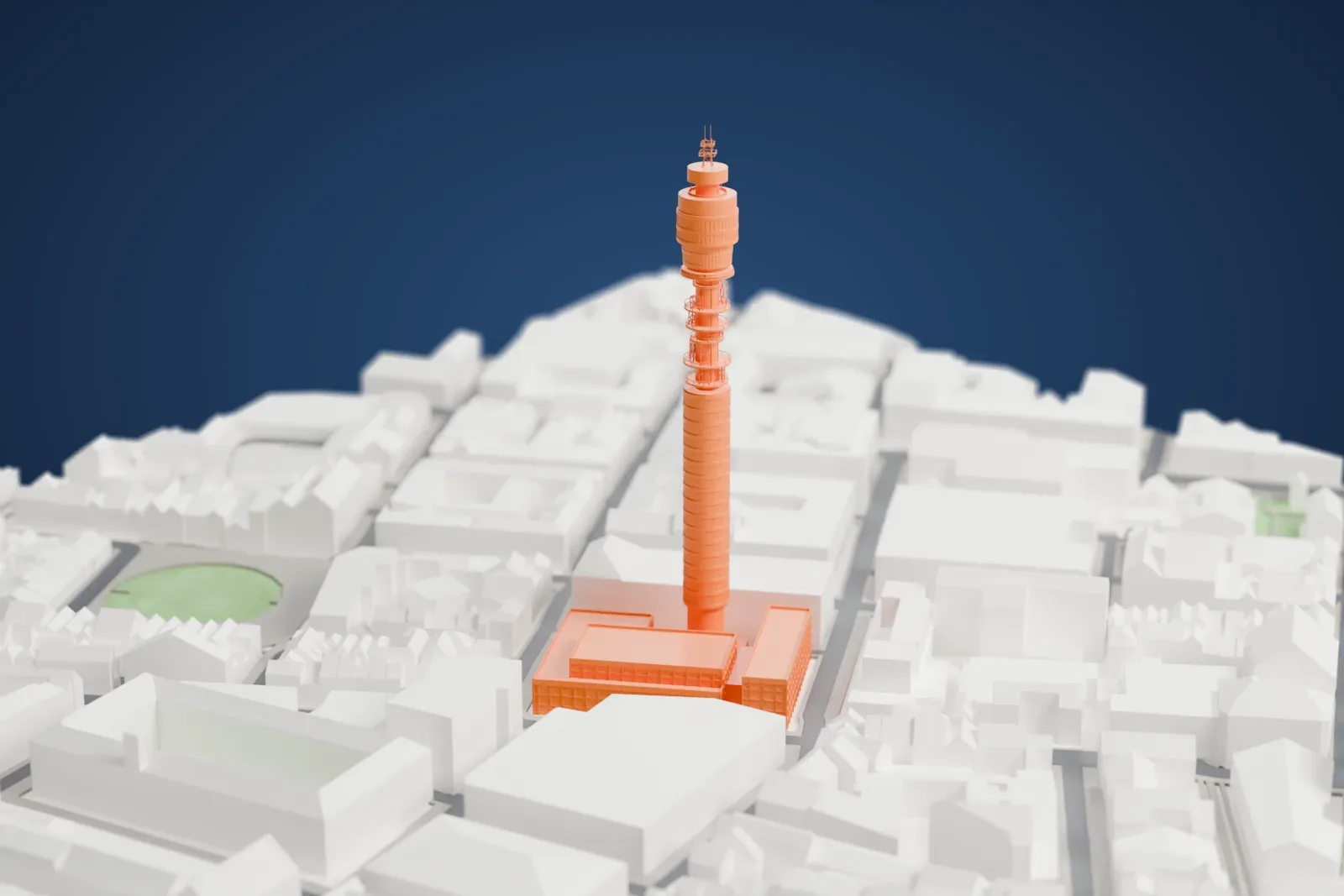
A free, printable model of the BT Tower, its slim shaft and the section above it, and the streets and buildings of Fitzrovia around it, generated from real map data in your browser.
-
 North
-
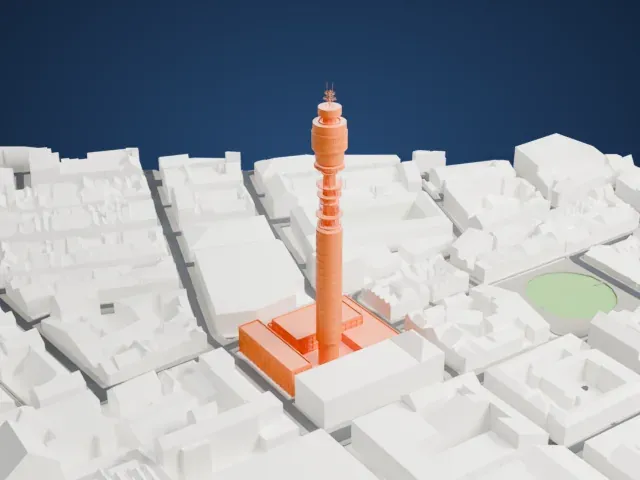 East
-
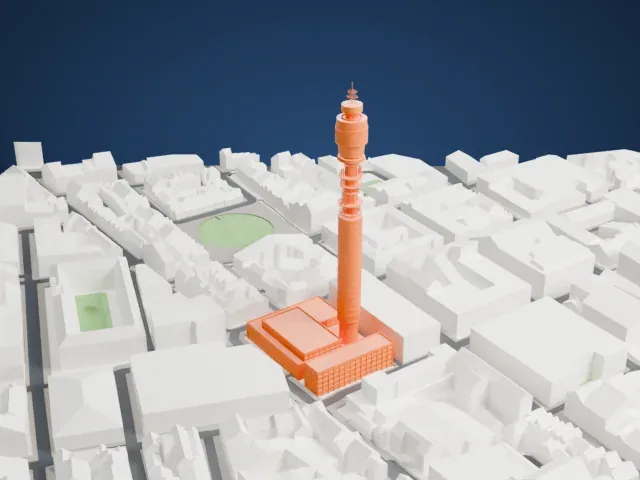 South
-
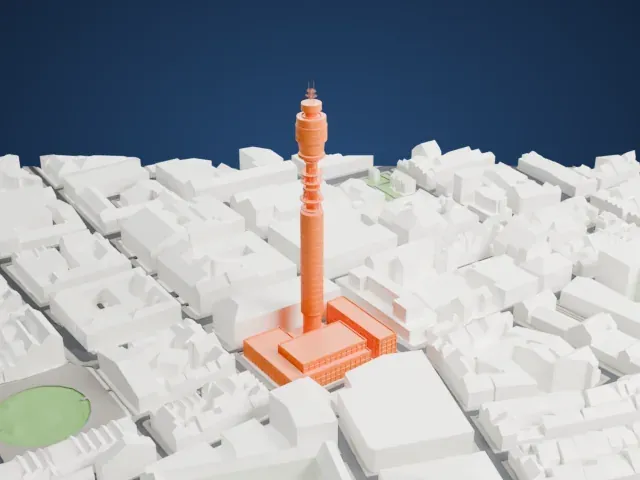 West
- Real height
- 177 m
- On a 160 mm print
- 51 mm
- Scale
- 1:3,750
177 m of the BT Tower, 51 mm on your shelf
Make this print opens the generator on a 600 m square around the landmark. Buildings print at close to true scale, so the landmark grows with the print size.
- A tall, slim shaft
Nothing else in this model comes close to its height, and the slim shaft is the part that can flex. Print slowly with good cooling, and use layers of 0.12–0.16 mm to keep it clean.
- Keep the top sharp
The model's highest section is also its finest, so it prints small at the top. Print friendly adapts it at the default size; Full detail keeps it for a large print or a fine nozzle.
- One piece with the ground
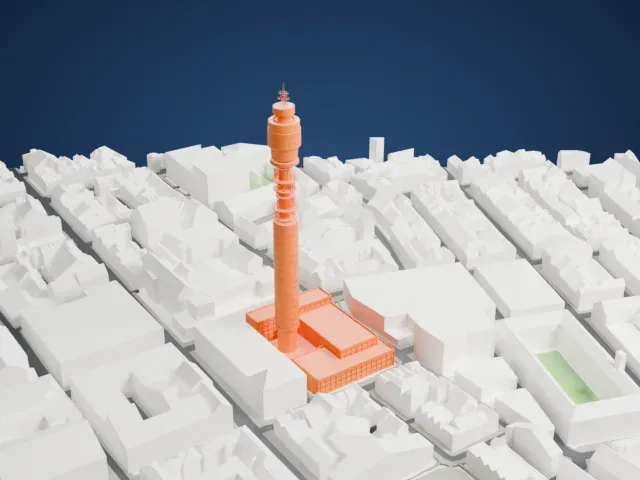
The BT Tower is joined to the ground in the exported file, and the four-side check found no floating parts, so nothing needs gluing.
- Pick the detail for your nozzle
In the Buildings settings, set Landmark detail to Print friendly to adapt thin parts and small details to the print scale. Full detail keeps every modeled feature, for larger prints or a finer nozzle.
- Colors
Buildings, roads, water and ground arrive as separate filament slots in the 3MF. The BT Tower takes the building color.
- File format
You get a 3MF for Bambu Studio, OrcaSlicer or PrusaSlicer. Any of them can save it as STL if you need one.
About the BT Tower
The BT Tower, a communications tower completed in 1964, stands in Fitzrovia, in central London, England. When it was finished it carried the name Museum Radio Tower, after the neighboring Museum Telephone Exchange, and it later became the Post Office Tower and the Telecom Tower before taking its present name in 1991. Historic England designated it a Grade II listed building in 2003.
The General Post Office commissioned the tower to carry the microwave aerials that once handled telecommunications traffic between London and the rest of Britain, replacing a shorter steel lattice tower that stood on the exchange roof. Government architects led by Eric Bedford and G R Yeats designed it, with a narrow concrete-and-glass cylinder, a shape chosen as a stable platform for the aerials: the structure shifts no more than 25 centimeters (10 in) in winds reaching 150 km/h (95 mph).
Construction began in June 1961, the tower was topped out on July 15, 1964, and Prime Minister Harold Wilson inaugurated it on October 8, 1965. The main structure reaches 177 m (581 ft), and its aerial rigging takes the total to 189 m (620 ft); until 1980 no structure in London stood higher. Butlins ran the revolving restaurant from 1966 to 1980, and a 360° LED screen on the shaft shows news across central London.
About this model
The BT Tower is one of more than 4,400 landmark models in Mini Skyline. They are made with AI, and each one is checked from four sides in its real surroundings before release. Everything around it is built from OpenStreetMap and Overture map data. If you would rather print the shape from map data, turn off Landmark models in the Buildings settings.
Same skyline