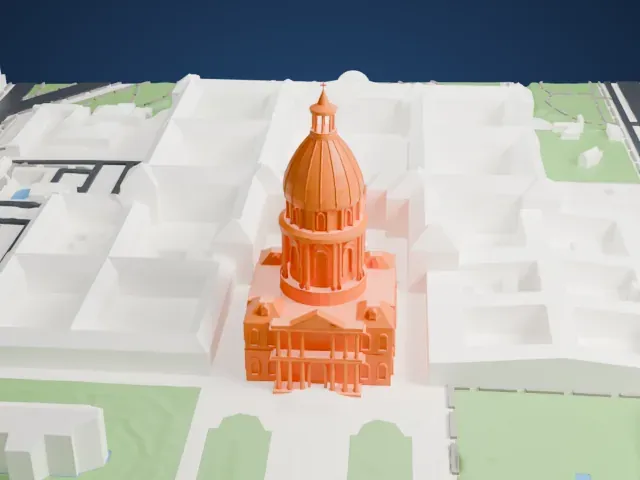
3D print the Louvre Pyramid
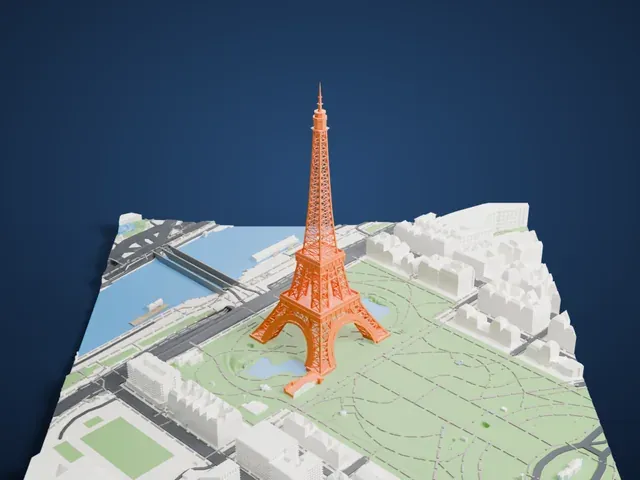
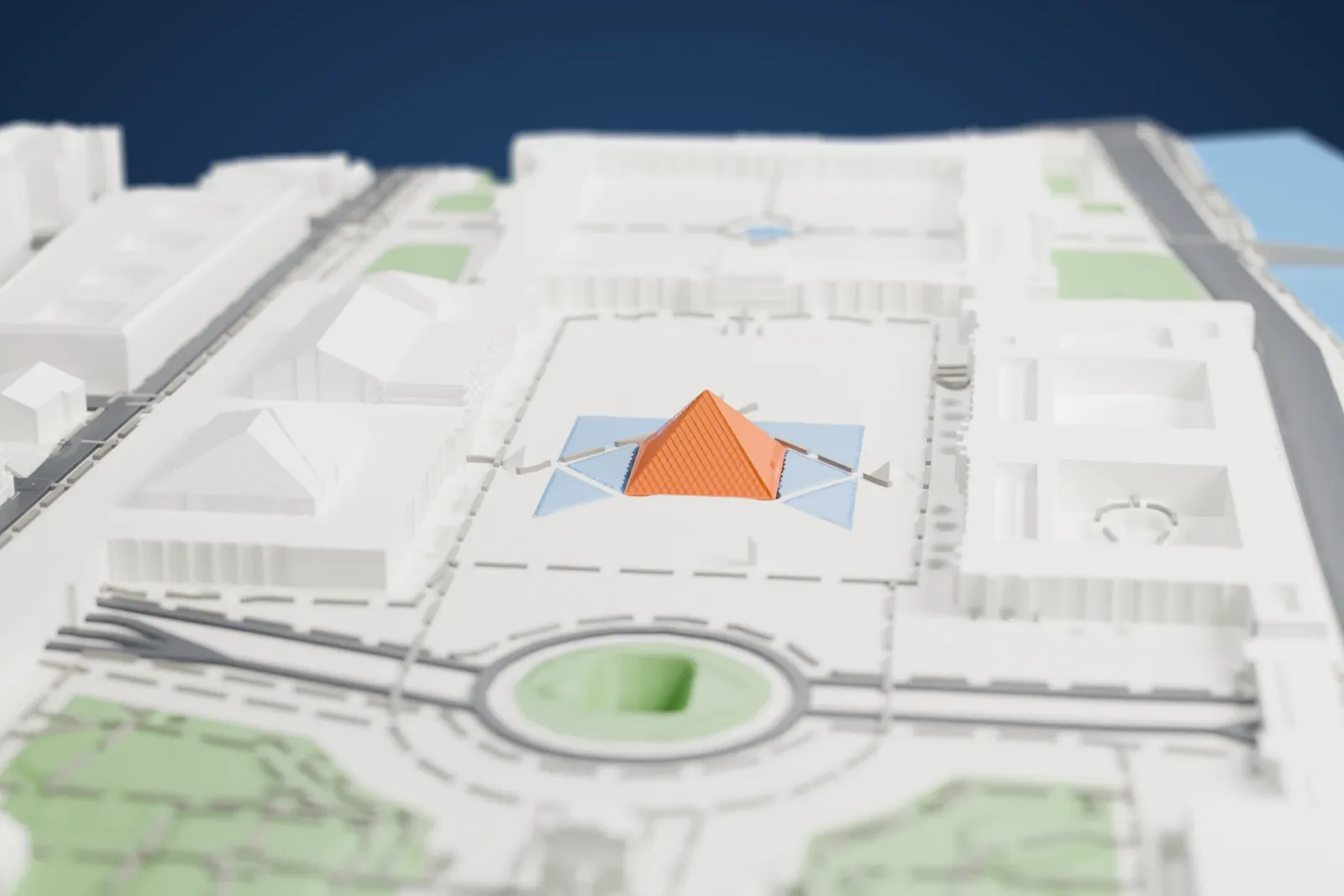
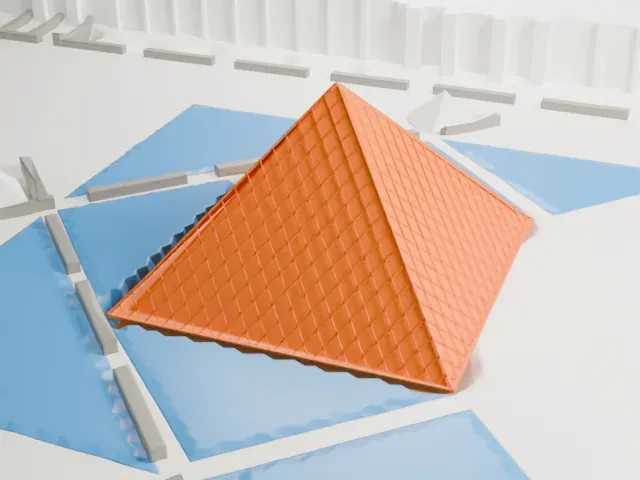
A free, printable model of the Louvre Pyramid, its diamond-patterned glass, with the smaller pyramids, triangular pools and courtyard around it, generated from real map data in your browser.
-
 North
-
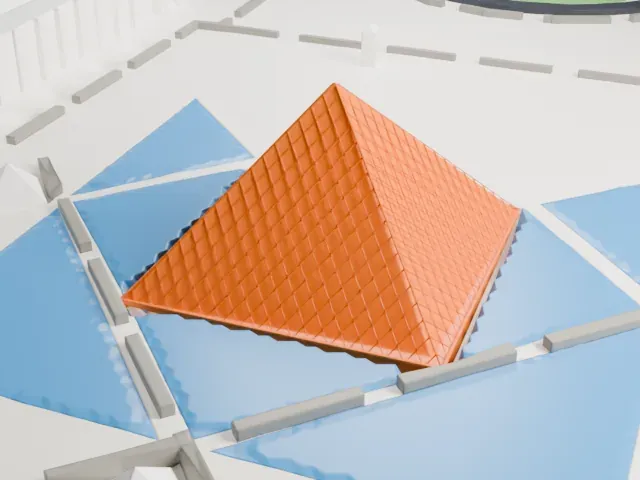 East
-
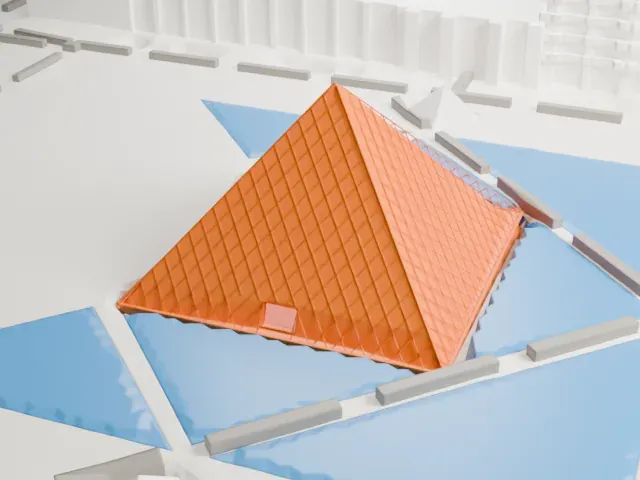 South
-
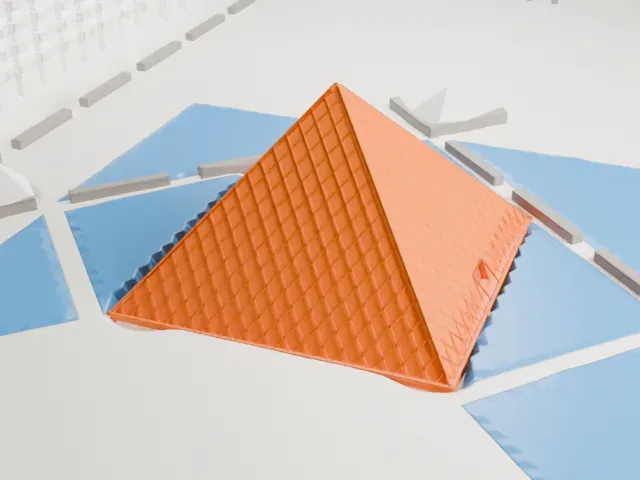 West
- Real height
- 22 m
- On a 160 mm print
- 8 mm
- Scale
- 1:3,750
22 m of the Louvre Pyramid, 8 mm on your shelf
Make this print opens the generator on a 600 m square around the landmark. Buildings print at close to true scale, so the landmark grows with the print size.
- Diamond lattice of thin bars
The glazing is a grid of thin diamond-shaped frames. Print friendly adapts the thin bars to the print scale; Full detail keeps every one, which suits a larger print or a fine nozzle. Layers of 0.12 to 0.16 mm keep the edges crisp.
- Sloping faces and a sharp apex
The four sloping faces meet at a sharp point. Printing slowly with good cooling helps the tip form cleanly, and a larger print size keeps the diamond grid readable.
- One piece with the ground
The Louvre Pyramid is joined to the ground in the exported file, and the four-side check found no floating parts, so nothing needs gluing.
- Pick the detail for your nozzle
In the Buildings settings, set Landmark detail to Print friendly to adapt thin parts and small details to the print scale. Full detail keeps every modeled feature, for larger prints or a finer nozzle.
- Colors
Buildings, roads, water and ground arrive as separate filament slots in the 3MF. The Louvre Pyramid takes the building color.
- File format
You get a 3MF for Bambu Studio, OrcaSlicer or PrusaSlicer. Any of them can save it as STL if you need one.
About the Louvre Pyramid
Architect I. M. Pei, who was Chinese-American, designed the Louvre Pyramid, a big structure of glass and metal that is both an entrance and a skylight. It sits in the main courtyard of the Louvre Palace in Paris, the Cour Napoléon, ringed by three smaller pyramids in the same style that act as lightwells. The big pyramid is the main way into the Louvre Museum and lets daylight into the visitors hall below ground. Low triangular reflecting pools with fountains, in a modernist style, lie on three sides. It was completed in 1989 within the wider Grand Louvre project.
Made entirely of glass segments and metal poles, the pyramid is 21.6 m (71 ft) high. Its square base measures 34 m (112 ft) along each side and covers 1,000 square meters (11,000 sq ft). The glazing is made of 603 rhombus-shaped panes and 70 triangular ones, 673 in all, as confirmed by the Louvre, despite a longstanding rumor of exactly 666. The sides slope at 51.52 degrees to the base, close to the slope of ancient Egyptian pyramids.
President François Mitterrand announced the Grand Louvre project in 1981, and Pei was selected as its architect in 1983. Pei first designed the pyramid in late 1983 and presented it to the public in early 1984. Building it set off many years of lively debate on aesthetics and politics. A smaller Inverted Pyramid, an upside-down skylight, sits in front of the museum within the Carrousel du Louvre mall.
About this model
The Louvre Pyramid is one of more than 4,300 landmark models in Mini Skyline. They are made with AI, and each one is checked from four sides in its real surroundings before release. Everything around it is built from OpenStreetMap and Overture map data. If you would rather print the shape from map data, turn off Landmark models in the Buildings settings.
Same skyline