3D print the Panthéon, Paris
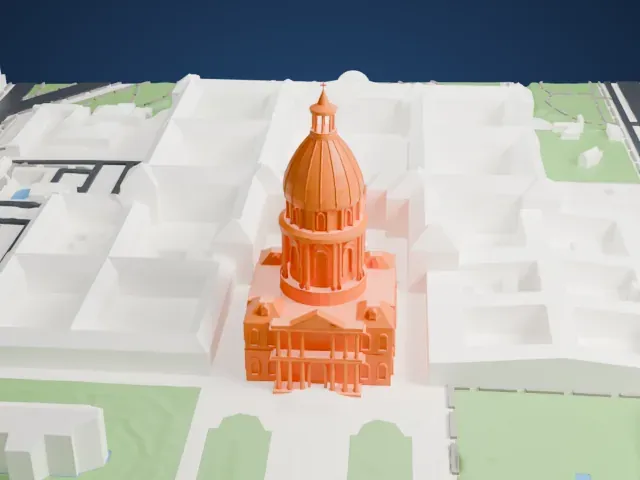
A free, printable model of the Panthéon and the narrow streets and blocks of the Latin Quarter around it in Paris, generated from real map data in your browser.
-
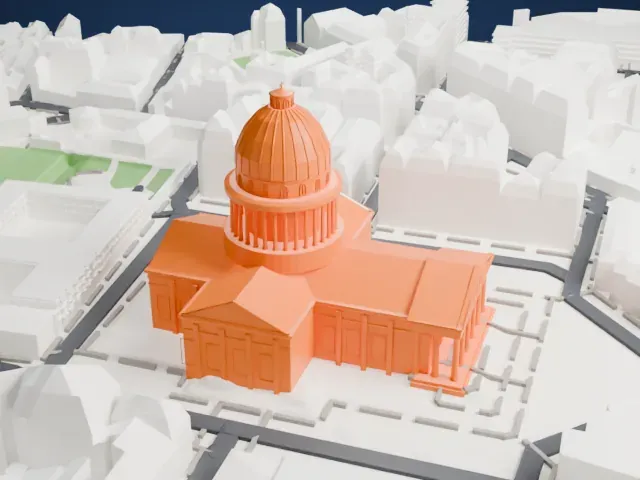 North
-
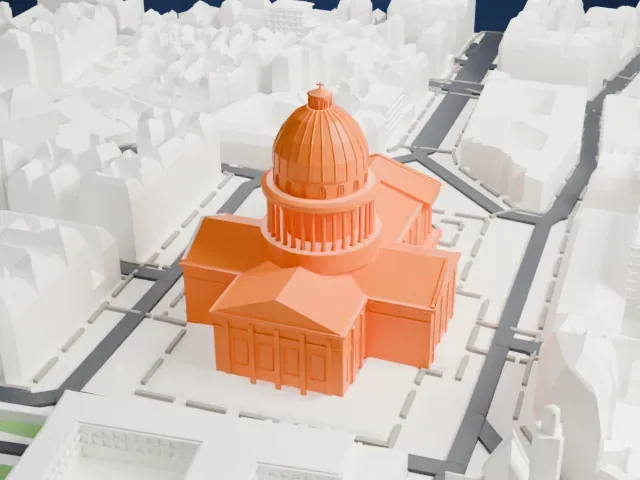 East
-
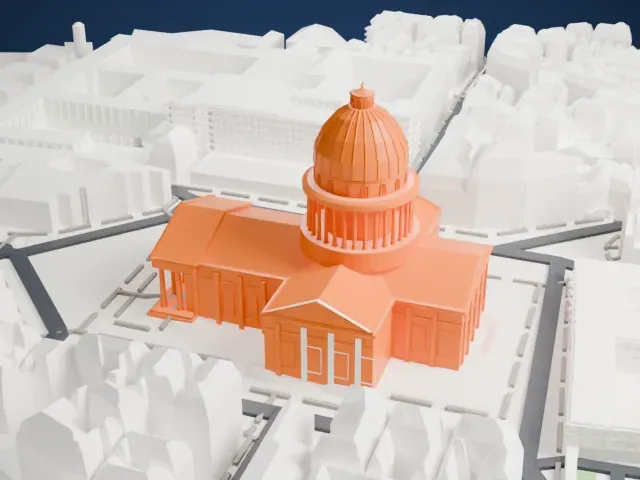 South
-
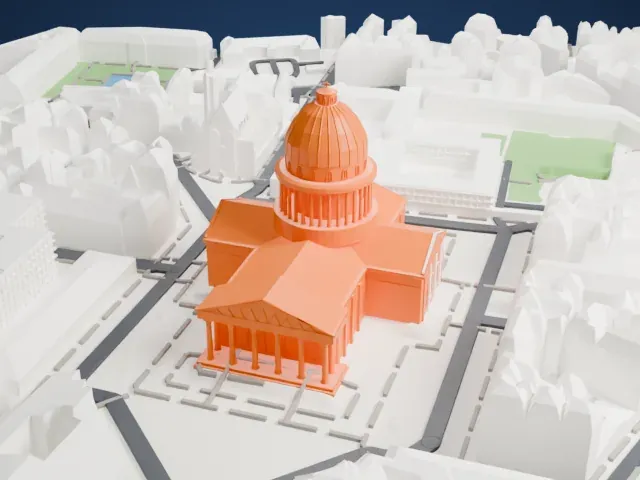 West
The model you print
Panthéon, Paris in 3D
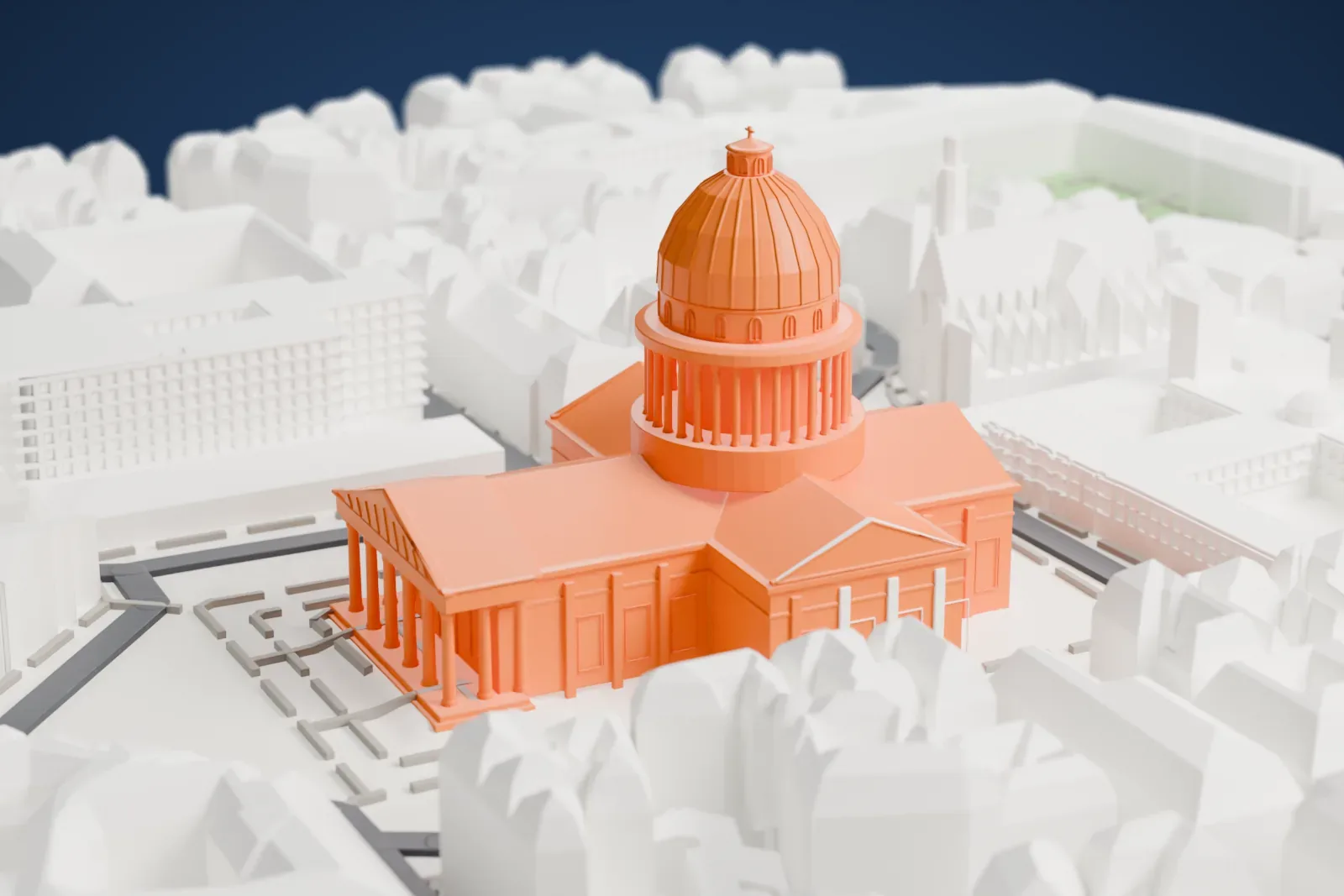
The landmark on its own, at its size on a 160 mm print. Print friendly thickens thin parts for a 0.4 mm nozzle; Full detail keeps every part.
- Real height
- 83 m
- On a 160 mm print
- 23 mm
- Scale
- 1:3,750
83 m of the Panthéon, Paris, 23 mm on your shelf
Make this print opens the generator on a 600 m square around the landmark. Buildings print at close to true scale, so the landmark grows with the print size.
- Slender columns under the dome
A drum ringed by slender columns carries the ribbed dome, and a small lantern sits on top. Print slowly with good cooling, and try Print friendly so the thinnest columns adapt to the print scale.
- Columns and a pediment out front
A columned portico with a triangular pediment stands at one end. Full detail keeps each column, which suits a larger print or a fine nozzle, and layers of 0.12 to 0.16 mm keep them crisp.
- Pick the detail for your nozzle
In the Buildings settings, set Landmark detail to Print friendly to adapt thin parts and small details to the print scale. Full detail keeps every modeled feature, for larger prints or a finer nozzle.
- Colors
Buildings, roads, water and ground arrive as separate filament slots in the 3MF. The Panthéon, Paris takes the building color.
- File format
You get a 3MF for Bambu Studio, OrcaSlicer or PrusaSlicer. Any of them can save it as STL if you need one.
About the Panthéon, Paris
The Panthéon is a monument standing in Paris, France, within the 5th arrondissement. It sits in the Latin Quarter, on the Montagne Sainte-Geneviève, at the center of the Place du Panthéon, a square named after it. Jacques-Germain Soufflot drew up the designs, and it was built between 1758 and 1790 at the request of King Louis XV. The king meant it to be a church to hold the relics of Saint Genevieve, the patron saint of Paris. Neither man lived to see it finished.
By the time construction ended, the French Revolution had begun. In 1791 the National Constituent Assembly voted to turn the church into a mausoleum holding the remains of eminent French people, modeled on the Pantheon in Rome. In the 19th century it went back to church use twice, until the Third Republic decreed in 1881 that it would serve only as a mausoleum. Victor Hugo was laid in the crypt in 1885, the first entombment there in more than 50 years. Léon Foucault demonstrated diurnal motion in 1851 by hanging a pendulum from the ceiling, and a copy of it is still visible.
Soufflot's first design was a Greek cross, with four equal-length naves, a monumental dome over the crossing and a classical portico of Corinthian columns. The finished building is 110 m long, 84 m wide and 83 m high, with a crypt of the same size beneath it. The dome is really three domes nested inside one another; the outermost is stone held together by iron cramps, under a lead covering. The building is an early work of Neoclassicism, and its dome borrows some of its character from Bramante's Tempietto.
About this model
The Panthéon, Paris is one of more than 5,500 landmark models in Mini Skyline. They are made with AI, and each one is checked in its real surroundings before release. Each model is written as code from public descriptions, plans, photographs and aerial views used only as references; no image or third-party model is copied into it. Everything around it is built from OpenStreetMap and Overture map data. Rights in the building itself, its name and any brands on it are not granted by Mini Skyline; clear them separately before you sell prints. If you would rather print the shape from map data, turn off Landmark models in the Buildings settings.
Mini Skyline is not affiliated with, or endorsed by, the owners of this building or its names and marks.
Same skyline