3D print the McMath–Pierce Solar Telescope
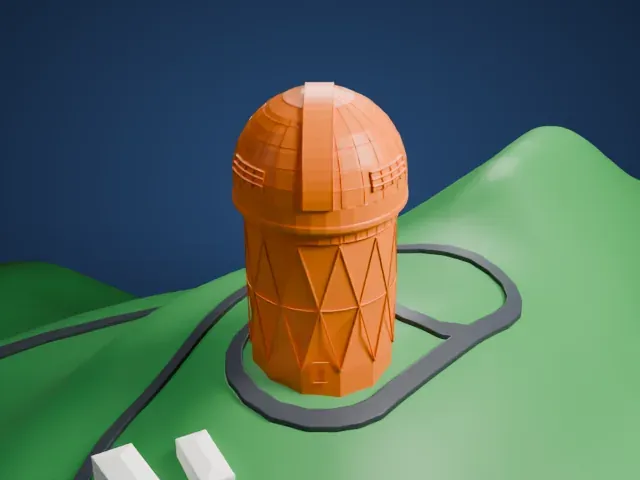
A free, printable model of the McMath–Pierce solar telescope and the hillside, roads and few buildings around it, generated from real map data in your browser.
Free, in your browser. Exports a slicer-ready 3MF.
About the McMath–Pierce Solar Telescope
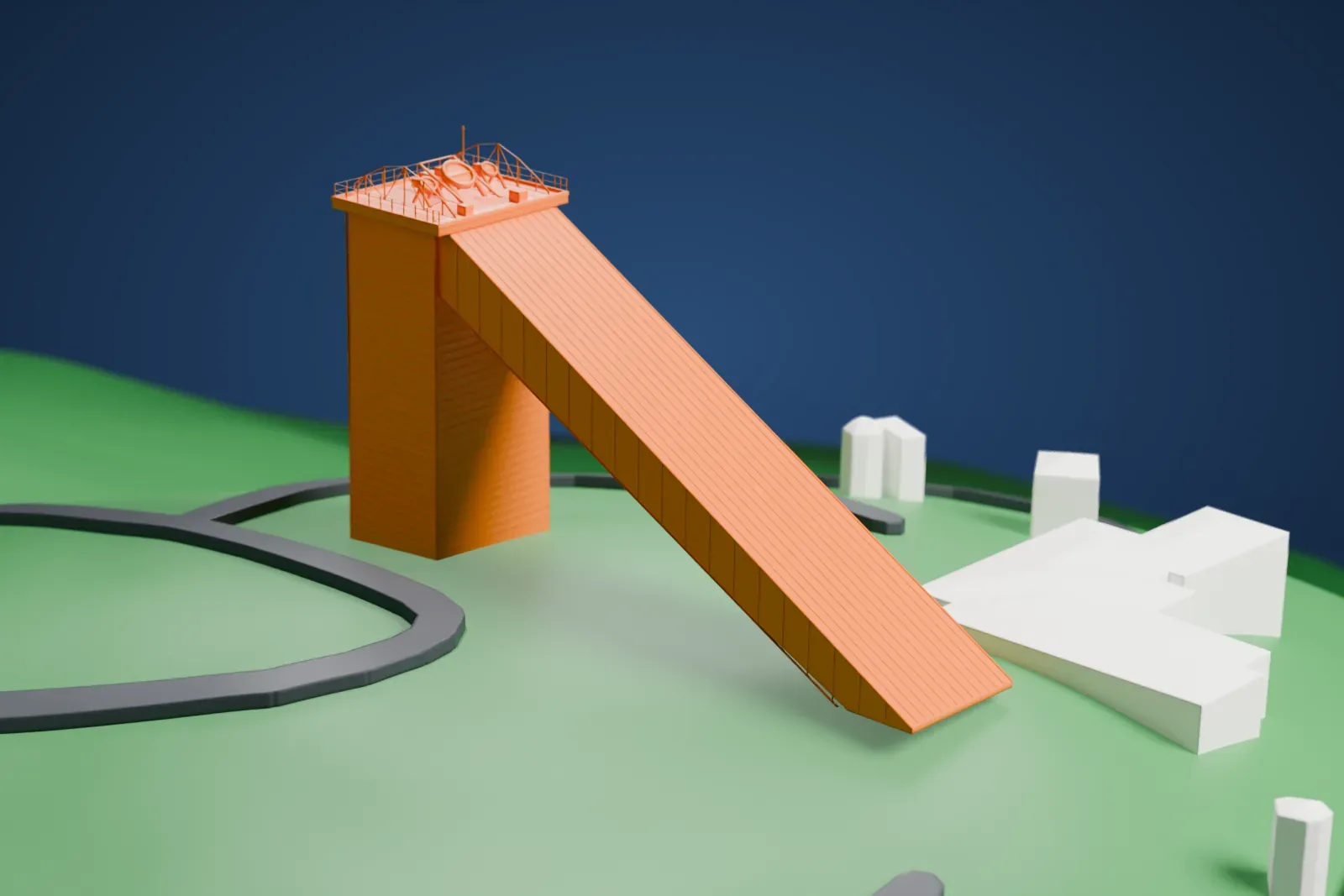
The McMath–Pierce solar telescope stands in Arizona, at Kitt Peak National Observatory. It is a reflecting solar telescope rated 1.6 m f/54. The structure dates to 1962 and was designed by the architect Myron Goldsmith, who was American, and the structural engineer Fazlur Rahman Khan, who was Bangladeshi-American. It was the world's largest solar telescope and also the world's largest optical telescope with an unobstructed aperture. Its name honors Robert Raynolds McMath and Keith Pierce, two astronomers. Its first name was the McMath Solar Telescope, and the name McMath-Pierce Solar Telescope came in 1992.
The telescope is a triple instrument: a main telescope with a primary mirror 1.61 meters across, fed by a 2.03 meter heliostat, plus two auxiliary telescopes called East and West, with primary mirrors of 1.07 meters and 0.91 meters. Sunlight is sent by the heliostat from the top of the main tower down a long shaft toward the primary mirrors. The shaft, a distinctive diagonal, continues underground, where the main primary mirror sits. Skidmore, Owings and Merrill's Chicago office designed and engineered the enclosure.
The telescope is made for watching the Sun, but it can also be used to look at bright objects at night. The main telescope's third mirror sends light down into the observing room, and a vacuum spectrograph sits beneath each of two of its three positions; one is 18 meters deep and the other 4 meters deep.
How it prints
Make this print opens the generator on a 600 m square around the landmark. Buildings print at close to true scale, so the landmark grows with the print size.
| Print size | Landmark height | Scale |
|---|---|---|
| 160 mm default | 9 mm | 1:3,750 |
| 200 mm | 12 mm | 1:3,000 |
| 256 mm | 15 mm | 1:2,344 |
-
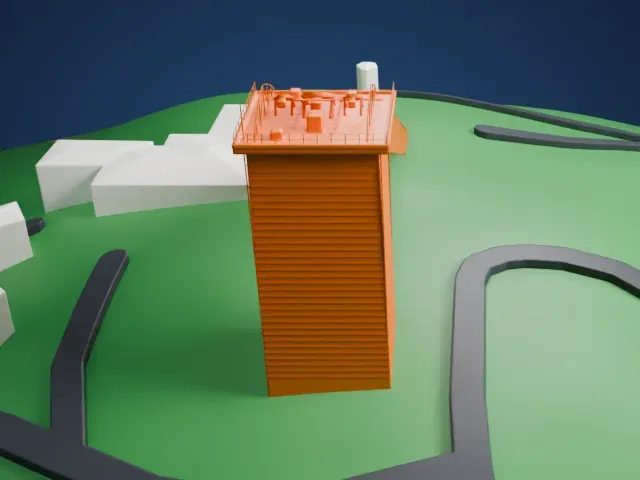 North
North
-
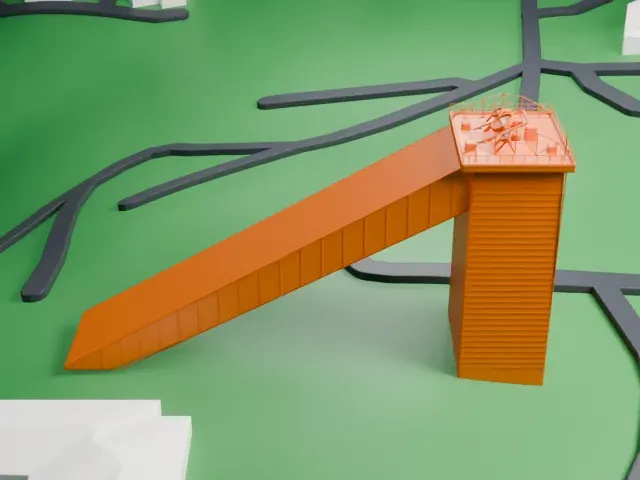 East
East
-
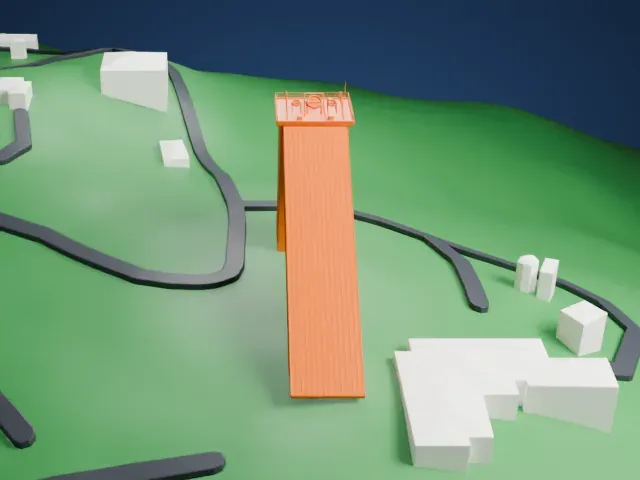 South
South
-
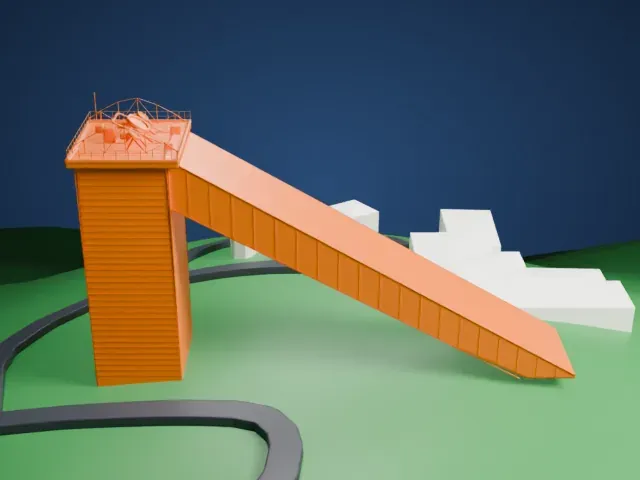 West
West
- Long diagonal shaft
- A long diagonal shaft slopes down the hillside from the tower. Layers of 0.12 to 0.16 mm keep its sloping edges clean, and printing slowly helps tall, narrow parts.
- Lattice frame and railings on top
- A lattice frame and thin railings sit on top of the tower. Print friendly adapts these thin parts to the print scale; Full detail keeps them, which suits a larger print.
- One piece with the ground
- The McMath–Pierce Solar Telescope is joined to the ground in the exported file, and the four-side check found no floating parts, so nothing needs gluing.
- Pick the detail for your nozzle
- In the Buildings settings, set Landmark detail to Print friendly to adapt thin parts and small details to the print scale. Full detail keeps every modeled feature, for larger prints or a finer nozzle.
- Colors
- Buildings, roads, water and ground arrive as separate filament slots in the 3MF. The McMath–Pierce Solar Telescope takes the building color.
- File format
- You get a 3MF for Bambu Studio, OrcaSlicer or PrusaSlicer. Any of them can save it as STL if you need one.
About this model
The McMath–Pierce Solar Telescope is one of more than 2,300 landmark models in Mini Skyline. They are made with AI, and each one is checked from four sides in its real surroundings before release. Everything around it is built from OpenStreetMap and Overture map data. If you would rather print the shape from map data, turn off Landmark models in the Buildings settings.
Common questions
Is there a McMath–Pierce Solar Telescope STL I can download?
Mini Skyline builds the file for you in your browser and exports 3MF, which every major slicer opens. If you need an STL, open the 3MF in your slicer and export it from there.
How big can I print it?
Any print size from 40 mm across. The McMath–Pierce Solar Telescope grows with the print: about 9 mm tall on the default 160 mm print. For a model larger than your printer bed, Project Mode splits the area into tiles.
Is it free?
Yes. Generation runs in your browser, with no account and nothing behind a paywall.