3D print the Nicholas U. Mayall Telescope
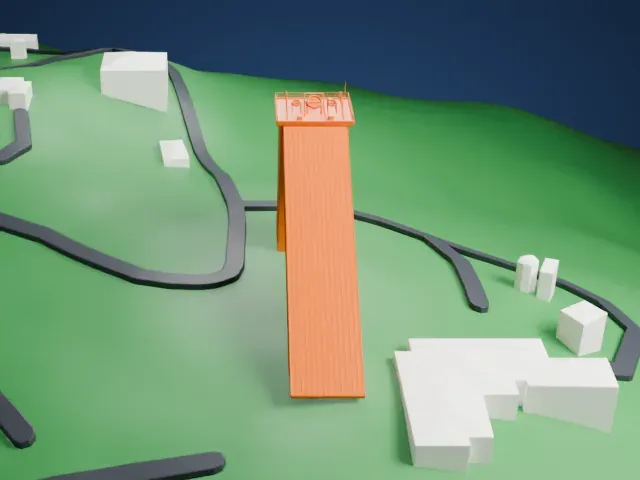
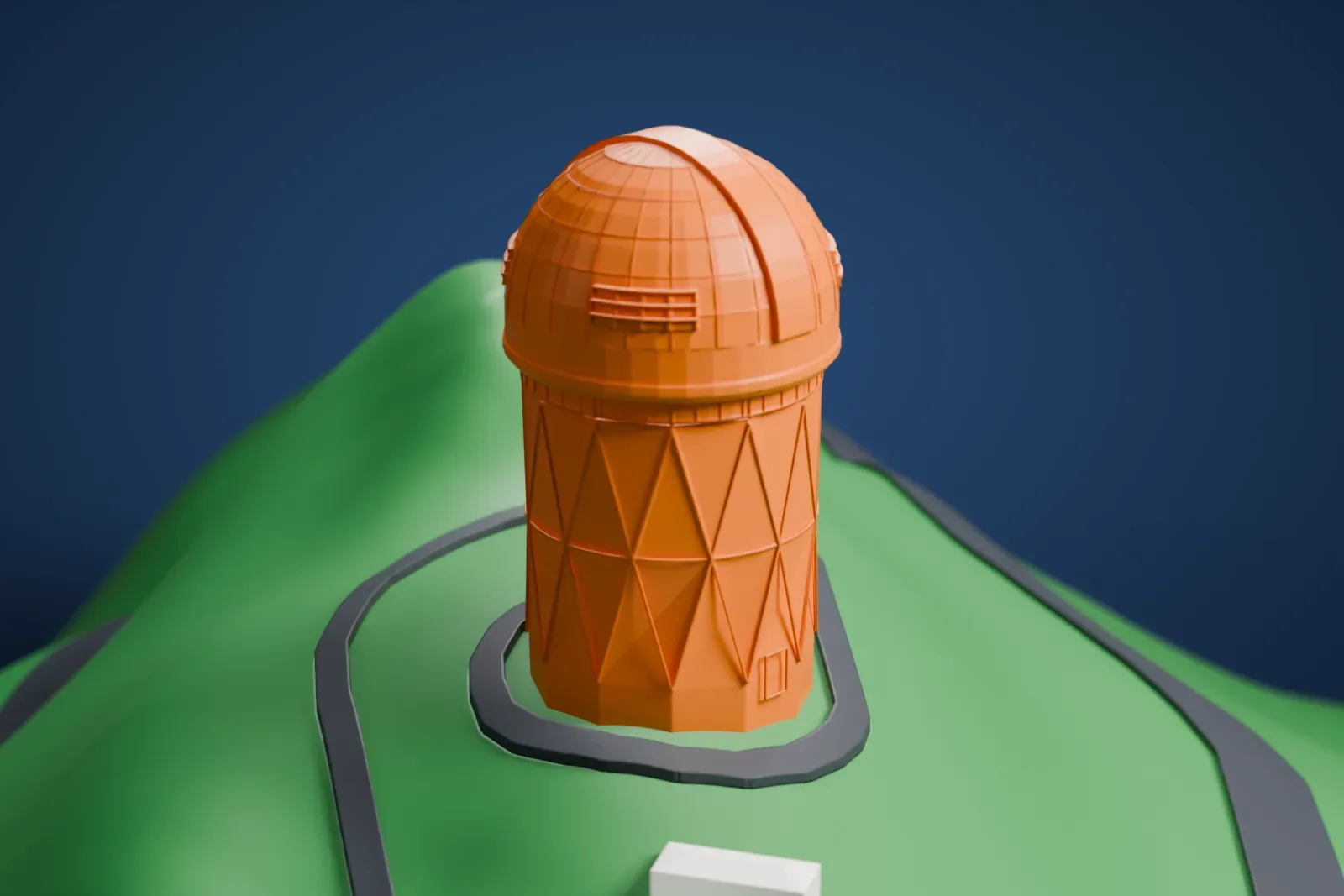
A free, printable model of the Nicholas U. Mayall Telescope, a domed tower with a diamond pattern on its walls, and the green hilltop around it, generated from real map data in your browser.
Free, in your browser. Exports a slicer-ready 3MF.
About the Nicholas U. Mayall Telescope
The Nicholas U. Mayall Telescope, or Mayall 4-meter Telescope, is a reflector of four-meter (158 inches) aperture, sited at Kitt Peak National Observatory in Arizona. It is named for Nicholas U. Mayall, who directed the observatory for more than a decade. First light came on February 27, 1973, and it was the world's second largest telescope then, behind the 5 m Hale and ahead of the 3 m Shane. The dedication took place on June 20, 1973, once Mayall had retired as director.
Mayall proposed a larger telescope for Kitt Peak in 1961. Work on the site started in 1968, and the mirror arrived there by 1971. Owens-Illinois made it of fused quartz, a material valued for its low thermal expansion. The Kitt Peak optical lab ground the blank. Its shape is hyperboloidal, f/2.7, made from a fused quartz disk two feet (61 cm, or 24 in) thick and held in a mirror cell of advanced design.
The field of view at prime focus is 3.2 degrees, which is six times that of the Hale reflector. The telescope hosts the Dark Energy Spectroscopic Instrument, whose installation was completed in late 2019, with five thousand fiber optic sensors that can each be targeted robotically at the focal plane. In Chile, the Cerro Tololo Inter-American Observatory later gained an identical instrument, the Víctor M. Blanco Telescope.
How it prints
Make this print opens the generator on a 600 m square around the landmark. Buildings print at close to true scale, so the landmark grows with the print size.
| Print size | Landmark height | Scale |
|---|---|---|
| 160 mm default | 16 mm | 1:3,750 |
| 200 mm | 21 mm | 1:3,000 |
| 256 mm | 26 mm | 1:2,344 |
-
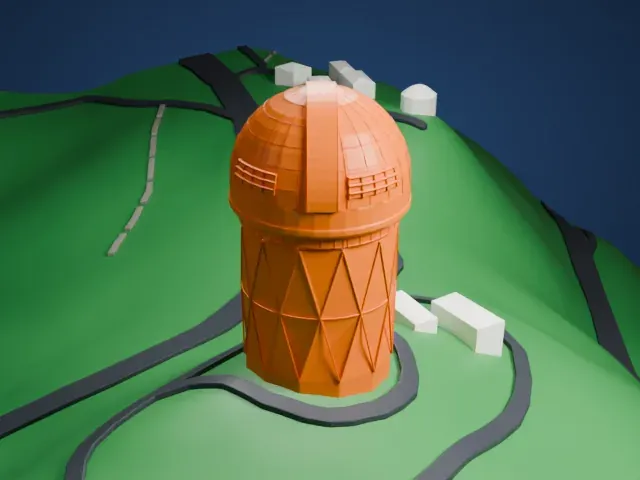 North
North
-
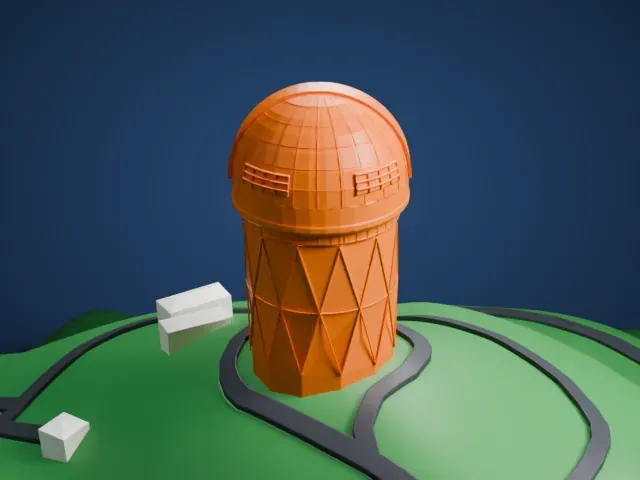 East
East
-
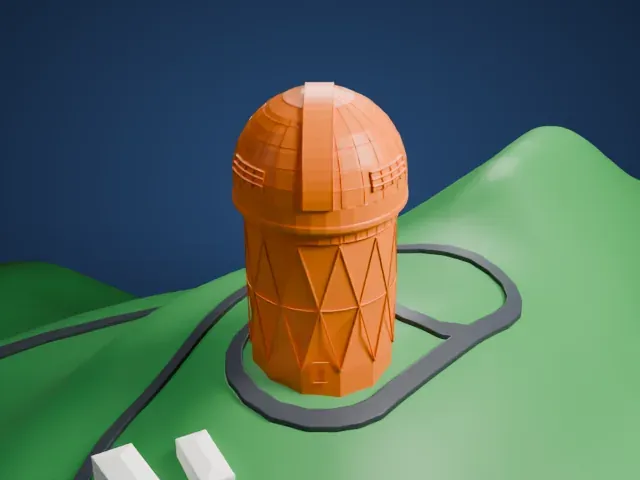 South
South
-
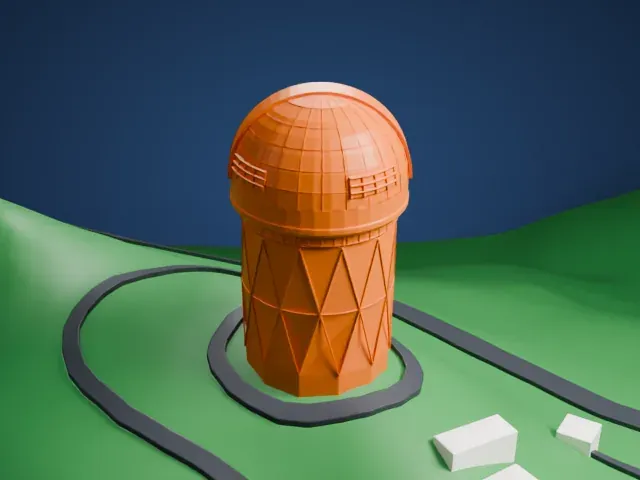 West
West
- Diamond pattern on the tower
- A pattern of diamond-shaped panels covers the tower walls. Layers of 0.12–0.16 mm keep the edges crisp, and a larger print size keeps the panels distinct.
- Dome with a narrow strip
- A narrow vertical strip runs up the rounded dome, with small railings at its base. Use Full detail with a fine nozzle, or a larger print, to keep these small parts.
- Pick the detail for your nozzle
- In the Buildings settings, set Landmark detail to Print friendly to adapt thin parts and small details to the print scale. Full detail keeps every modeled feature, for larger prints or a finer nozzle.
- Colors
- Buildings, roads, water and ground arrive as separate filament slots in the 3MF. The Nicholas U. Mayall Telescope takes the building color.
- File format
- You get a 3MF for Bambu Studio, OrcaSlicer or PrusaSlicer. Any of them can save it as STL if you need one.
About this model
The Nicholas U. Mayall Telescope is one of more than 2,300 landmark models in Mini Skyline. They are made with AI, and each one is checked from four sides in its real surroundings before release. Everything around it is built from OpenStreetMap and Overture map data. If you would rather print the shape from map data, turn off Landmark models in the Buildings settings.
Common questions
Is there a Nicholas U. Mayall Telescope STL I can download?
Mini Skyline builds the file for you in your browser and exports 3MF, which every major slicer opens. If you need an STL, open the 3MF in your slicer and export it from there.
How big can I print it?
Any print size from 40 mm across. The Nicholas U. Mayall Telescope grows with the print: about 16 mm tall on the default 160 mm print. For a model larger than your printer bed, Project Mode splits the area into tiles.
Is it free?
Yes. Generation runs in your browser, with no account and nothing behind a paywall.