3D print Monticello
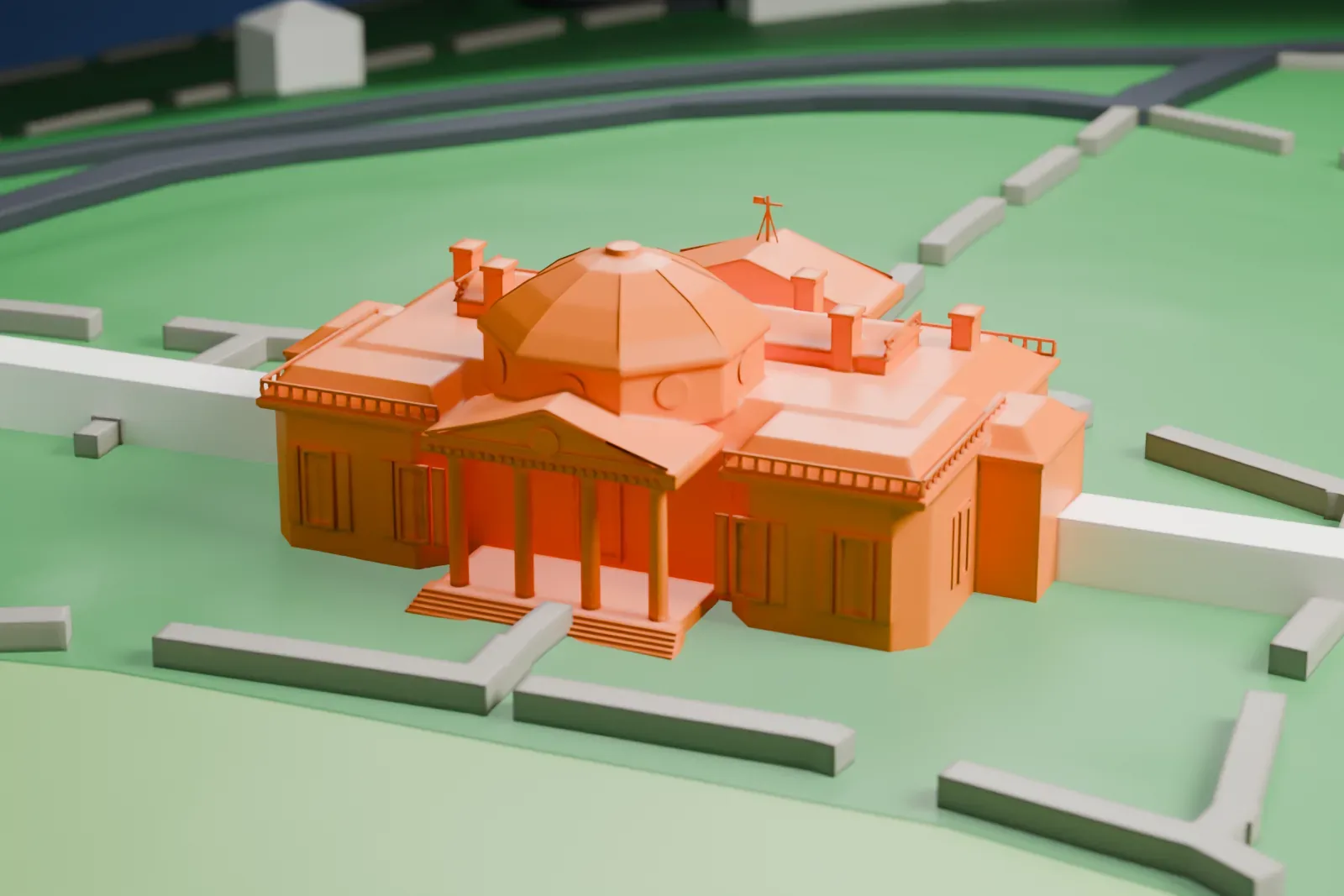
A free, printable model of the house, its dome and columned porticos, and the green grounds around it, generated from real map data in your browser.
Free, in your browser. Exports a slicer-ready 3MF.
About Monticello
Monticello was Thomas Jefferson's plantation and main home. Jefferson was a Founding Father and the third US president, and he wrote the Declaration of Independence. The estate lies in the Piedmont region of Virginia, just outside Charlottesville, on a peak that is 260 m (850 ft) high in the Southwest Mountains. The name comes from an Italian phrase meaning little mountain. The plantation originally covered 20 km2 (5,000 acres), and its tobacco and mixed crops were grown with the forced labor of enslaved people.
Jefferson designed the main house himself, using neoclassical principles pioneered by the Italian Renaissance architect Andrea Palladio. Work began on the first version in 1768. In 1794 he started rebuilding it with ideas he had gathered in Europe, and the remodeling ran through most of his presidency (1801–1809). He added a central hallway and a parallel row of rooms, more than doubling its area, and put an octagonal dome over the west front instead of a portico on the second story. He kept working on the house until his death in 1826.
A broad central hall and windows set in line with each other were designed to let a cooling breeze move through the house, while the octagonal cupola pulls hot air upward and out. After Jefferson's death the property changed hands several times. Uriah P. Levy, a U.S. Navy commodore, bought it in 1834 for $2,500, and in 1923 it passed to the Thomas Jefferson Foundation, which runs the site as a house museum and an educational institution. In 1987 the house and the nearby University of Virginia, another Jefferson design, were listed together as a UNESCO World Heritage Site.
How it prints
Make this print opens the generator on a 600 m square around the landmark. Buildings print at close to true scale, so the landmark grows with the print size.
| Print size | Landmark height | Scale |
|---|---|---|
| 160 mm default | 4 mm | 1:3,750 |
| 200 mm | 5 mm | 1:3,000 |
| 256 mm | 6 mm | 1:2,344 |
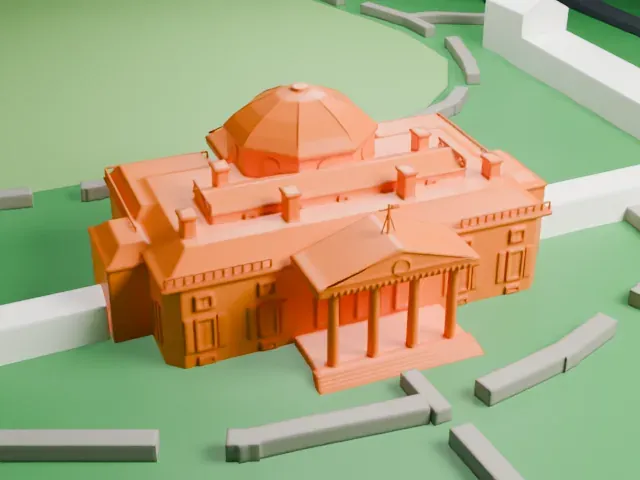
-
 North
North
-
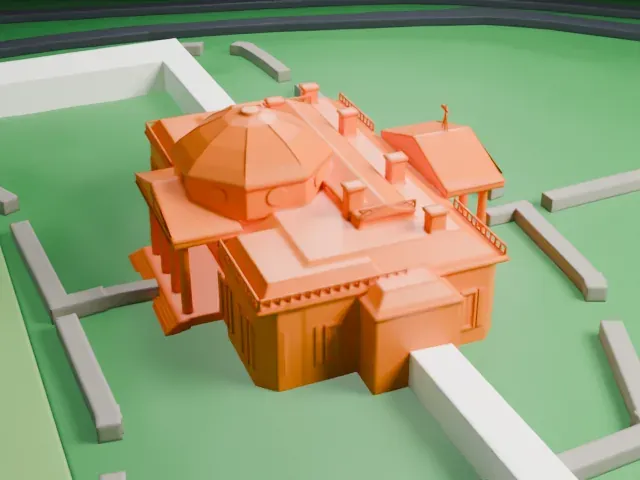
 East
East
-
 South
South
-
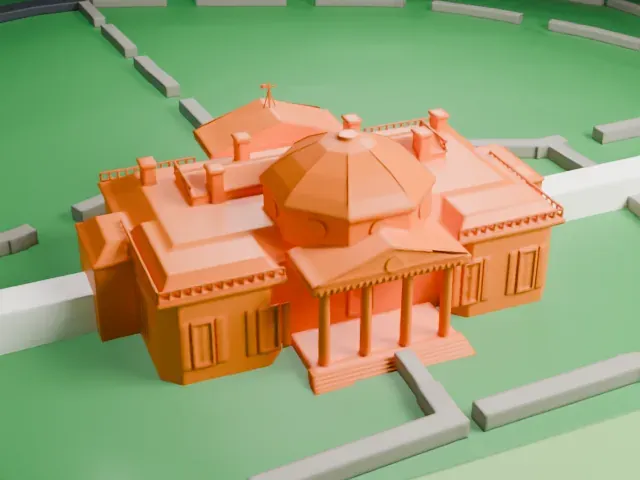 West
West
- Porticos on slender columns
- The porches stand on thin columns under pediments. A bigger print keeps them as separate columns, and Print friendly adapts them to the print scale when the model is small.
- Dome and chimneys on the roof
- The octagonal dome and the small chimneys are fine roof details. Printing slowly and using layers of 0.12 to 0.16 mm helps keep their edges crisp.
- One piece with the ground
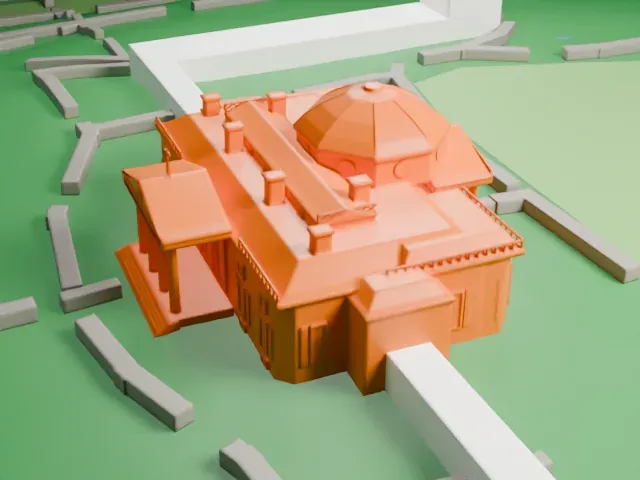
- Monticello is joined to the ground in the exported file, and the four-side check found no floating parts, so nothing needs gluing.
- Pick the detail for your nozzle
- In the Buildings settings, set Landmark detail to Print friendly to adapt thin parts and small details to the print scale. Full detail keeps every modeled feature, for larger prints or a finer nozzle.
- Colors
- Buildings, roads, water and ground arrive as separate filament slots in the 3MF. Monticello takes the building color.
- File format
- You get a 3MF for Bambu Studio, OrcaSlicer or PrusaSlicer. Any of them can save it as STL if you need one.
About this model
Monticello is one of more than 2,300 landmark models in Mini Skyline. They are made with AI, and each one is checked from four sides in its real surroundings before release. Everything around it is built from OpenStreetMap and Overture map data. If you would rather print the shape from map data, turn off Landmark models in the Buildings settings.
Common questions
Is there a Monticello STL I can download?
Mini Skyline builds the file for you in your browser and exports 3MF, which every major slicer opens. If you need an STL, open the 3MF in your slicer and export it from there.
How big can I print it?
Any print size from 40 mm across. Monticello grows with the print: about 4 mm tall on the default 160 mm print. For a model larger than your printer bed, Project Mode splits the area into tiles.
Is it free?
Yes. Generation runs in your browser, with no account and nothing behind a paywall.