3D print the Mortuary Temple of Hatshepsut
A free, printable model of the Mortuary Temple of Hatshepsut, its terraces, ramps and colonnades, and the desert slopes behind it, generated from real map data in your browser.
Free, in your browser. Exports a slicer-ready 3MF.
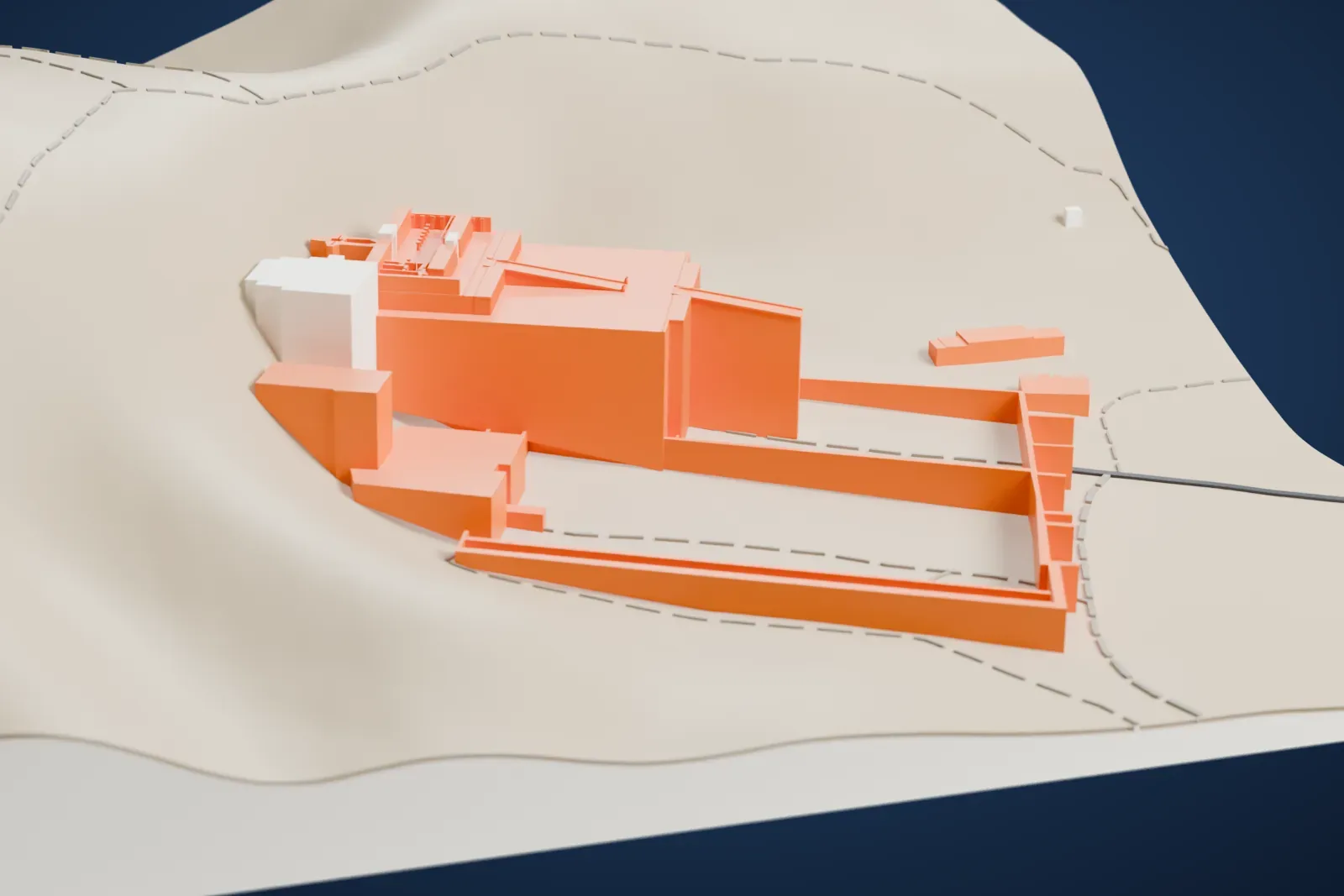
About the Mortuary Temple of Hatshepsut
The mortuary temple of Hatshepsut dates to the reign of that pharaoh of the Eighteenth Dynasty of Egypt. It lies opposite the city of Luxor and is considered a masterpiece of ancient architecture. Three massive terraces climb from the desert floor against the cliffs at Deir el-Bahari. Work ran from the seventh to the twentieth year of Hatshepsut's reign, and the plans were revised several times. The design was heavily influenced by the Eleventh Dynasty's neighboring Temple of Mentuhotep II, built six centuries before.
A valley temple at the desert's edge, 1 km east, is joined to the complex by a causeway that is 1 km (0.62 mi) long and 37 m (121 ft) wide. The builders used limestone almost throughout, along with some red granite and sandstone, and one architrave is violet sandstone. The lowest terrace is 75 m (246 ft) wide and 120 m (390 ft) deep. At the end of the main axis stood a shrine of Amun-Re, which received his barque at the Beautiful Festival of the Valley each May. Two more shrines honored Hathor and Anubis, and altogether the temple held five cult sites.
Two decades after Hatshepsut's death, Thutmose III directed a brief but intense campaign against references to her rule, and the reasons remain a mystery. Saint Phoibammon's Coptic monastery was founded at the temple sometime from the 6th to the 8th century AD. Édouard Naville directed a full excavation for the Egypt Exploration Fund between 1893 and 1906, and the Polish Centre of Mediterranean Archaeology has done consolidation and restoration work across the temple since 1961.
How it prints
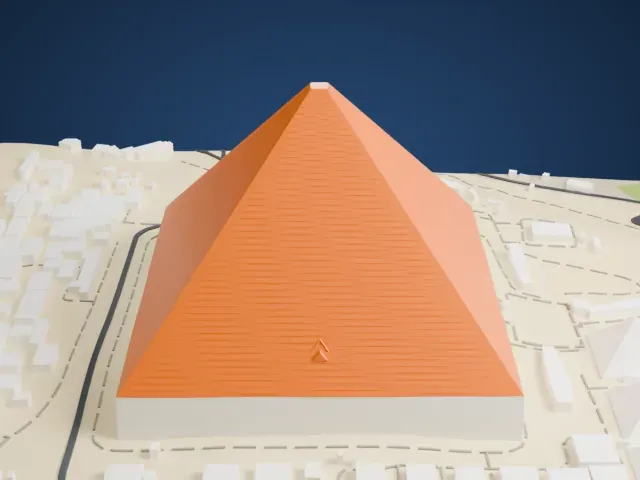
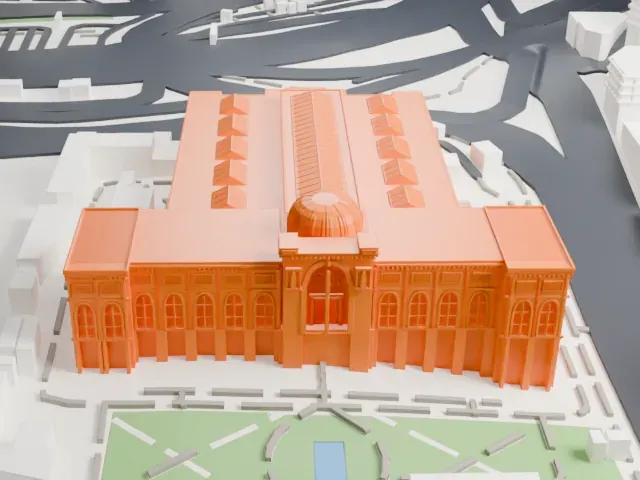
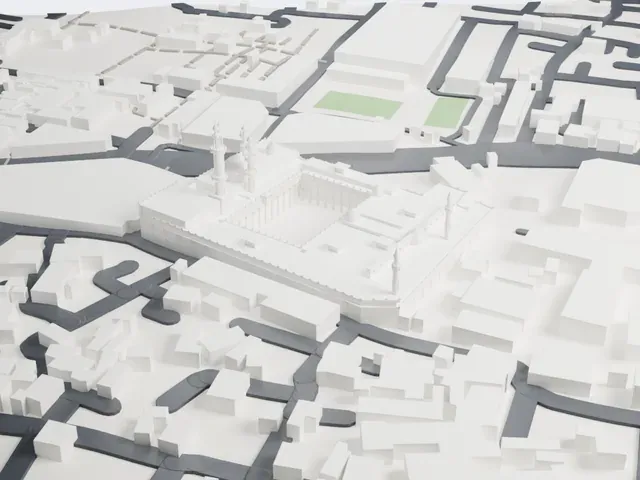
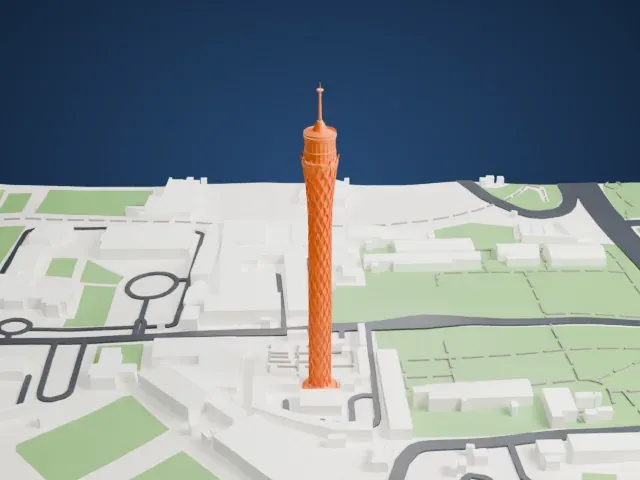
Make this print opens the generator on a 600 m square around the landmark. Buildings print at close to true scale, so the landmark grows with the print size.
| Print size | Landmark height | Scale |
|---|---|---|
| 160 mm default | 21 mm | 1:3,750 |
| 200 mm | 26 mm | 1:3,000 |
| 256 mm | 33 mm | 1:2,344 |
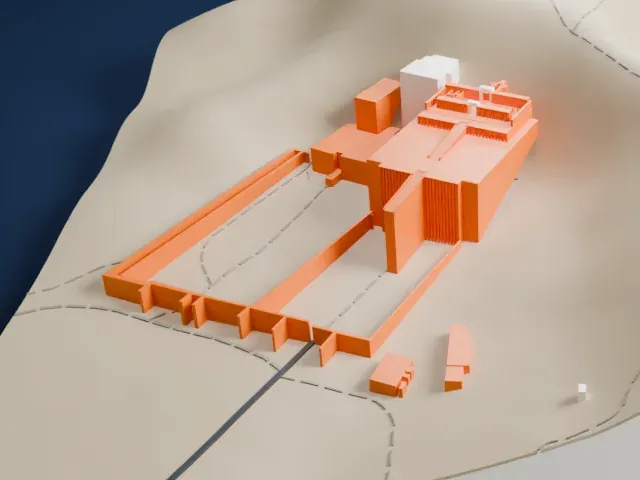
-
 North
North
-
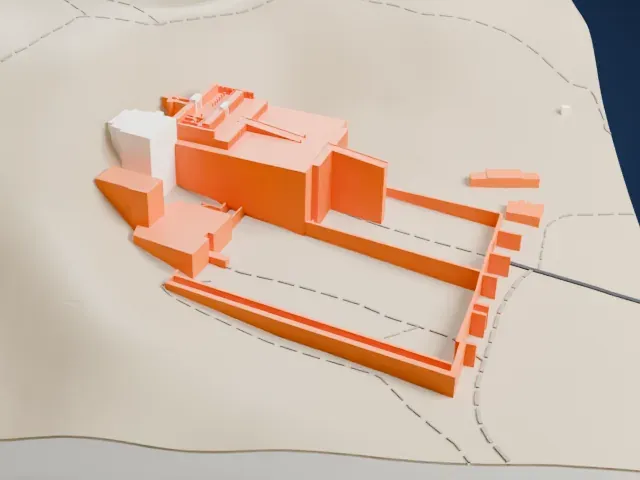
 East
East
-
 South
South
-
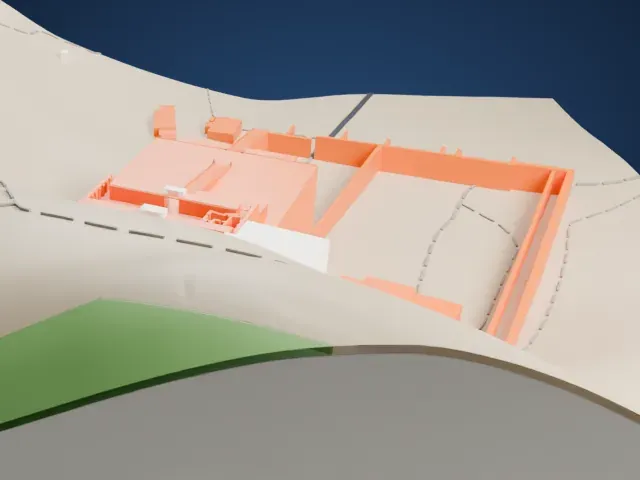 West
West
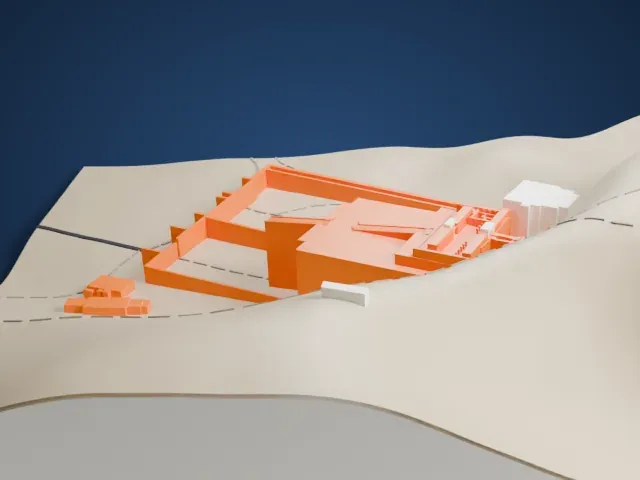
- Rows of slender columns
- Each terrace is fronted by rows of thin columns. Print friendly adapts them to the print scale; Full detail keeps every column on a larger print.
- Stepped terraces and ramps
- Three flat terraces are linked by narrow ramps. Layers of 0.12–0.16 mm keep the steps and ramp edges crisp, and a larger print size gives the ramps more width.
- Pick the detail for your nozzle
- In the Buildings settings, set Landmark detail to Print friendly to adapt thin parts and small details to the print scale. Full detail keeps every modeled feature, for larger prints or a finer nozzle.
- Colors
- Buildings, roads, water and ground arrive as separate filament slots in the 3MF. The Mortuary Temple of Hatshepsut takes the building color.
- File format
- You get a 3MF for Bambu Studio, OrcaSlicer or PrusaSlicer. Any of them can save it as STL if you need one.
About this model
The Mortuary Temple of Hatshepsut is one of more than 2,300 landmark models in Mini Skyline. They are made with AI, and each one is checked from four sides in its real surroundings before release. Everything around it is built from OpenStreetMap and Overture map data. If you would rather print the shape from map data, turn off Landmark models in the Buildings settings.
Common questions
Is there a Mortuary Temple of Hatshepsut STL I can download?
Mini Skyline builds the file for you in your browser and exports 3MF, which every major slicer opens. If you need an STL, open the 3MF in your slicer and export it from there.
How big can I print it?
Any print size from 40 mm across. The Mortuary Temple of Hatshepsut grows with the print: about 21 mm tall on the default 160 mm print. For a model larger than your printer bed, Project Mode splits the area into tiles.
Is it free?
Yes. Generation runs in your browser, with no account and nothing behind a paywall.