3D print the National Museum of the United States Air Force Hangars
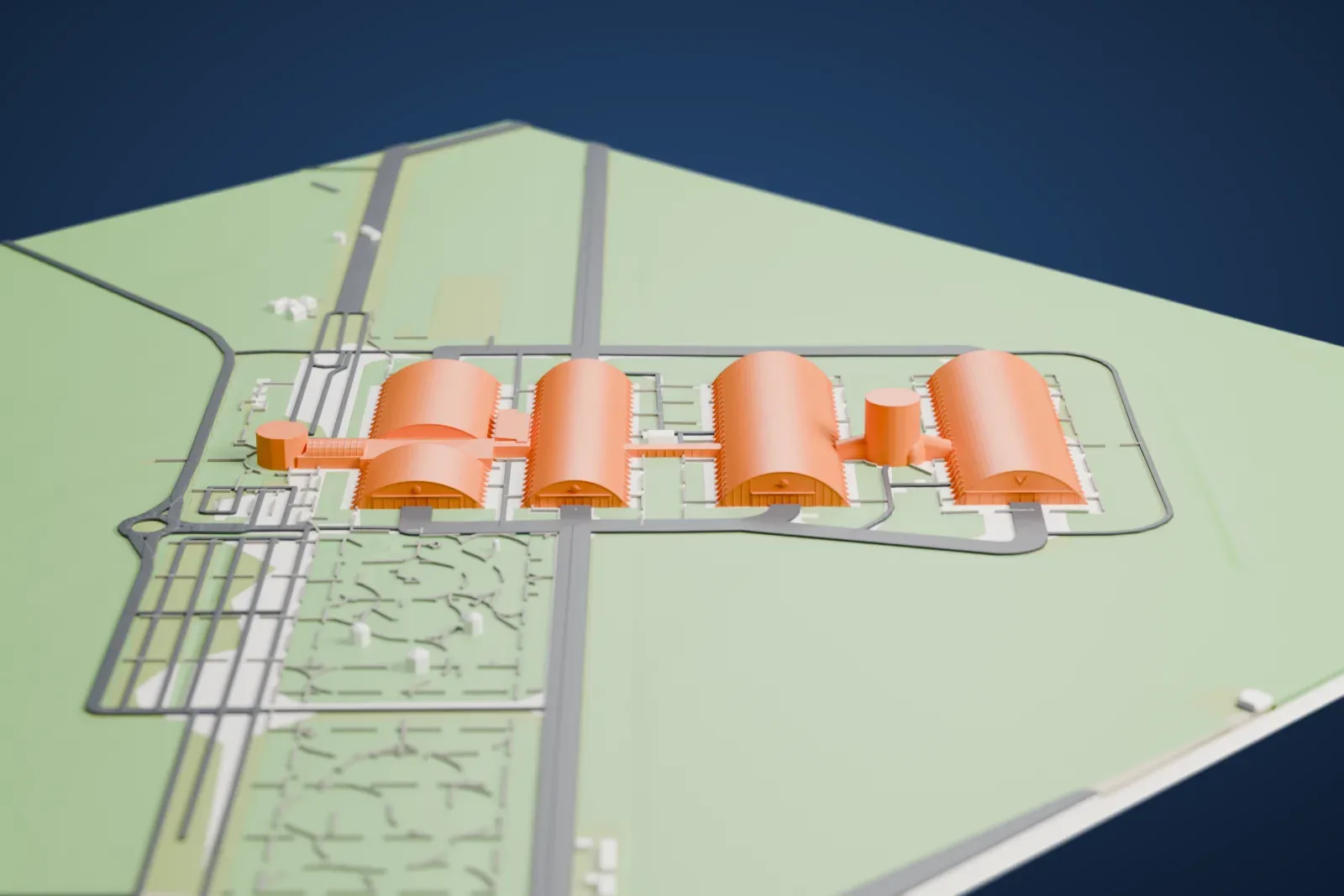
A free, printable model of the museum's arched hangars and the open grassland, roads and paved strips around them, generated from real map data in your browser.
-
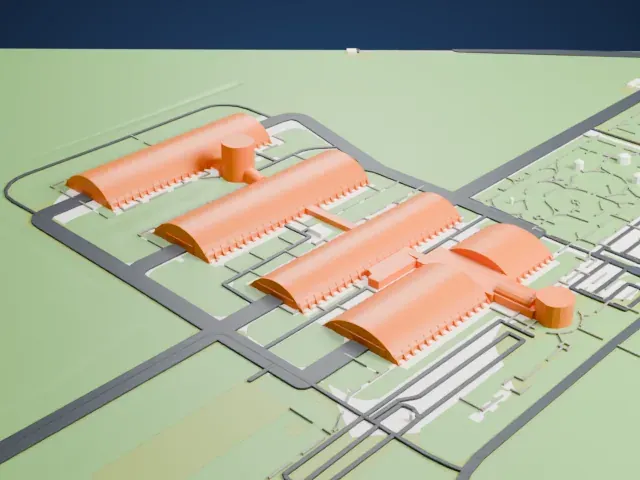 North
-
 East
-
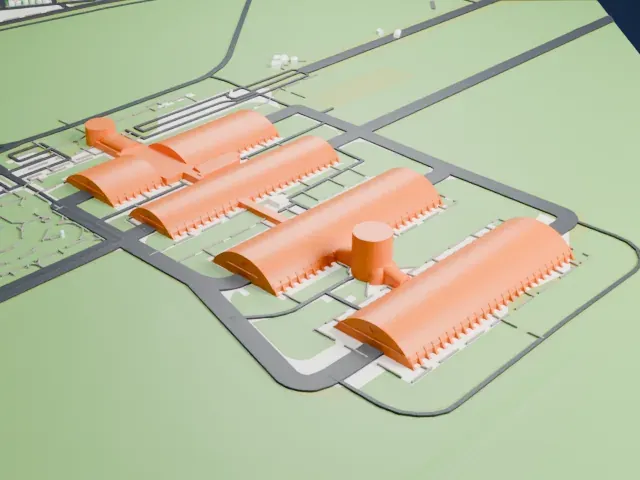 South
-
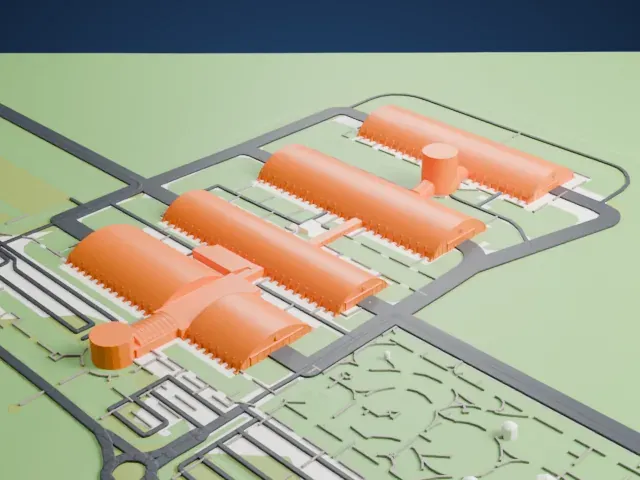 West
- On a 160 mm print
- 6 mm
- Scale
- 1:7,813
6 mm tall on a 160 mm print
Make this print opens the generator on a 1250 m square around the landmark. Buildings print at close to true scale, so the landmark grows with the print size.
- Long arched roofs
The hangars are long barrel-vault roofs with fine ribs along their edges. Print friendly adapts these small ribs to the print scale; Full detail keeps them, which suits a larger print.
- Wide, low layout
The buildings are low and spread across a broad, flat site. A larger print size makes the arched roofs easier to read, and layers of 0.12 to 0.16 mm keep their curves smooth.
- One piece with the ground
The National Museum of the United States Air Force Hangars is joined to the ground in the exported file, and the four-side check found no floating parts, so nothing needs gluing.
- Pick the detail for your nozzle
In the Buildings settings, set Landmark detail to Print friendly to adapt thin parts and small details to the print scale. Full detail keeps every modeled feature, for larger prints or a finer nozzle.
- Colors
Buildings, roads, water and ground arrive as separate filament slots in the 3MF. The National Museum of the United States Air Force Hangars takes the building color.
- File format
You get a 3MF for Bambu Studio, OrcaSlicer or PrusaSlicer. Any of them can save it as STL if you need one.
About the National Museum of the United States Air Force Hangars
The United States Air Force's national museum sits at Wright-Patterson Air Force Base, northeast of Dayton, Ohio, at a distance of six miles (9.7 km). It ranks as the world's oldest and largest military aviation museum, displaying more than 360 aircraft and missiles. The collection began in 1923 at Dayton's McCook Field, where the Engineering Division started preserving technical artifacts. It opened to the public in 1954, in a former engine overhaul hangar.
Charles F. Kettering's son Eugene led the effort to build a permanent building and served as the first chairman of the Air Force Museum Foundation's board. Virginia, his widow, carried on after his death in 1969, and the building opened in 1971. Hangars were added in 1988, 2003 and 2016. The fourth building, 224,000 square feet (20,800 m2), houses the Space Gallery, the Presidential Aircraft Gallery and the Global Reach Gallery. The Foundation paid for it entirely with private donations, for $40.8 million.
The collection includes Endeavour, the Apollo 15 Command Module, which circled the Moon 74 times in 1971. Among its rare aircraft are a Convair B-36 Peacemaker, one of four that survive; the only surviving XB-70 Valkyrie; and Bockscar, the B-29 Superfortress from which the Fat Man atomic bomb fell on Nagasaki in the final days of World War II. Planes used by Presidents Roosevelt, Truman and Eisenhower are on show, and Kennedy, Johnson and Nixon regularly used the centerpiece, SAM 26000, a modified Boeing 707.
About this model
The National Museum of the United States Air Force Hangars is one of more than 4,300 landmark models in Mini Skyline. They are made with AI, and each one is checked from four sides in its real surroundings before release. Everything around it is built from OpenStreetMap and Overture map data. If you would rather print the shape from map data, turn off Landmark models in the Buildings settings.
Keep exploring