3D print Neyland Stadium
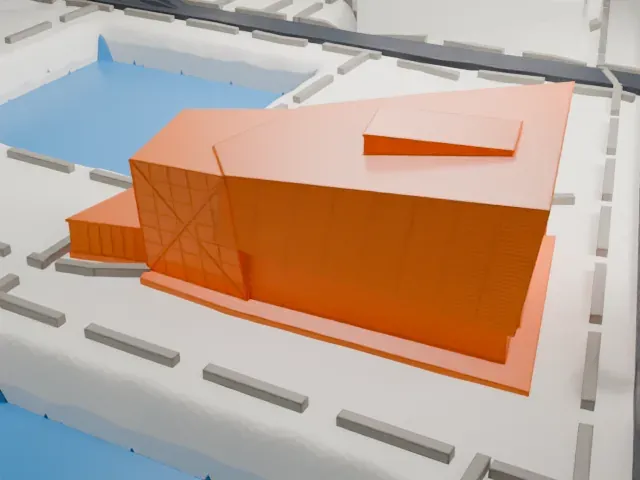
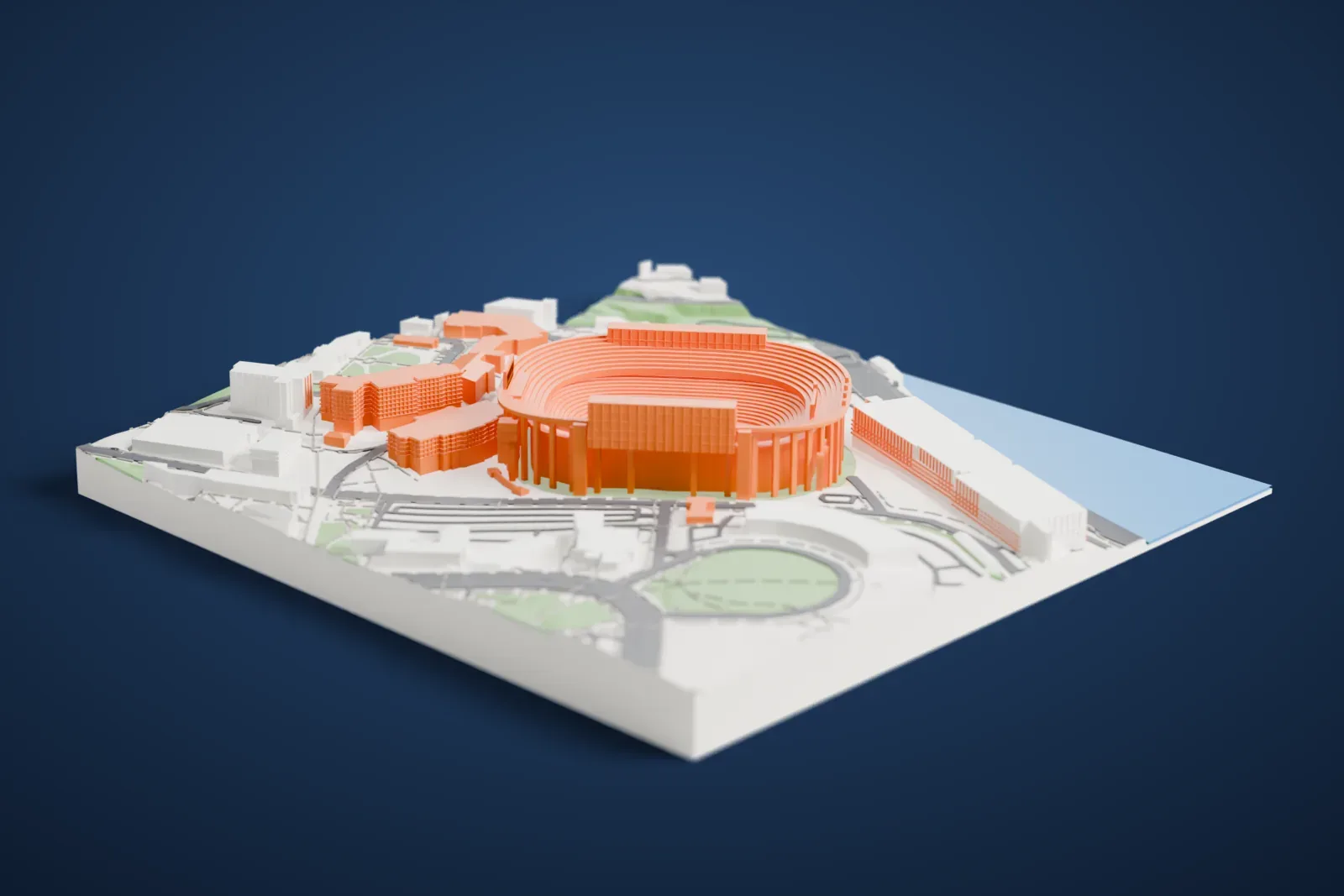
A free, printable model of the stadium's tiered bowl and arched outer wall, with the water, buildings and roads around it, generated from real map data in your browser.
Free, in your browser. Exports a slicer-ready 3MF.
About Neyland Stadium
Neyland Stadium, in Knoxville, Tennessee, United States, is mainly the venue for Tennessee Volunteers football. It also hosts large conventions and has been the site of several National Football League exhibition games. The official capacity is 101,915, and its size puts it sixth among stadiums in the United States and eighth in the world. It was built in 1921 as Shields–Watkins Field, a name the playing surface keeps, and has been through 16 expansion projects. Its name honors Robert Neyland, who led the University of Tennessee football program as head coach during three stints between 1926 and 1952.
The idea for the stadium dates to 1919. Colonel W.S. Shields, a University of Tennessee trustee who headed City National Bank in Knoxville, supplied the starting funds. The first version, which forms the lower level of the West Stands, was named Shields–Watkins Field to honor Shields and his wife, Alice Watkins-Shields. When the project ran out of money, students and faculty finished the field themselves over two days. The first Tennessee football game there was played on September 24, 1921, a 27–0 win over Emory & Henry.
The stadium took its present name in 1962, after Neyland's death. A "horseshoe" of 15,000 seats closed off the south end zone in 1948, and the last major expansion, finished in 1996, added the North Upper Deck, which completed the enclosure of the upper level. In 1968 it became one of the first stadiums with an artificial turf surface, which stayed until natural grass returned in 1994. The largest crowd on record, 109,061, came on September 18, 2004, for a 30–28 Tennessee win over Florida.
How it prints
Make this print opens the generator on a 600 m square around the landmark. Buildings print at close to true scale, so the landmark grows with the print size.
| Print size | Landmark height | Scale |
|---|---|---|
| 160 mm default | 22 mm | 1:3,750 |
| 200 mm | 28 mm | 1:3,000 |
| 256 mm | 36 mm | 1:2,344 |
-
 North
North
-
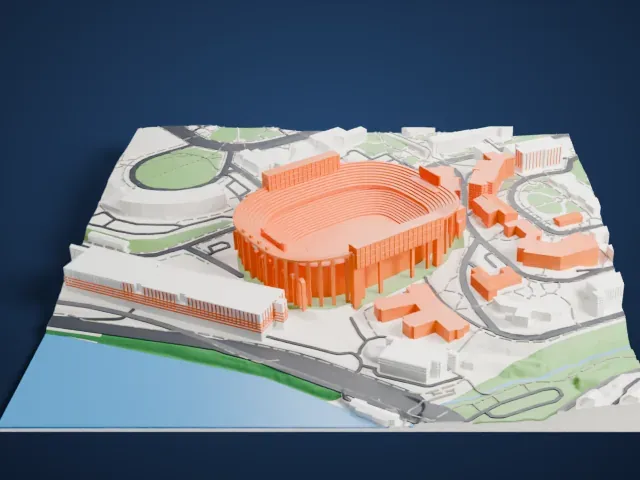 East
East
-
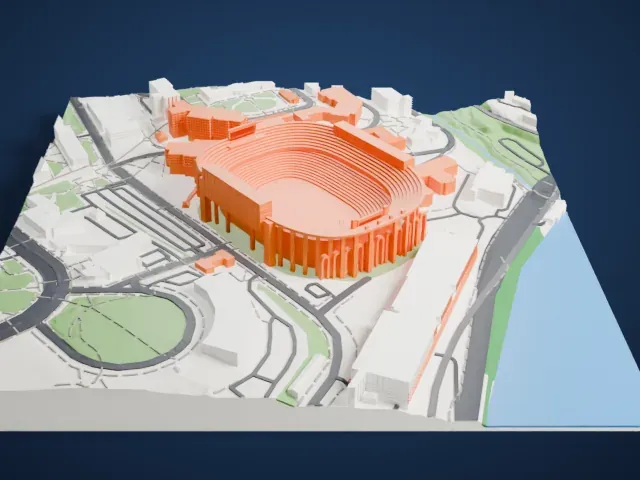 South
South
-
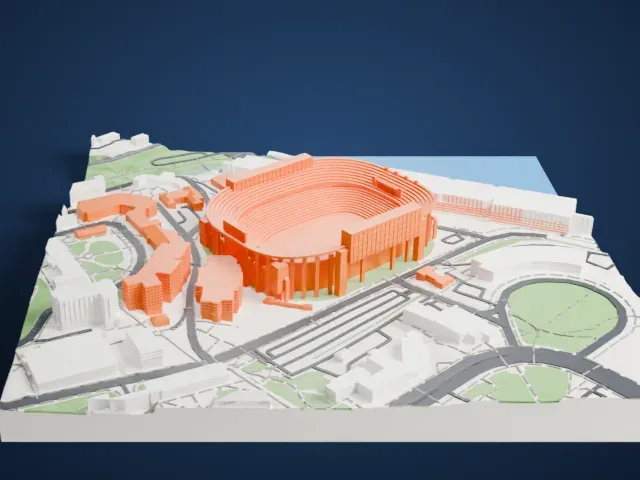 West
West
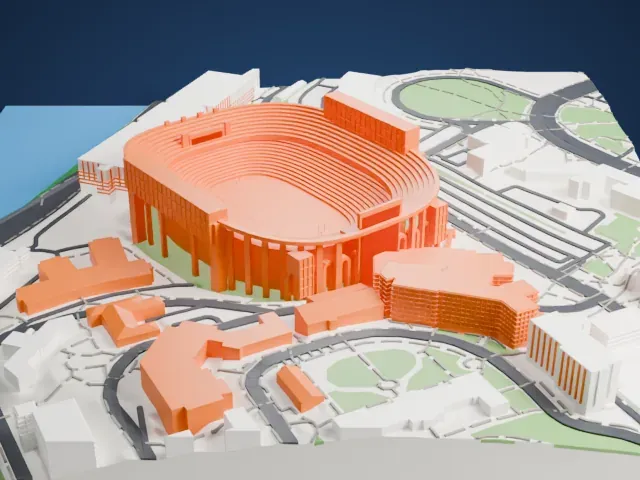
- Arches and slim columns
- The outer wall is a ring of tall columns and arched openings. Print friendly adapts the thin columns to your print scale; Full detail keeps every arch, which suits a larger print.
- Fine stepped seating rows
- The bowl is built from many narrow stepped rows. Layers of 0.12 to 0.16 mm keep their edges crisp, and printing larger gives each row more width.
- One piece with the ground
- Neyland Stadium is joined to the ground in the exported file, and the four-side check found no floating parts, so nothing needs gluing.
- Pick the detail for your nozzle
- In the Buildings settings, set Landmark detail to Print friendly to adapt thin parts and small details to the print scale. Full detail keeps every modeled feature, for larger prints or a finer nozzle.
- Colors
- Buildings, roads, water and ground arrive as separate filament slots in the 3MF. Neyland Stadium takes the building color.
- File format
- You get a 3MF for Bambu Studio, OrcaSlicer or PrusaSlicer. Any of them can save it as STL if you need one.
About this model
Neyland Stadium is one of more than 2,300 landmark models in Mini Skyline. They are made with AI, and each one is checked from four sides in its real surroundings before release. Everything around it is built from OpenStreetMap and Overture map data. If you would rather print the shape from map data, turn off Landmark models in the Buildings settings.
Common questions
Is there a Neyland Stadium STL I can download?
Mini Skyline builds the file for you in your browser and exports 3MF, which every major slicer opens. If you need an STL, open the 3MF in your slicer and export it from there.
How big can I print it?
Any print size from 40 mm across. Neyland Stadium grows with the print: about 22 mm tall on the default 160 mm print. For a model larger than your printer bed, Project Mode splits the area into tiles.
Is it free?
Yes. Generation runs in your browser, with no account and nothing behind a paywall.