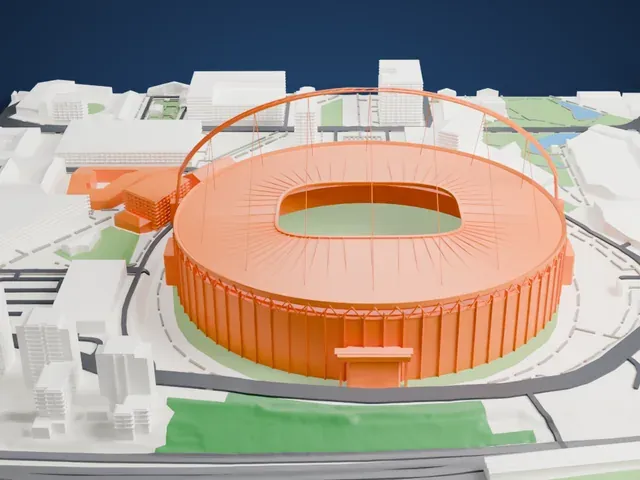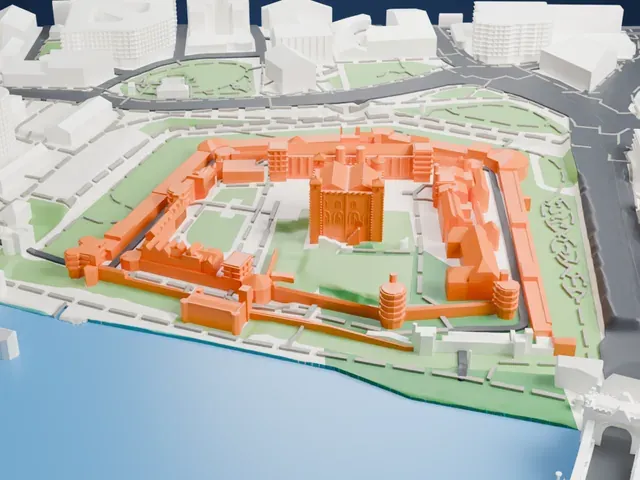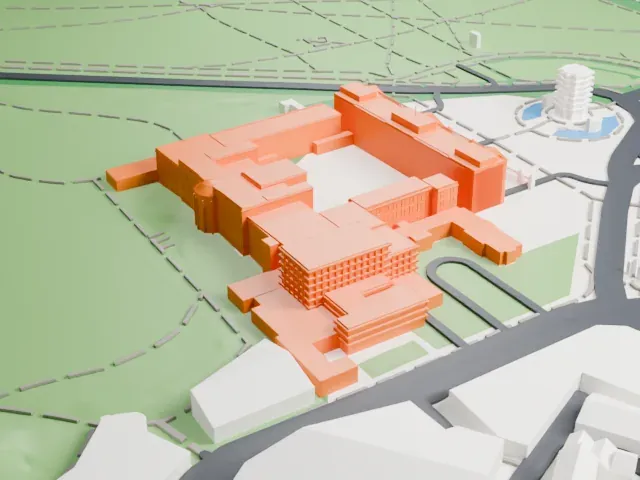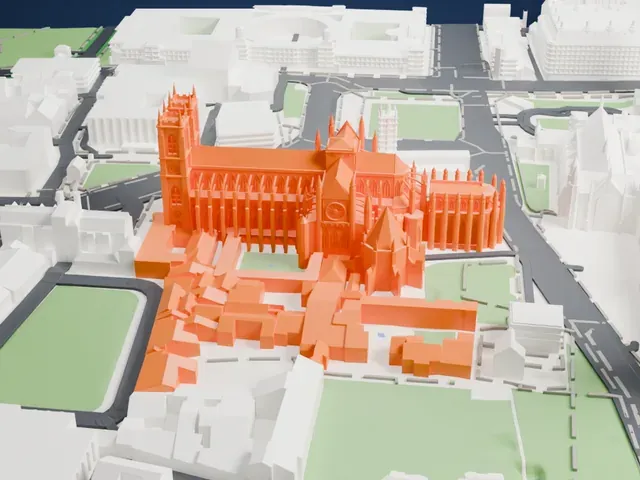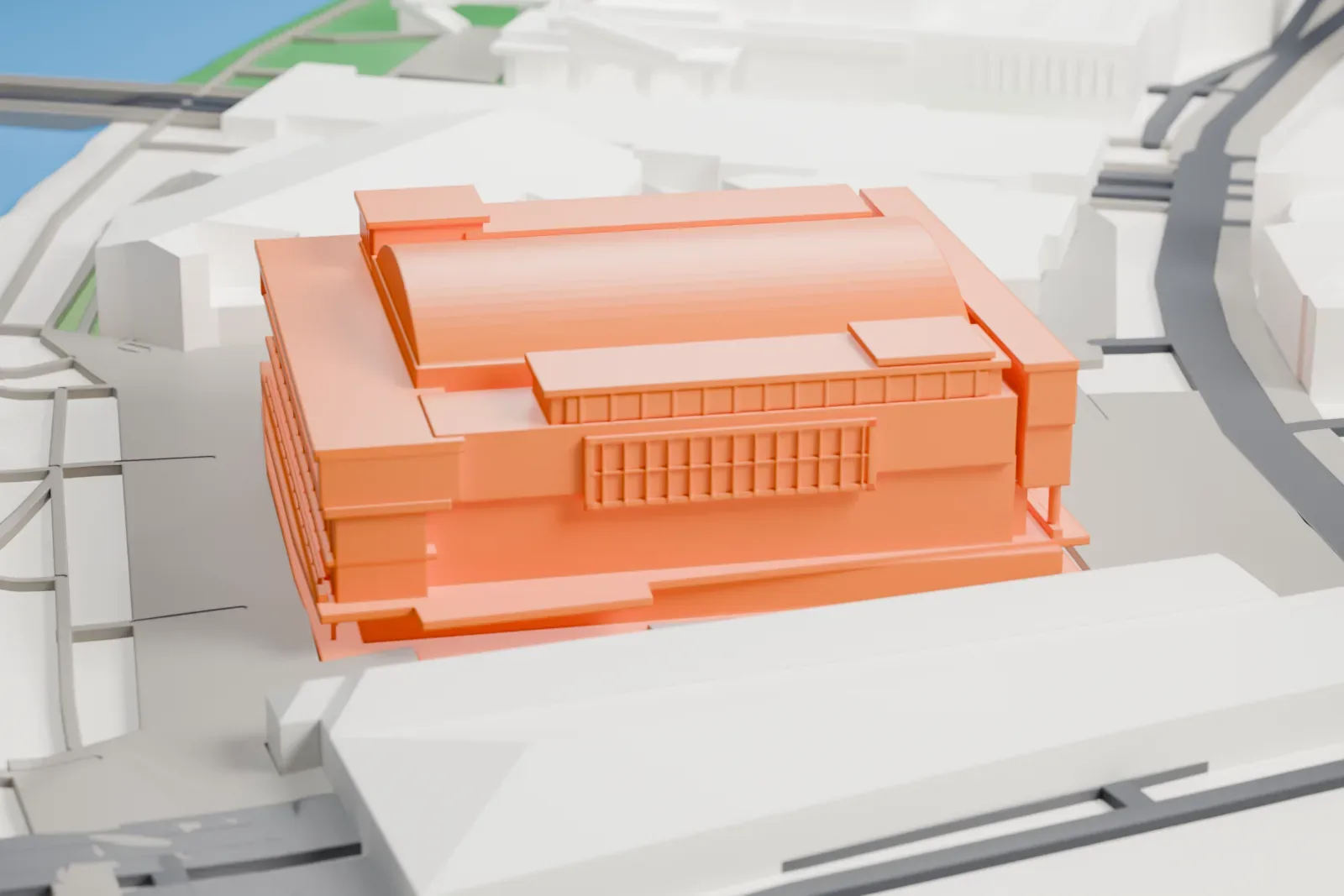
Royal Festival Hall in 3D
The Royal Festival Hall appears in city models you make here; its design may still be protected, so it isn't offered as a separate download.
-
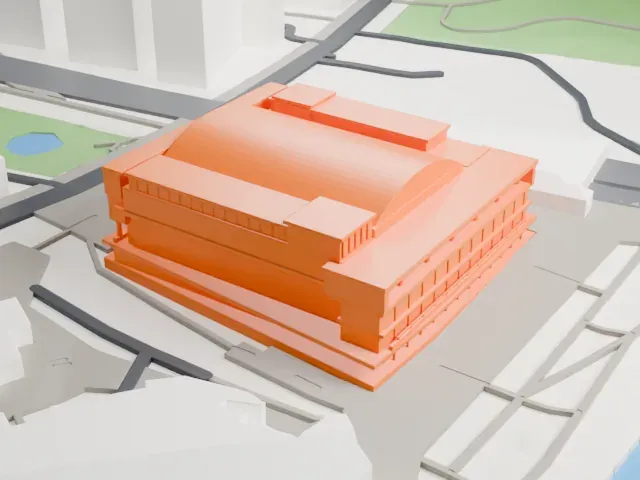 North
-
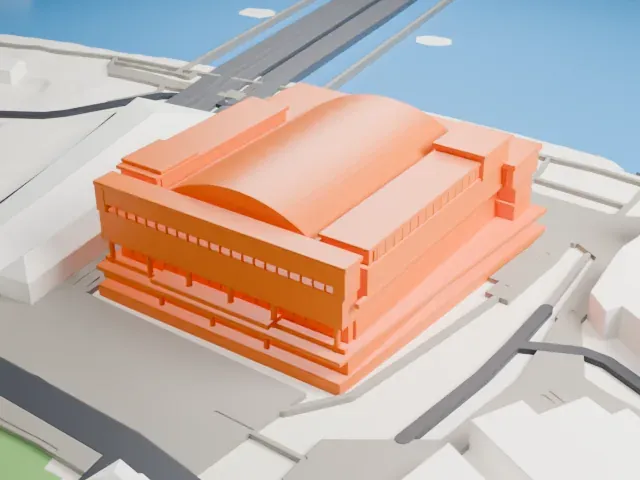 East
-
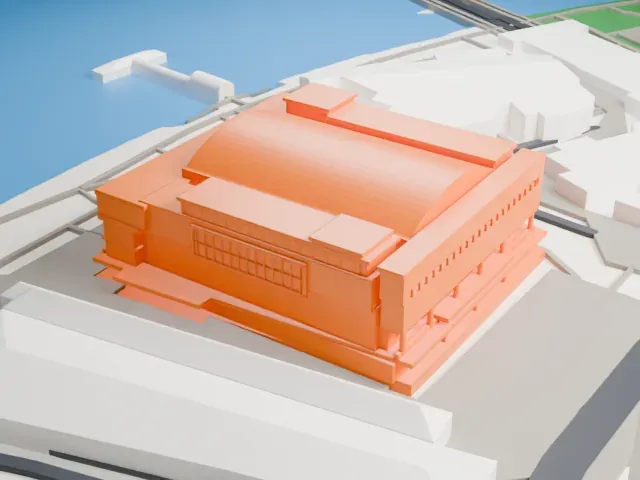 South
-
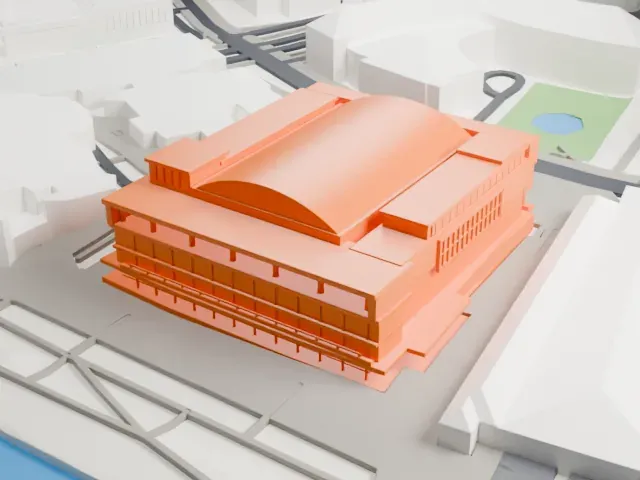 West
Copyright notice
The design of Royal Festival Hall may still be protected by copyright. It appears in the city models you make here, but it is not offered as a separate model.
- On a 160 mm print
- 9 mm
- Scale
- 1:3,750
9 mm tall on a 160 mm print
Make this print opens the generator on a 600 m square around the landmark. Buildings print at close to true scale, so the landmark grows with the print size.
- A low, wide massing
The hall prints as a low, broad shape, so the roof covers most of the model's area rather than a tower rising. A larger print size gives the roof edges and wall tops more room.
- Layers for the wall tops
Layers of 0.12 to 0.16 mm keep the edges of the flat roof and the wall tops clean, and printing slowly helps those long straight runs cool evenly.
- One piece with the ground
The Royal Festival Hall is joined to the ground in the exported file, and the four-side check found no floating parts, so nothing needs gluing.
- Pick the detail for your nozzle
In the Buildings settings, set Landmark detail to Print friendly to adapt thin parts and small details to the print scale. Full detail keeps every modeled feature, for larger prints or a finer nozzle.
- Colors
Buildings, roads, water and ground arrive as separate filament slots in the 3MF. The Royal Festival Hall takes the building color.
- File format
You get a 3MF for Bambu Studio, OrcaSlicer or PrusaSlicer. Any of them can save it as STL if you need one.
About the Royal Festival Hall
The hall holds 2,700 seats and serves as a venue for concerts, dance and talks, forming part of the Southbank Centre beside the River Thames in London. Its home is the South Bank, in the London Borough of Lambeth, close to Hungerford Bridge. In 1981 the hall became the first post-war building to be protected as Grade I listed. Among the ensembles based at Southbank Centre are the London Philharmonic Orchestra and the Philharmonia Orchestra.
The hall was built for London County Council as part of the 1951 Festival of Britain. Prime Minister Clement Attlee laid its foundation stone in 1949 on the old Lion Brewery site, and Holland, Hannen & Cubitts built it for £2 million. The official opening came on May 3, 1951: King George VI and Queen Elizabeth attended the gala concert, with Sir Adrian Boult and Sir Malcolm Sargent on the podium.
Robert Matthew, then chief architect of London County Council, led the project and gathered a team that included Leslie Martin, who led it with Edwin Williams and Peter Moro. The auditorium sits inside a ring of open foyers, which also shielded it from the noise of the railway bridge alongside, and the arrangement was nicknamed the egg in the box. The building used reinforced concrete alongside warmer elements, woods and Derbyshire fossilized limestone, and the exterior was bright white, meant to stand out against the blackened city around it.
About this model
The Royal Festival Hall is one of more than 5,500 landmark models in Mini Skyline. They are made with AI, and each one is checked in its real surroundings before release. Each model is written as code from public descriptions, plans, photographs and aerial views used only as references; no image or third-party model is copied into it. Everything around it is built from OpenStreetMap and Overture map data. Rights in the building itself, its name and any brands on it are not granted by Mini Skyline; clear them separately before you sell prints. If you would rather print the shape from map data, turn off Landmark models in the Buildings settings.
Mini Skyline is not affiliated with, or endorsed by, the owners of this building or its names and marks.
Same skyline