3D print the Rua Augusta Arch
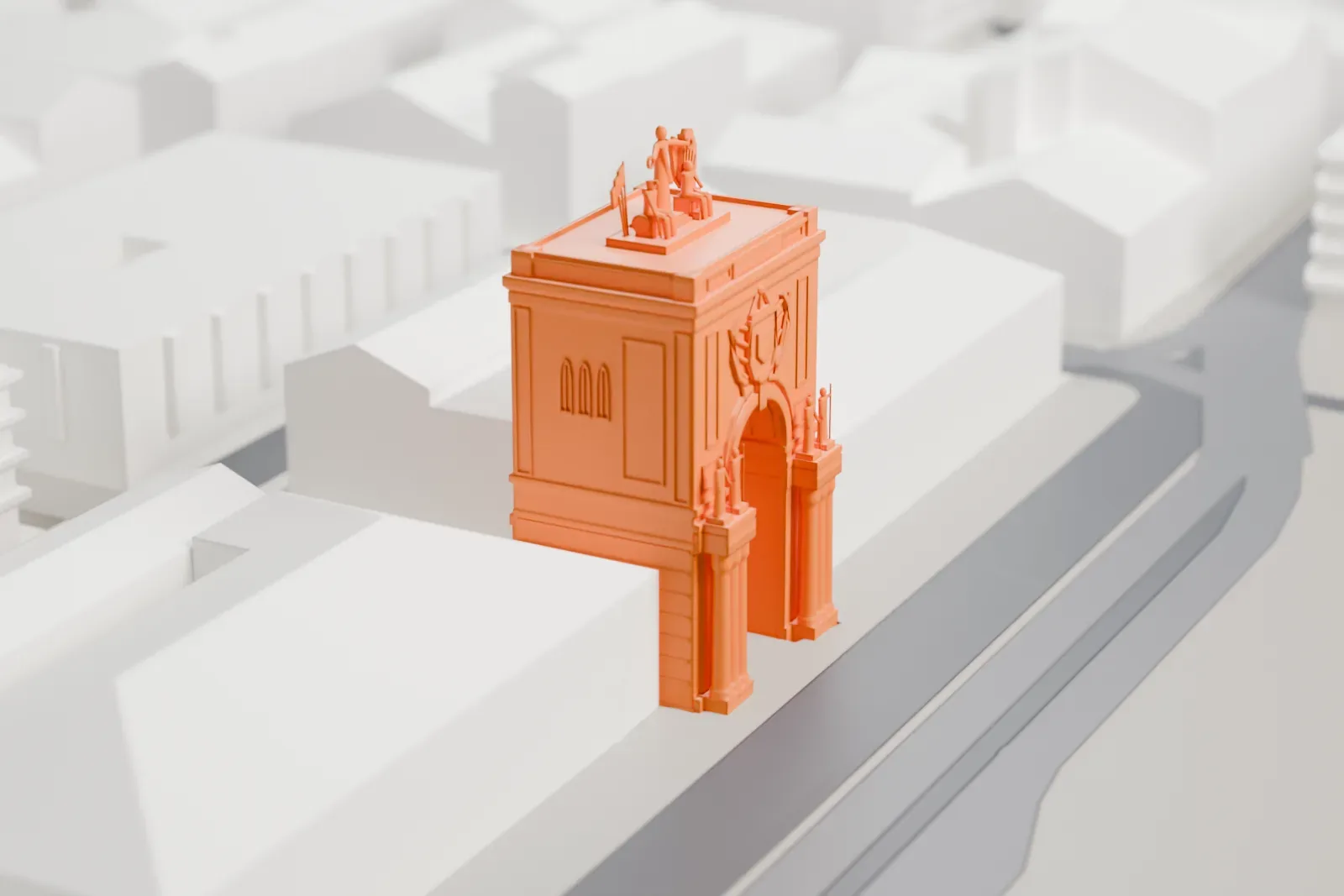
A free, printable model of the Rua Augusta Arch, standing at the edge of an open square, with the city blocks around it, generated from real map data in your browser.
-
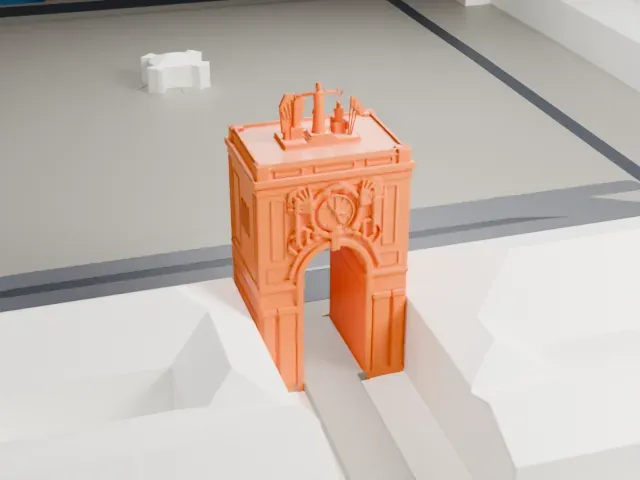 North
-
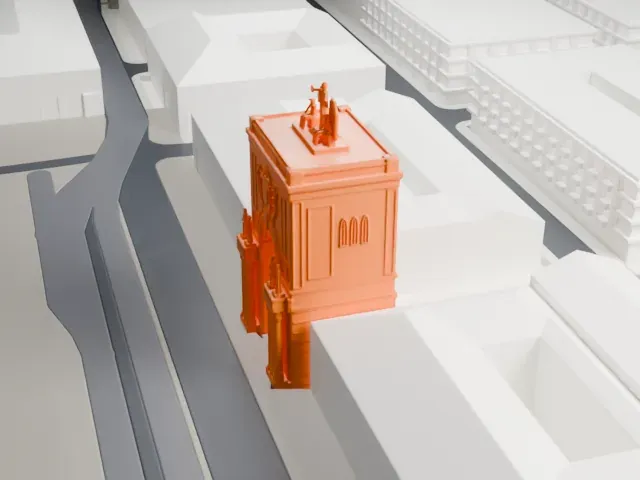 East
-
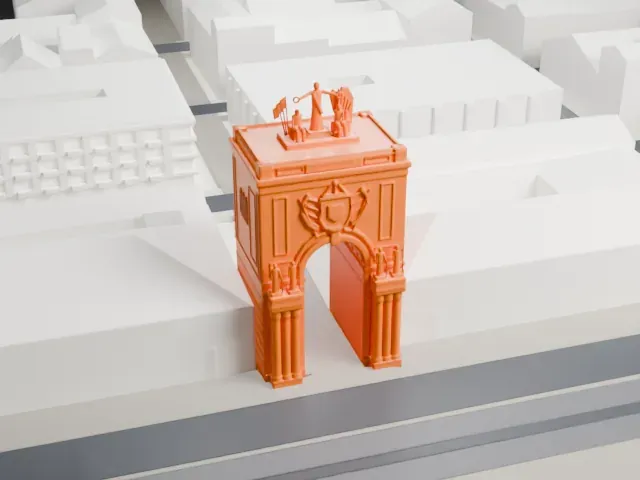 South
-
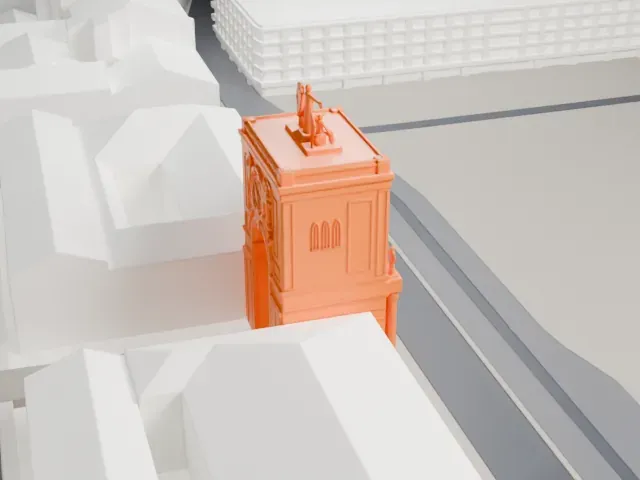 West
The model you print
Rua Augusta Arch in 3D
The landmark on its own, at its size on a 160 mm print. Print friendly thickens thin parts for a 0.4 mm nozzle; Full detail keeps every part.
- Real height
- 30 m
- On a 160 mm print
- 11 mm
- Scale
- 1:3,750
30 m of the Rua Augusta Arch, 11 mm on your shelf
Make this print opens the generator on a 600 m square around the landmark. Buildings print at close to true scale, so the landmark grows with the print size.
- Statue group on the top
The arch is topped by a small group of figures that is thin and detailed. Print friendly adapts it to the print scale; Full detail keeps it on a larger print, and slow, well-cooled printing helps at the top.
- Slender columns
The arch is built around thin columns and a tall central opening. A larger print size and a 0.12-0.16 mm layer height help keep the columns crisp.
- One piece with the ground
The Rua Augusta Arch is joined to the ground in the exported file, and the four-side check found no floating parts, so nothing needs gluing.
- Pick the detail for your nozzle
In the Buildings settings, set Landmark detail to Print friendly to adapt thin parts and small details to the print scale. Full detail keeps every modeled feature, for larger prints or a finer nozzle.
- Colors
Buildings, roads, water and ground arrive as separate filament slots in the 3MF. The Rua Augusta Arch takes the building color.
- File format
You get a 3MF for Bambu Studio, OrcaSlicer or PrusaSlicer. Any of them can save it as STL if you need one.
About the Rua Augusta Arch
The Rua Augusta Arch (Arco da Rua Augusta in Portuguese) is a triumphal arch of stone, and a visitor attraction, on Lisbon's Praça do Comércio in Portugal. Its purpose was to mark the rebuilding of the city after the 1755 earthquake. Six columns, some 11 meters (36 feet) high, support it, and statues of various historical figures decorate it.
The building was first designed as a bell tower, and only after more than a century did it become an elaborate arch. The top cornice is over 30 m (100 feet) up, so colossal figures were needed above it. At the very top, the French sculptor Célestin Anatole Calmels made an allegorical group showing Glory rewarding Valor and Genius. The female figure of Glory measures 7.0 m (23 feet) and stands on a three-step throne holding two crowns.
Victor Bastos made four statues over the columns. On the right are Nuno Alvares Pereira and the Marquis of Pombal, Sebastião José de Carvalho e Melo; on the left are Vasco da Gama and Viriatus. Two recumbent figures stand for the rivers Tagus and Douro. Together the figures stand for Portuguese history, and the triumphal arch form expresses victory in rebuilding the city after the damage.
About this model
The Rua Augusta Arch is one of more than 6,500 landmark models in Mini Skyline. They are made with AI, and each one is checked in its real surroundings before release. Each model is written as code from public descriptions, plans, photographs and aerial views used only as references; no image or third-party model is copied into it. Everything around it is built from OpenStreetMap and Overture map data. Rights in the building itself, its name and any brands on it are not granted by Mini Skyline; clear them separately before you sell prints. If you would rather print the shape from map data, turn off Landmark models in the Buildings settings.
Mini Skyline is not affiliated with, or endorsed by, the owners of this building or its names and marks.
Same skyline