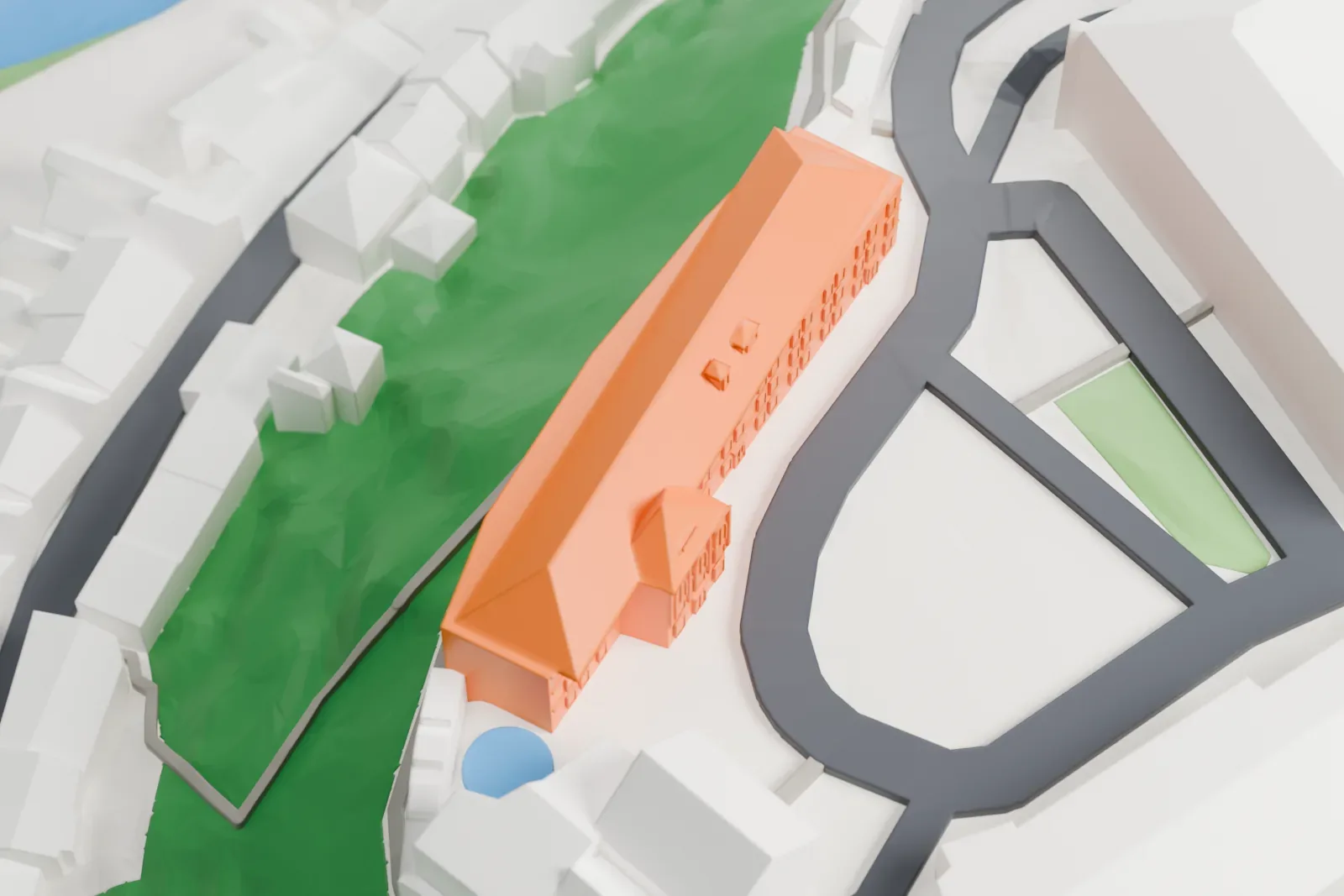
3D print the Sorbian Museum
A free, printable model of the Sorbian Museum and the hillside, streets and buildings around it, generated from real map data in your browser.
-
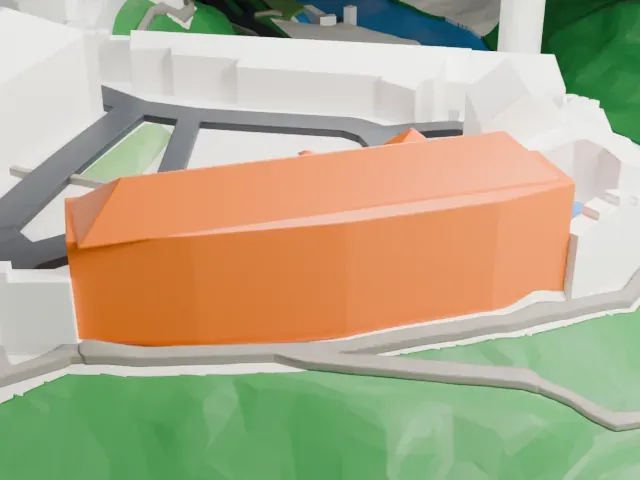 North
-
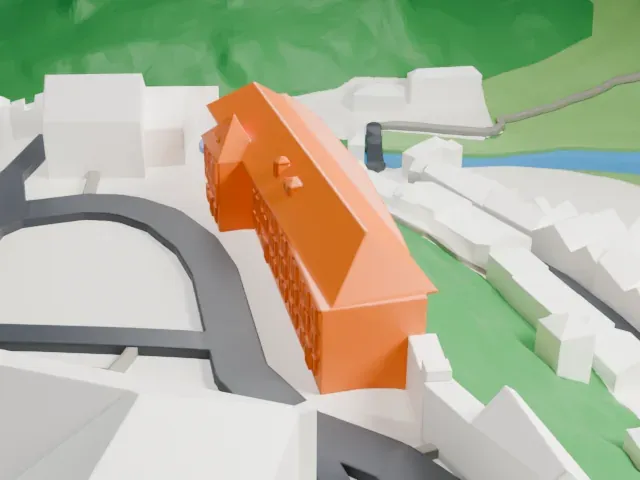 East
-
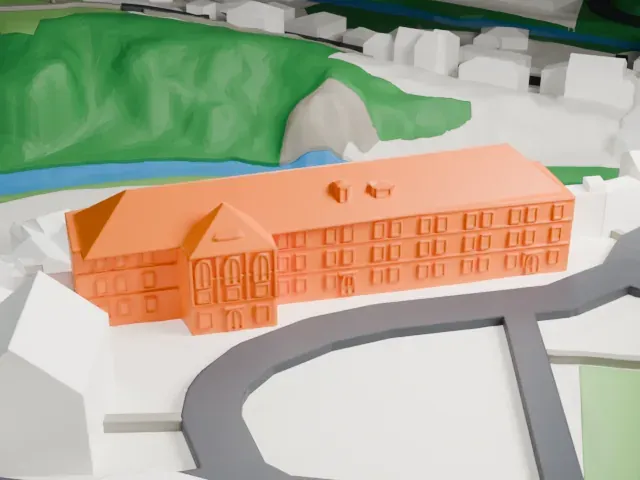 South
-
 West
The model you print
Sorbian Museum in 3D
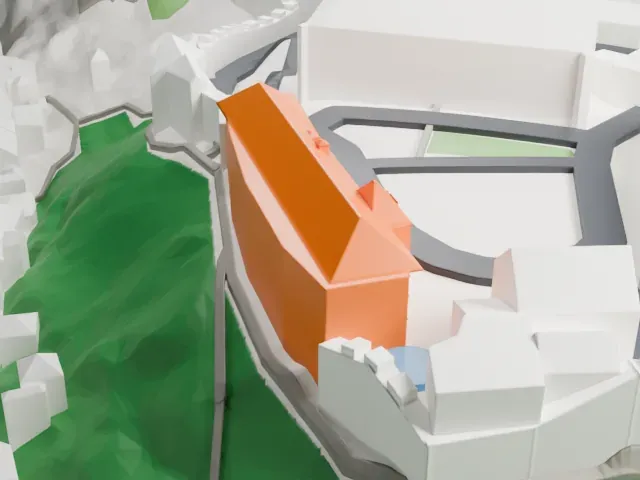
The landmark on its own, at its size on a 160 mm print. Print friendly thickens thin parts for a 0.4 mm nozzle; Full detail keeps every part.
- On a 160 mm print
- 6 mm
- Scale
- 1:3,750
6 mm tall on a 160 mm print
Make this print opens the generator on a 600 m square around the landmark. Buildings print at close to true scale, so the landmark grows with the print size.
- Long roof with small dormers
The long, steep roof carries a few small dormers. Print friendly adapts them to the print scale; Full detail on a larger print keeps them.
- One piece with the ground
The Sorbian Museum is joined to the ground in the exported file, and the four-side check found no floating parts, so nothing needs gluing.
- Pick the detail for your nozzle
In the Buildings settings, set Landmark detail to Print friendly to adapt thin parts and small details to the print scale. Full detail keeps every modeled feature, for larger prints or a finer nozzle.
- Colors
Buildings, roads, water and ground arrive as separate filament slots in the 3MF. The Sorbian Museum takes the building color.
- File format
You get a 3MF for Bambu Studio, OrcaSlicer or PrusaSlicer. Any of them can save it as STL if you need one.
About the Sorbian Museum
The Sorbian Museum (Serbski muzej in Upper Sorbian, Sorbisches Museum in German) occupies the Ortenburg's salthouse in Bautzen, Germany. With approximately 35,000 inventarized objects, it is the most important museum for the culture and history of the Sorbs. Its exhibition looks at Sorbian history and culture in Lusatia, concentrating mainly on the language, literature and art of the Sorbs.
The association Maćica Serbska put a Sorbian museum on its agenda in 1856, and the first Sorbian Museum opened in 1904 on the third floor of the Serbski dom. The Nazi government closed the Serbski dom in 1937, which ended that museum. In Hoyerswerda, a new museum covering Sorbian history and ethnology was set up in 1957, during the German Democratic Republic. Lacking space, it moved to Bautzen, and in 1988 a redesigned exhibition reopened it as an independent institution.
The building dates from 1782, when it was built as a salthouse; a restructuring in 1869 gave it its present form. The Royal Saxon Court of Appeals, Lusatia's highest judicial institution, used it as its seat from 1835. In 1976 it was judged a worthy home for the museum, and it was extensively restored in 2003.
About this model
The Sorbian Museum is one of more than 6,500 landmark models in Mini Skyline. They are made with AI, and each one is checked in its real surroundings before release. Each model is written as code from public descriptions, plans, photographs and aerial views used only as references; no image or third-party model is copied into it. Everything around it is built from OpenStreetMap and Overture map data. Rights in the building itself, its name and any brands on it are not granted by Mini Skyline; clear them separately before you sell prints. If you would rather print the shape from map data, turn off Landmark models in the Buildings settings.
Mini Skyline is not affiliated with, or endorsed by, the owners of this building or its names and marks.
Keep exploring
More landmarks to print
 Castle or houseNeuschwanstein CastleSchwangau
 Place of worshipCologne CathedralCologne
 RacingPorsche Experience Center HockenheimringHockenheim
 Airport or hangarSchwenningen International Aviation Museum hangarVillingen-Schwenningen
 Castle or houseEltz CastleWierschem
 Castle or houseHohenzollern CastleBisingen