3D print St. Bonifatius, Wiesbaden
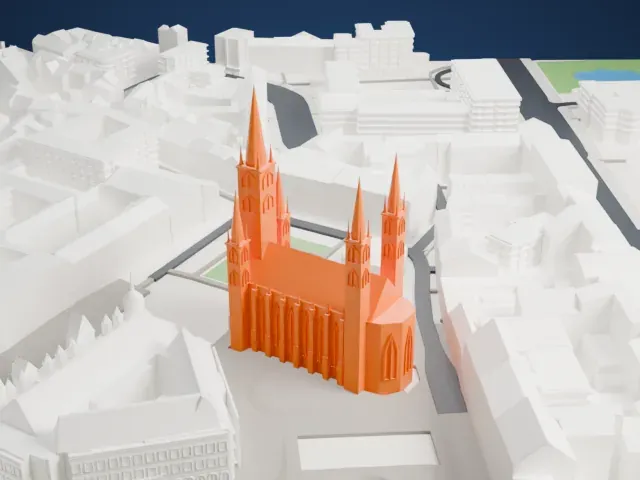
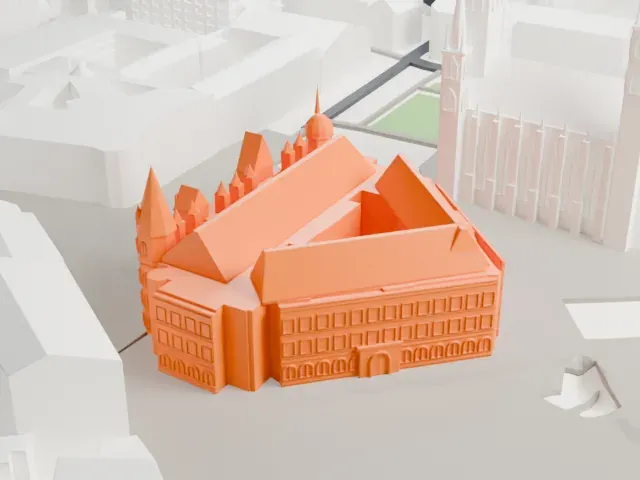
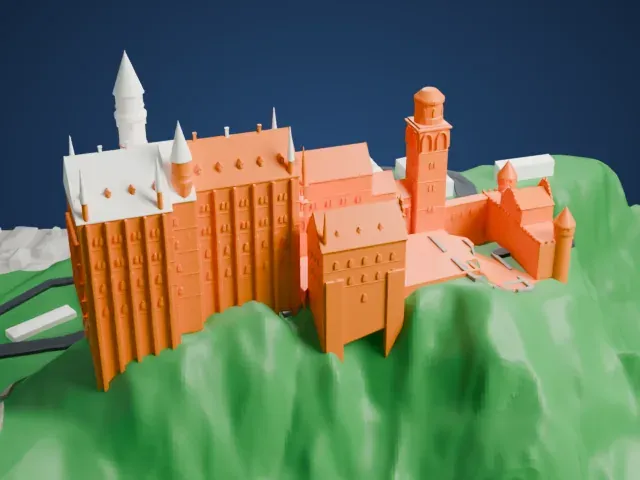
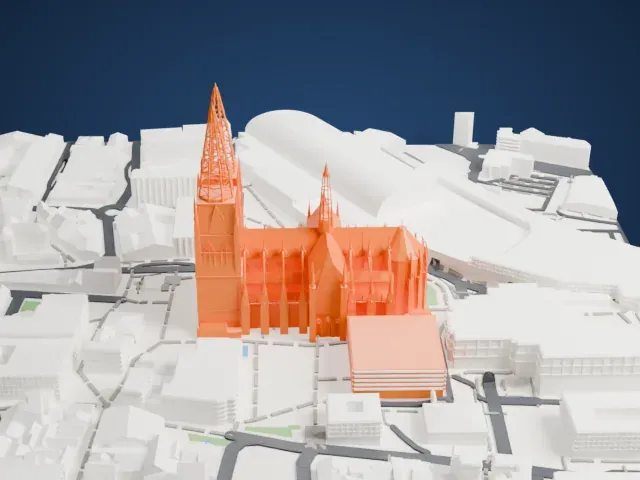
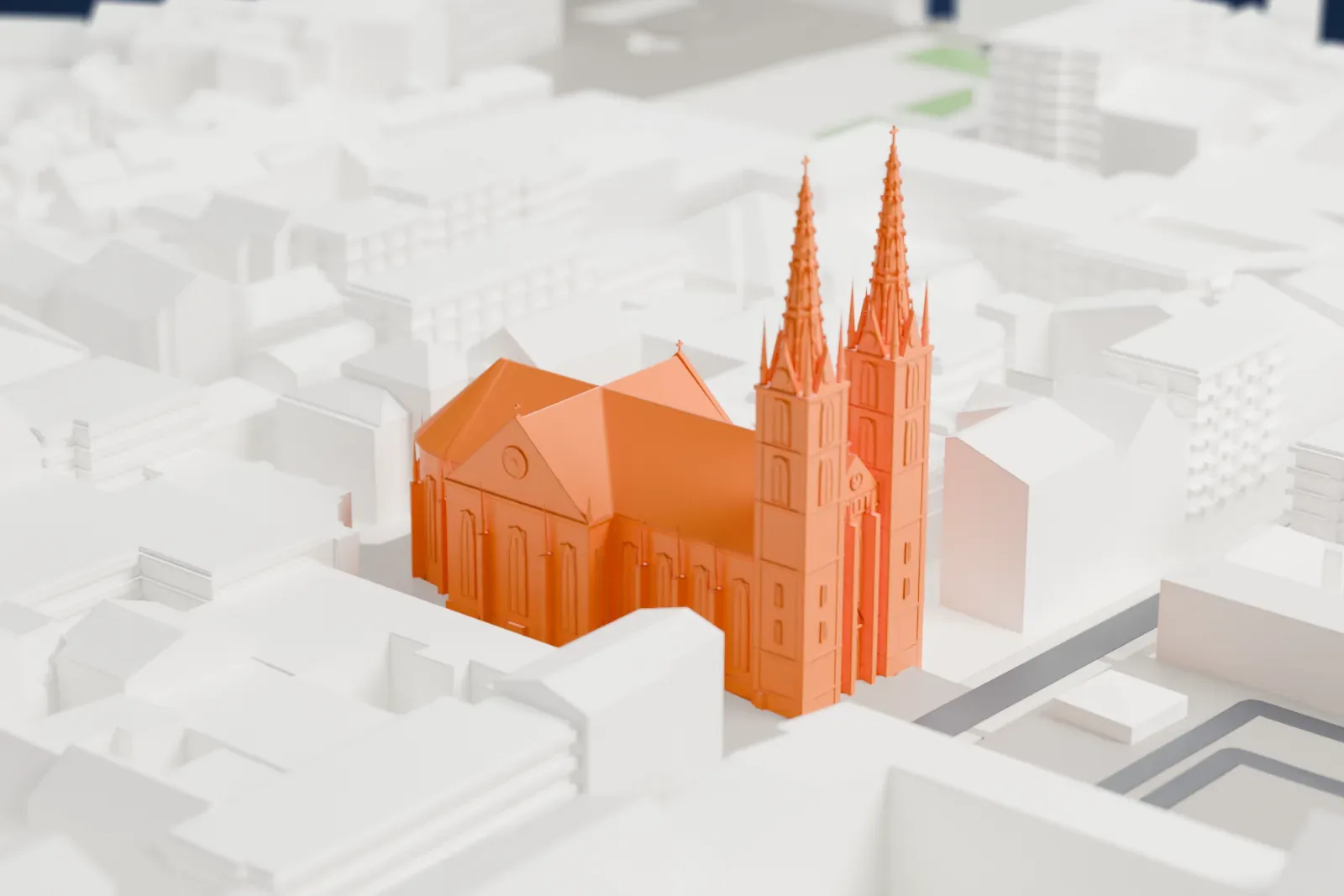
A free, printable model of St. Bonifatius with its twin spires, shown among the surrounding streets and buildings, generated from real map data in your browser.
-
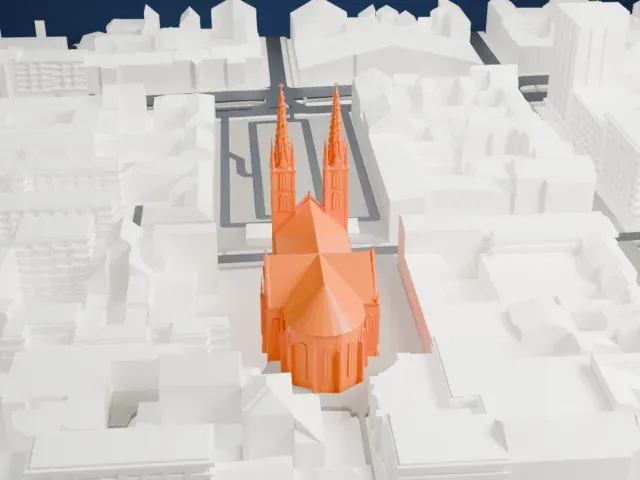 North
-
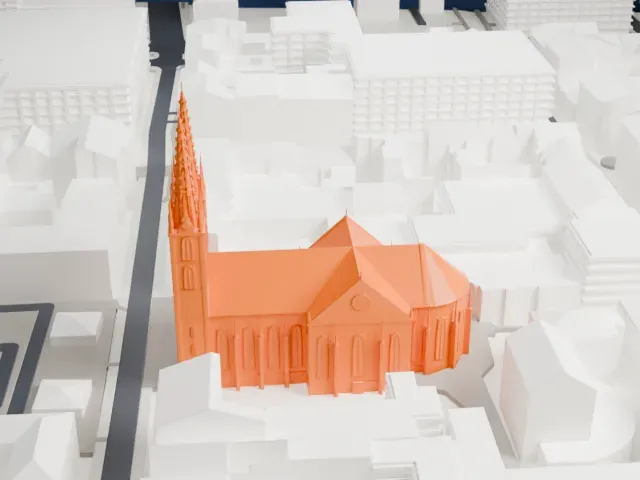 East
-
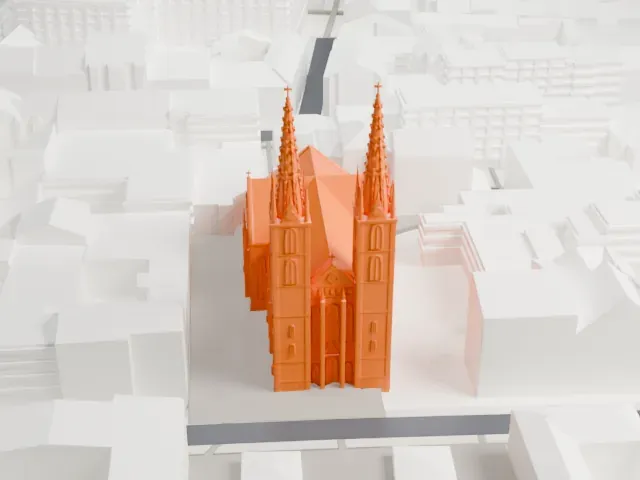 South
-
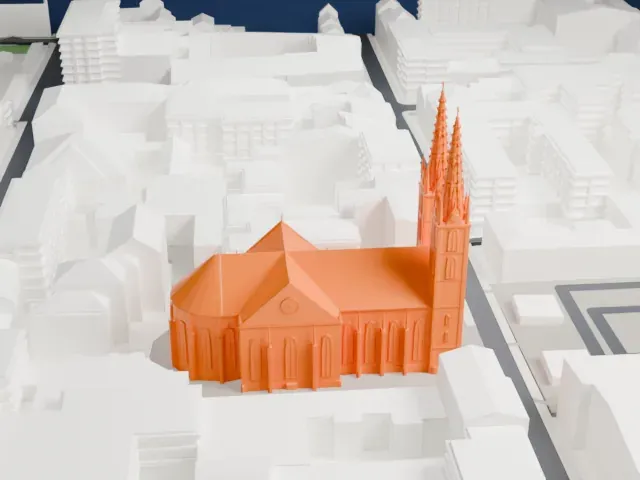 West
The model you print
St. Bonifatius, Wiesbaden in 3D
The landmark on its own, at its size on a 160 mm print. Print friendly thickens thin parts for a 0.4 mm nozzle; Full detail keeps every part.
- Real height
- 68 m
- On a 160 mm print
- 19 mm
- Scale
- 1:3,750
68 m of St. Bonifatius, Wiesbaden, 19 mm on your shelf
Make this print opens the generator on a 600 m square around the landmark. Buildings print at close to true scale, so the landmark grows with the print size.
- Twin spires
The two tall, thin spires with small pinnacles are the most fragile parts. Use Full detail at a larger print size, a 0.12-0.16 mm layer height, and print slowly so the tips stay clean.
- Pointed buttresses along the nave
Small pinnacles and buttresses run along the sides. Print friendly adapts them to the print scale; a larger print keeps more of them.
- One piece with the ground
St. Bonifatius, Wiesbaden is joined to the ground in the exported file, and the four-side check found no floating parts, so nothing needs gluing.
- Pick the detail for your nozzle
In the Buildings settings, set Landmark detail to Print friendly to adapt thin parts and small details to the print scale. Full detail keeps every modeled feature, for larger prints or a finer nozzle.
- Colors
Buildings, roads, water and ground arrive as separate filament slots in the 3MF. St. Bonifatius, Wiesbaden takes the building color.
- File format
You get a 3MF for Bambu Studio, OrcaSlicer or PrusaSlicer. Any of them can save it as STL if you need one.
About St. Bonifatius, Wiesbaden
St. Bonifatius serves as the central Catholic parish church of Wiesbaden, Germany, the capital of Hesse. The architect Philipp Hoffmann drew up its Gothic Revival design, and the church was built between 1844 and 1849. Its twin steeples, 68 m (223 ft) high, dominate the Luisenplatz. The parish belongs to the Diocese of Limburg.
An earlier Neoclassical church on the square, built from 1829 to 1831 by Friedrich Ludwig Schrumpf, collapsed on February 11, 1831, soon after it was finished; the likely cause was an inadequate foundation on ground that had been ponds. Hoffmann received the commission for the new church on May 24, 1843. His design recalls Gothic architecture, but it also draws on Romanesque architecture and has naturalistic ornament of the kind found later in Jugendstil. Twenty-two columns support a rib vault.
The interior was consecrated on June 19, 1849; the facade followed in 1856, while the towers were finished in 1866. The church was severely damaged in World War II: an air raid on February 2, 1945 destroyed every window and the roof, along with part of the vault. The vault was rebuilt in a general restoration in 1965, and Elmar Hillebrand made a new altar, added in 1967. Johannes Beeck designed the new stained glass windows, mainly white, red and blue.
About this model
St. Bonifatius, Wiesbaden is one of more than 6,500 landmark models in Mini Skyline. They are made with AI, and each one is checked in its real surroundings before release. Each model is written as code from public descriptions, plans, photographs and aerial views used only as references; no image or third-party model is copied into it. Everything around it is built from OpenStreetMap and Overture map data. Rights in the building itself, its name and any brands on it are not granted by Mini Skyline; clear them separately before you sell prints. If you would rather print the shape from map data, turn off Landmark models in the Buildings settings.
Mini Skyline is not affiliated with, or endorsed by, the owners of this building or its names and marks.
Keep exploring