3D print Stade du 5 Juillet 1962
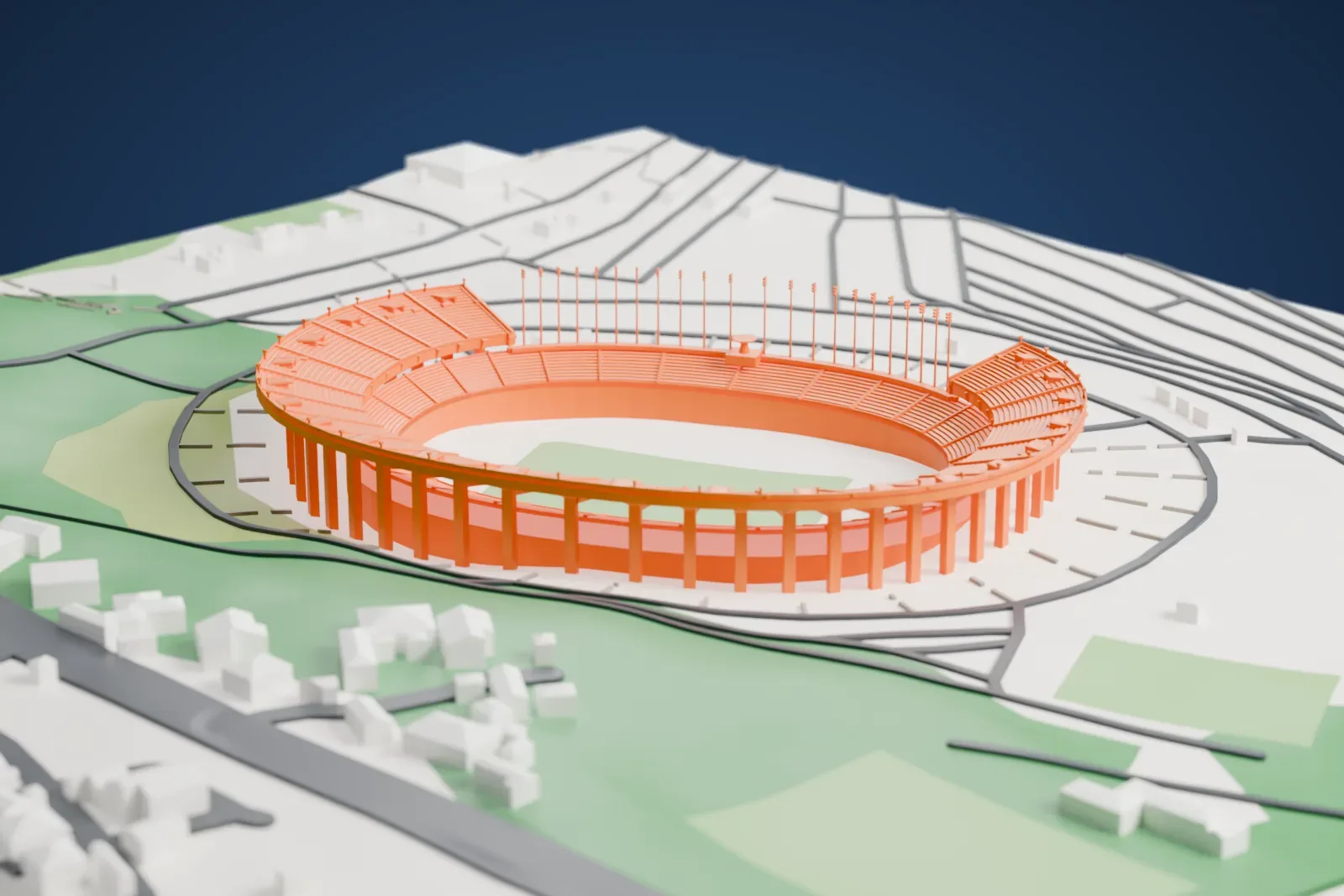
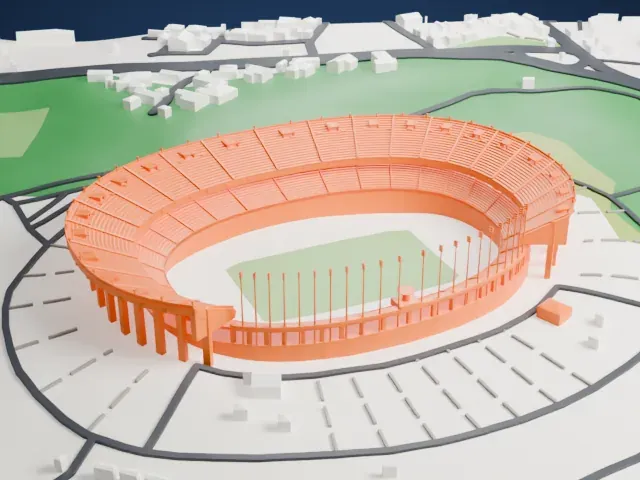
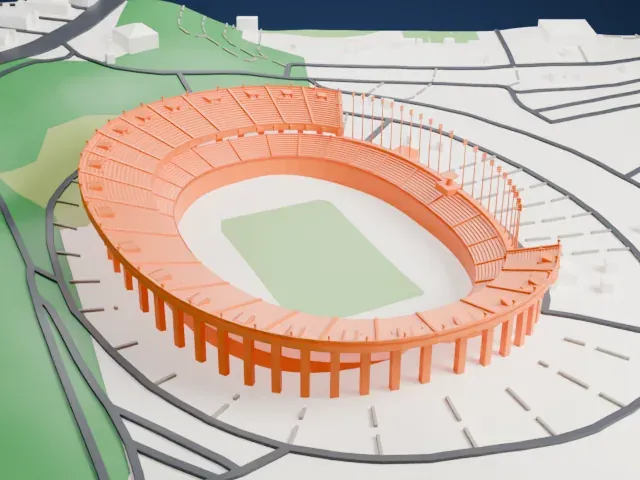
A free, printable model of Stade du 5 Juillet 1962, an oval stadium with tiered stands, a ring of outer columns and tall thin masts, generated from real map data in your browser.
Free, in your browser. Exports a slicer-ready 3MF.
About Stade du 5 Juillet 1962
Stade du 5 Juillet 1962 is a football and athletics stadium in Algiers, Algeria, named for the day Algeria declared independence. Work began in 1970 and lasted two years, and President Houari Boumediene opened the stadium in 1972. Its opening on June 17, 1972 was marked by a friendly tournament among four teams: Hungary, Palmeiras, AC Milan and the Arab Maghreb team.
Four multi-nation events used it as their main stadium: the Mediterranean Games of 1975, the All-Africa Games of 1978 and 2007, and the Pan Arab Games of 2004. In the 1990 African Cup of Nations it was one of two venues, hosting 9 of the matches, including the final, which drew 105,302 spectators. Algeria beat Nigeria 1–0 in the final, taking the title as the home team. The 2000 African Championships in Athletics were held there too.
Work to meet safety standards came in 1999, and a new phase of renovation followed in 2003. Work in 2008 covered a new lawn and a renovation of the stadium's infrastructure, and it finished in August 2009. A friendly between Algeria and Uruguay on August 12, 2009 marked the reopening. In March 2015 the natural turf was replaced with hybrid grass using AirFibr technology.
How it prints
Make this print opens the generator on a 700 m square around the landmark. Buildings print at close to true scale, so the landmark grows with the print size.
| Print size | Landmark height | Scale |
|---|---|---|
| 160 mm default | 13 mm | 1:4,375 |
| 200 mm | 17 mm | 1:3,500 |
| 256 mm | 21 mm | 1:2,734 |
-
 North
North
-
 East
East
-
 South
South
-
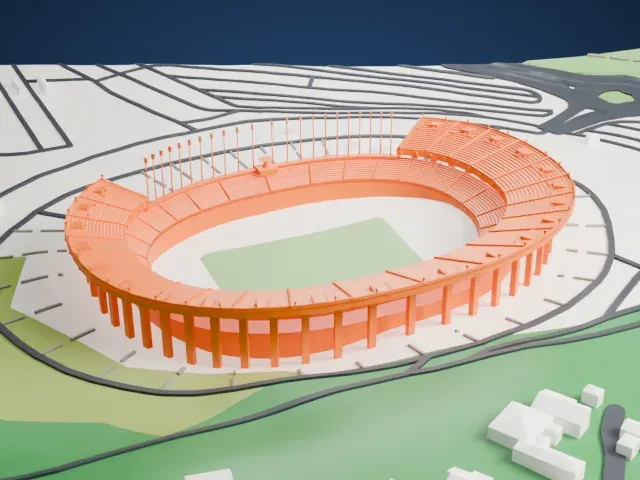 West
West
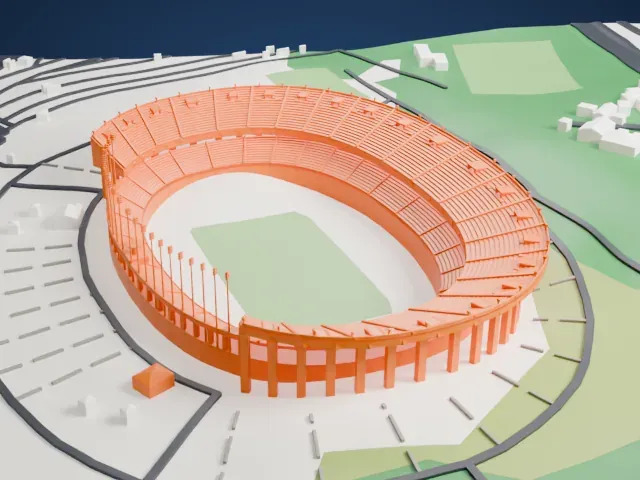
- A ring of slim outer columns
- Slim columns circle the outside of the stands. Print friendly adapts thin parts like these to the print scale, while Full detail keeps every column, which suits a larger print.
- Tall thin masts
- A row of tall, very thin masts stands along one side of the stands. Printing slowly with good cooling helps them stay clean, and a bigger print size keeps more of them.
- One piece with the ground
- Stade du 5 Juillet 1962 is joined to the ground in the exported file, and the four-side check found no floating parts, so nothing needs gluing.
- Pick the detail for your nozzle
- In the Buildings settings, set Landmark detail to Print friendly to adapt thin parts and small details to the print scale. Full detail keeps every modeled feature, for larger prints or a finer nozzle.
- Colors
- Buildings, roads, water and ground arrive as separate filament slots in the 3MF. Stade du 5 Juillet 1962 takes the building color.
- File format
- You get a 3MF for Bambu Studio, OrcaSlicer or PrusaSlicer. Any of them can save it as STL if you need one.
About this model
Stade du 5 Juillet 1962 is one of more than 2,300 landmark models in Mini Skyline. They are made with AI, and each one is checked from four sides in its real surroundings before release. Everything around it is built from OpenStreetMap and Overture map data. If you would rather print the shape from map data, turn off Landmark models in the Buildings settings.
Common questions
Is there a Stade du 5 Juillet 1962 STL I can download?
Mini Skyline builds the file for you in your browser and exports 3MF, which every major slicer opens. If you need an STL, open the 3MF in your slicer and export it from there.
How big can I print it?
Any print size from 40 mm across. Stade du 5 Juillet 1962 grows with the print: about 13 mm tall on the default 160 mm print. For a model larger than your printer bed, Project Mode splits the area into tiles.
Is it free?
Yes. Generation runs in your browser, with no account and nothing behind a paywall.