3D print the Cotton Bowl (stadium)
A free, printable model of the Cotton Bowl and the surrounding streets and buildings of Fair Park, generated from real map data in your browser.
-
 North
-
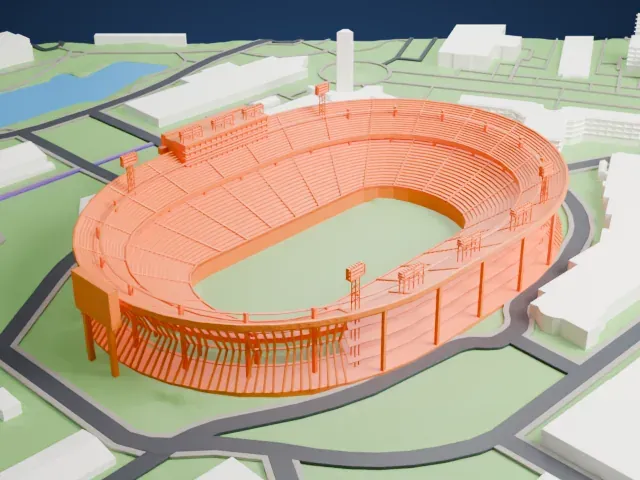 East
-
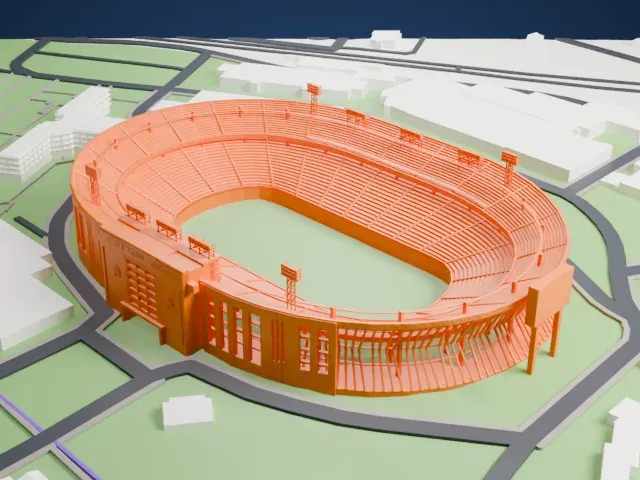 South
-
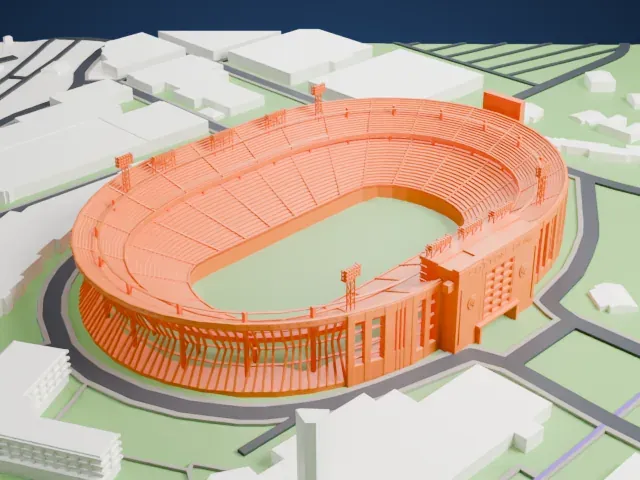 West
The model you print
Cotton Bowl (stadium) in 3D
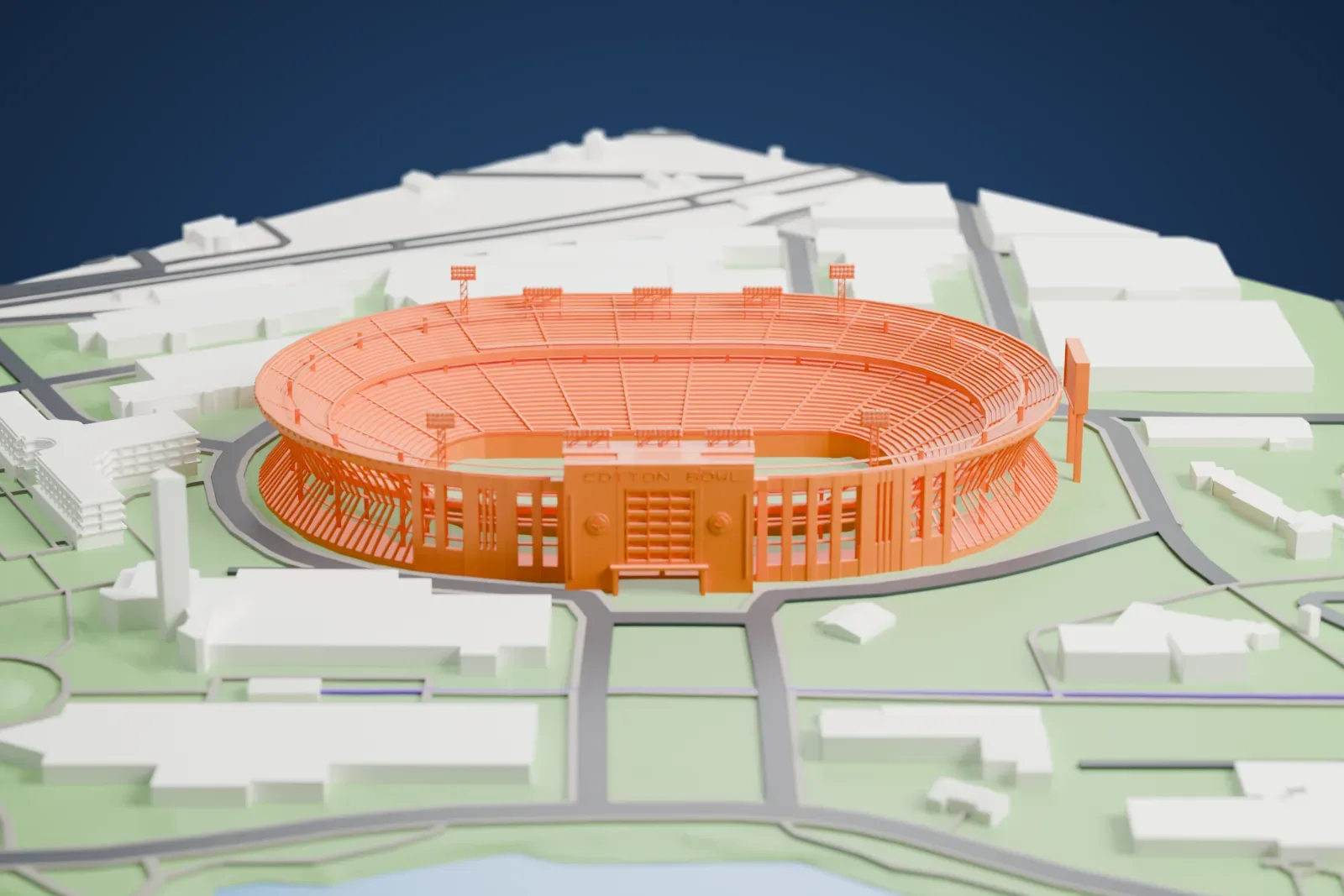
The landmark on its own, at its size on a 160 mm print. Print friendly thickens thin parts for a 0.4 mm nozzle; Full detail keeps every part.
- On a 160 mm print
- 14 mm
- Scale
- 1:4,063
14 mm tall on a 160 mm print
Make this print opens the generator on a 650 m square around the landmark. Buildings print at close to true scale, so the landmark grows with the print size.
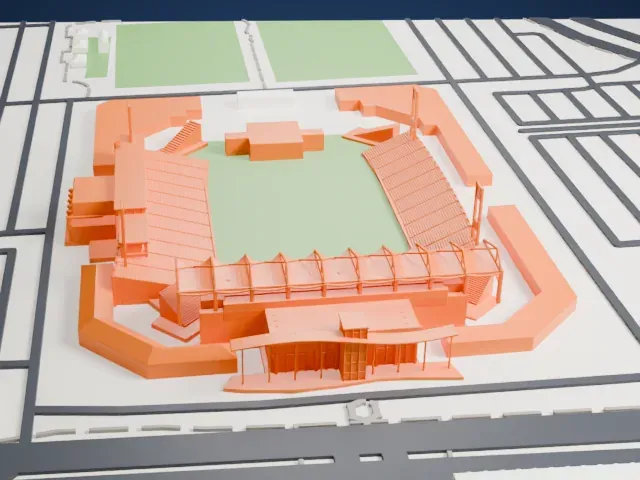
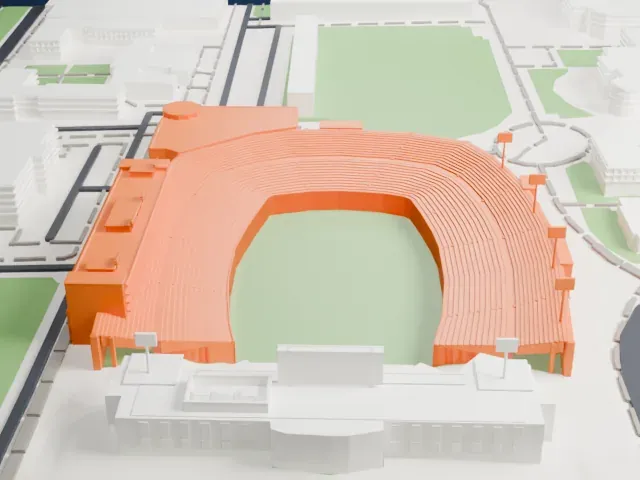
- Open two-tier bowl
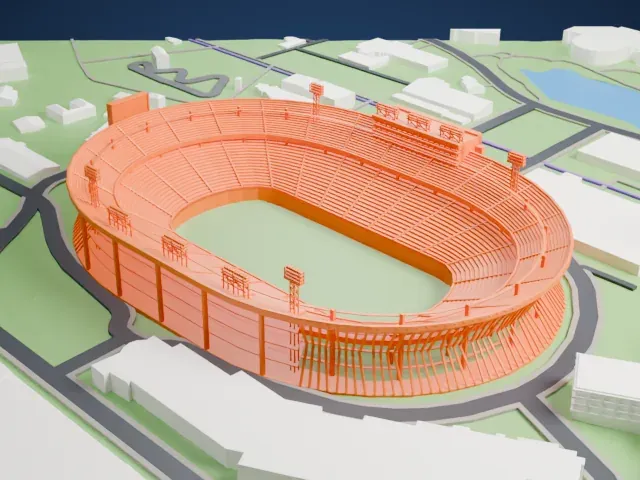
The stadium prints as an open bowl with two seating tiers and no spectator roof. Print friendly simplifies the thin end screens and light frames; Full detail keeps the Art Deco entrance and the floodlights.
- Waisted end screens
The rounded ends carry folded vertical screens with a narrow waist. Their thin ribbons need a larger print size or fine layers to stay open and distinct.
- One piece with the ground
The Cotton Bowl (stadium) is joined to the ground in the exported file, and the four-side check found no floating parts, so nothing needs gluing.
- Pick the detail for your nozzle
In the Buildings settings, set Landmark detail to Print friendly to adapt thin parts and small details to the print scale. Full detail keeps every modeled feature, for larger prints or a finer nozzle.
- Colors
Buildings, roads, water and ground arrive as separate filament slots in the 3MF. The Cotton Bowl (stadium) takes the building color.
- File format
You get a 3MF for Bambu Studio, OrcaSlicer or PrusaSlicer. Any of them can save it as STL if you need one.
About the Cotton Bowl (stadium)
The Cotton Bowl stands in Dallas, Texas, and is an open-air stadium. It was completed in 1930 with the name Fair Park Stadium, on the State Fair of Texas grounds at Fair Park. That first lower bowl held 45,507 spectators and cost $328,000. In 1936 the venue took the Cotton Bowl name.
The Cotton Bowl Classic, a postseason college football bowl game, played there for many years. Its first 73 editions ran from New Year's Day 1937 until January 2009; the 2010 edition was played in Arlington, at AT&T Stadium. The Red River Rivalry, an annual game between Oklahoma and Texas, is also held there.
Upper decks came in 1948 and again the next year, taking capacity to 75,504. Doak Walker's large following as an SMU running back in the late 1940s earned the place the nickname "The House That Doak Built". Seating reached 92,100 after the 2008 renovation. The stadium was also one of nine host venues at the 1994 FIFA World Cup.
About this model
The Cotton Bowl (stadium) is one of more than 4,900 landmark models in Mini Skyline. They are made with AI, and each one is checked from four sides in its real surroundings before release. Everything around it is built from OpenStreetMap and Overture map data. If you would rather print the shape from map data, turn off Landmark models in the Buildings settings.
Same skyline