3D print the Estadio de la Cerámica
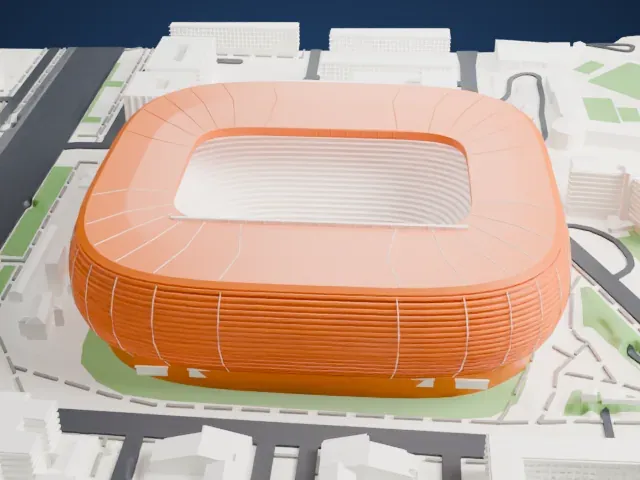
A free, printable model of the Estadio de la Cerámica, an enclosed football bowl under one continuous roof, among surrounding streets and buildings, generated from real map data in your browser.
-
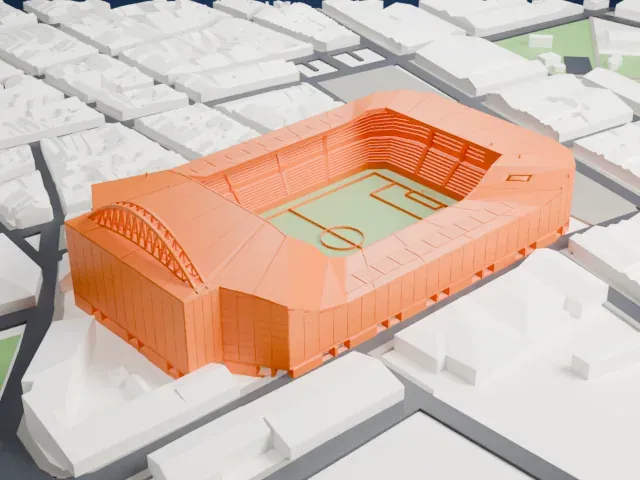 North
-
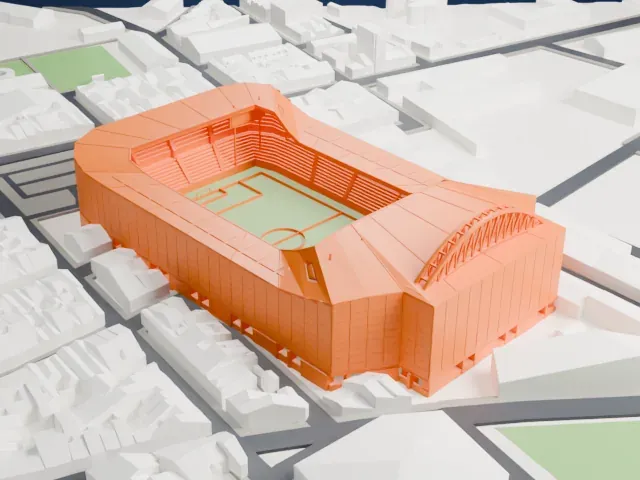 East
-
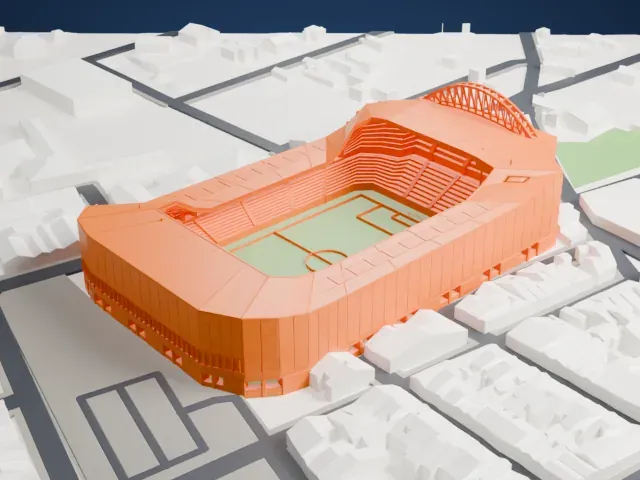 South
-
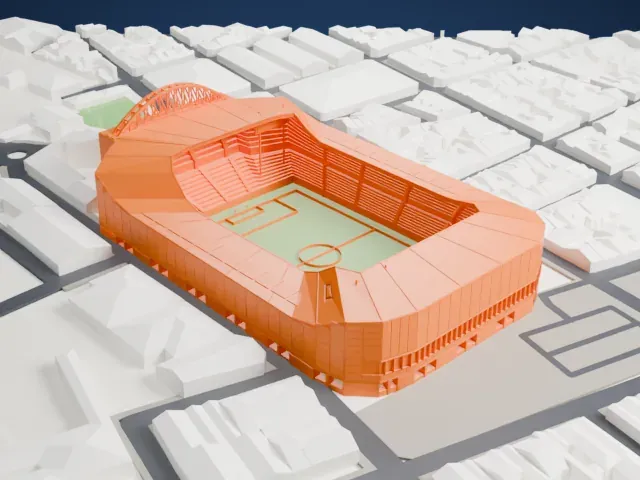 West
The model you print
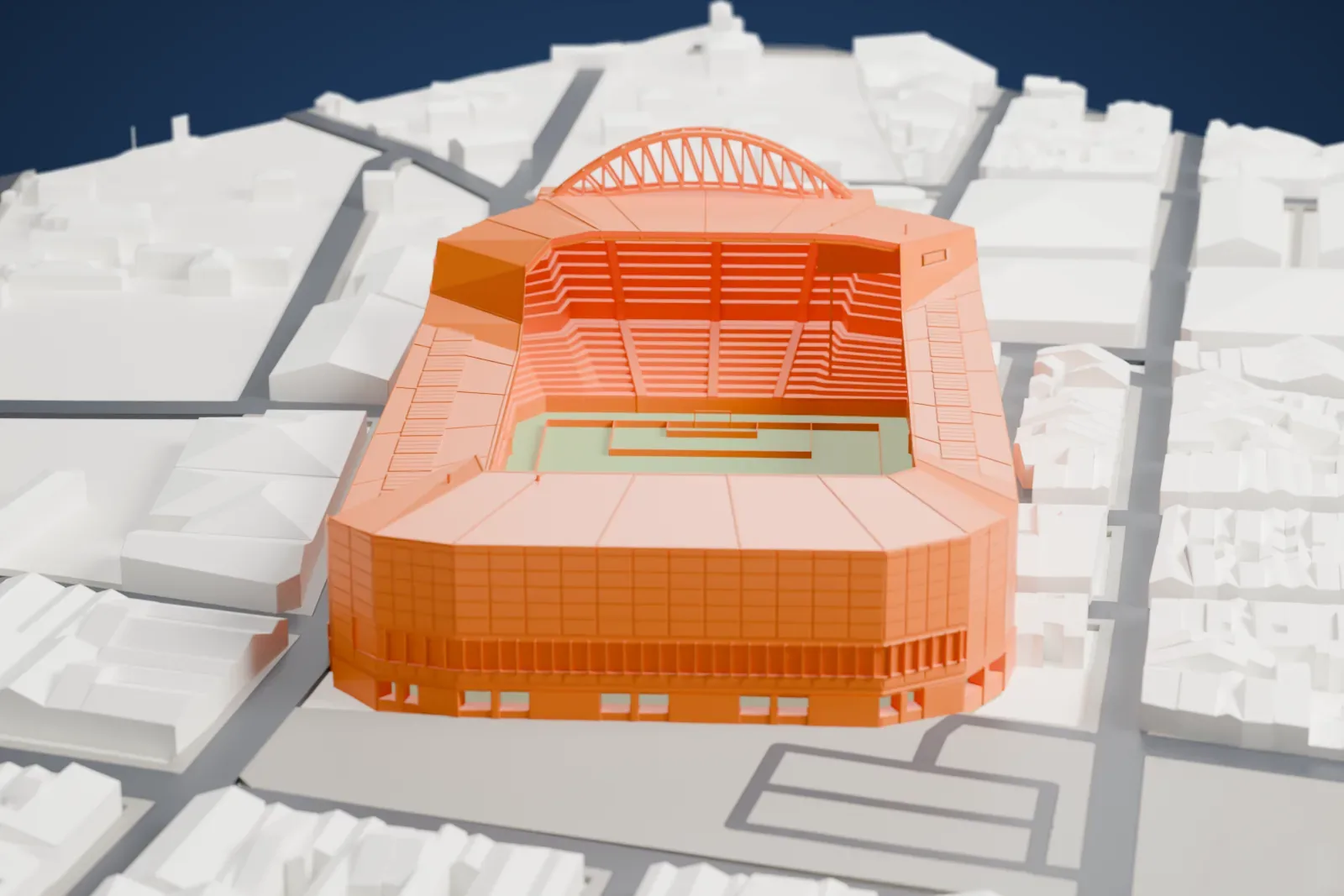
Estadio de la Cerámica in 3D
The landmark on its own, at its size on a 160 mm print. Print friendly thickens thin parts for a 0.4 mm nozzle; Full detail keeps every part.
- On a 160 mm print
- 14 mm
- Scale
- 1:3,750
14 mm tall on a 160 mm print
Make this print opens the generator on a 600 m square around the landmark. Buildings print at close to true scale, so the landmark grows with the print size.
- North truss and canopy
The taller north end carries an exposed bowed truss with open gaps between its chords, and those members are among the finest in the model. Full detail keeps the truss; a larger print or 0.12–0.16 mm layers helps it read.
- Ceramic façade panels
Shallow horizontal joints and vertical divisions model the ceramic skin. Print friendly softens the smallest relief, while a larger print preserves the panel grid.
- One piece with the ground
The Estadio de la Cerámica is joined to the ground in the exported file, and the four-side check found no floating parts, so nothing needs gluing.
- Pick the detail for your nozzle
In the Buildings settings, set Landmark detail to Print friendly to adapt thin parts and small details to the print scale. Full detail keeps every modeled feature, for larger prints or a finer nozzle.
- Colors
Buildings, roads, water and ground arrive as separate filament slots in the 3MF. The Estadio de la Cerámica takes the building color.
- File format
You get a 3MF for Bambu Studio, OrcaSlicer or PrusaSlicer. Any of them can save it as STL if you need one.
About the Estadio de la Cerámica
The Estadio de la Cerámica in Villarreal, Spain, has been a football ground since 1923 and is home to Villarreal CF of La Liga. It holds 23,008 spectators, about half of Vila-real's population, and ranks as Spain's 26th-largest stadium and the Valencian Community's fifth-largest. The reserve side Villarreal B has also played there since 2023.
The ground opened as Campo del Villarreal. Two years later it was renamed in honor of the rural land where it stood and became widely known as El Madrigal. It also carries the nicknames Feudo Amarillo, or Yellow Fief, and La Cerámica. On January 8, 2017, before a league match against Barcelona, the club renamed it Estadio de la Cerámica in recognition of the local ceramics industry.
A centenary remodeling in 2022 gave the ground a single continuous canopy and closed it into a fully enclosed bowl, with a yellow ceramic façade and solar panels on the roof. IDOM designed the roughly €35 million project, and Alviben, a Vila-real builder, constructed it. Work began on May 16, 2022, and the rebuilt stadium reopened on December 31, 2022. The ground stands at Plaza Labrador, about ten kilometers from the Mediterranean Sea.
About this model
The Estadio de la Cerámica is one of more than 4,900 landmark models in Mini Skyline. They are made with AI, and each one is checked from four sides in its real surroundings before release. Everything around it is built from OpenStreetMap and Overture map data. If you would rather print the shape from map data, turn off Landmark models in the Buildings settings.
Keep exploring