3D print Estadio El Alcoraz
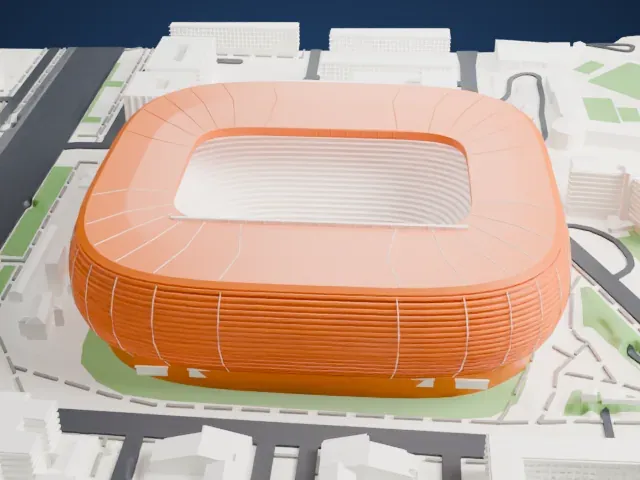
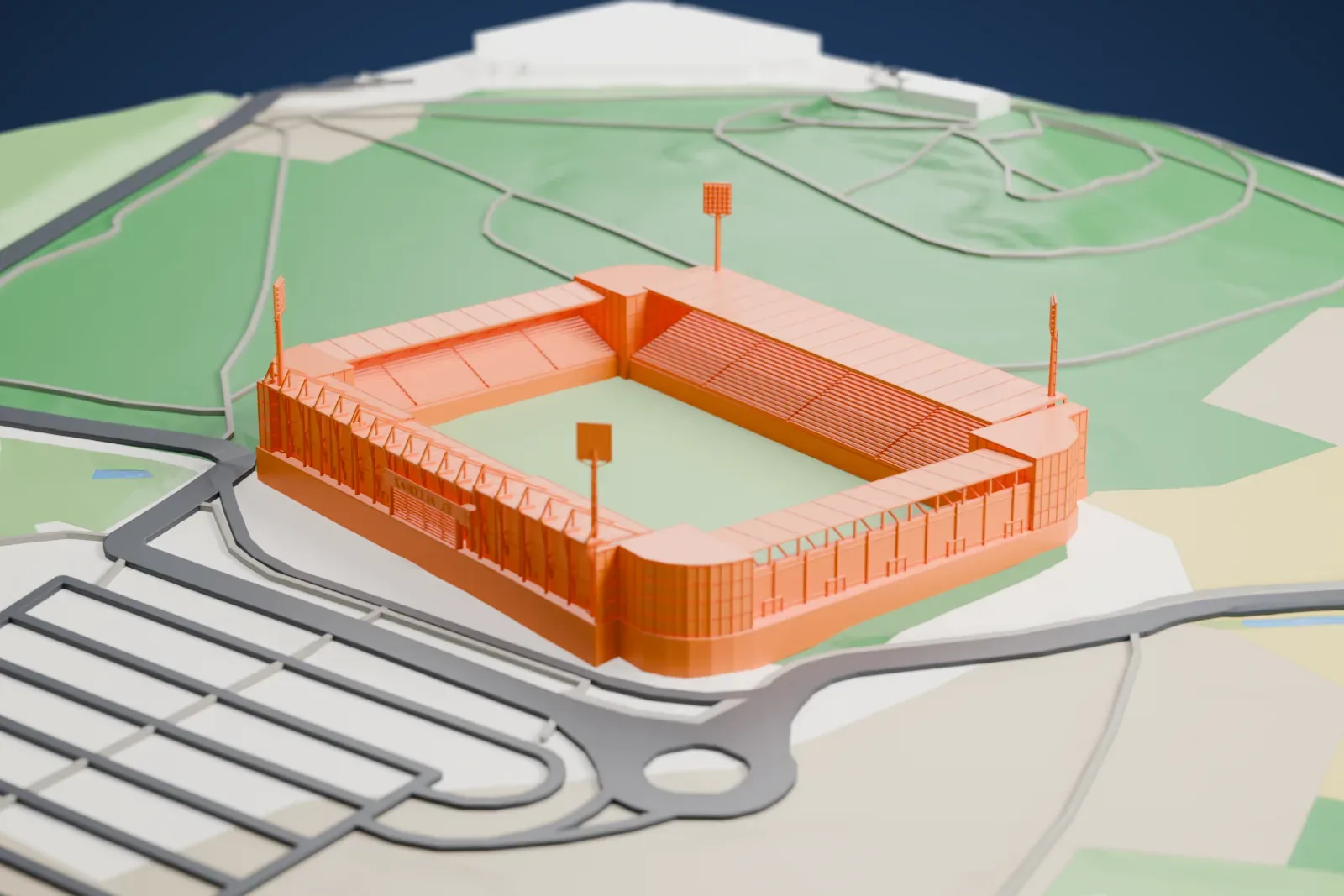
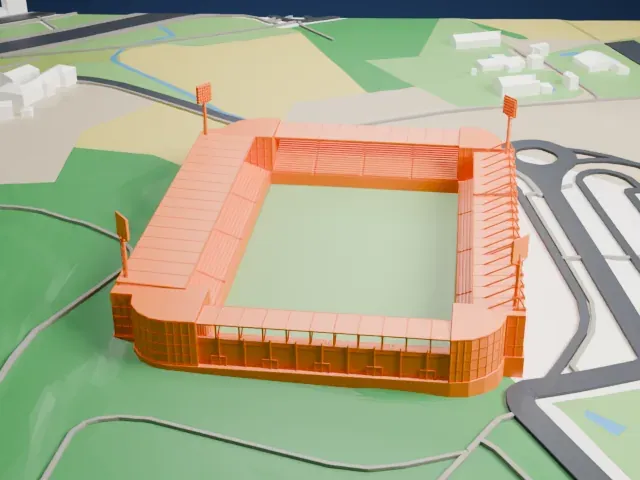
A free, printable model of the stadium, with its covered stand and four floodlight towers, and the green slopes, roads and parking lots around it, generated from real map data in your browser.
-
 North
-
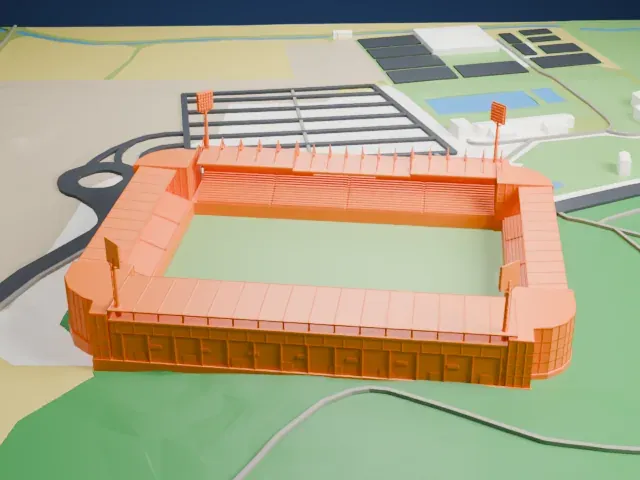 East
-
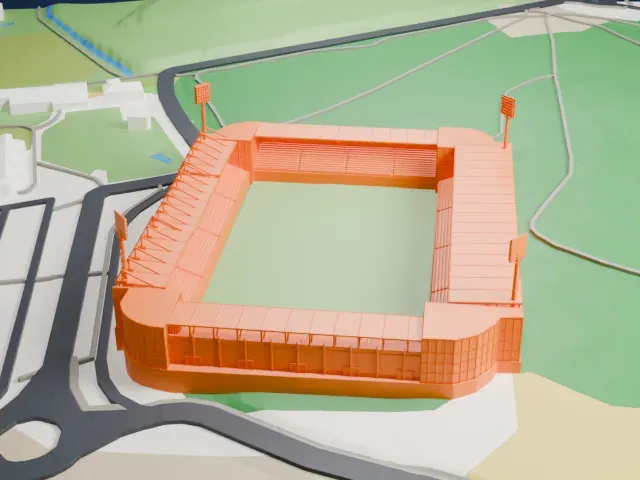 South
-
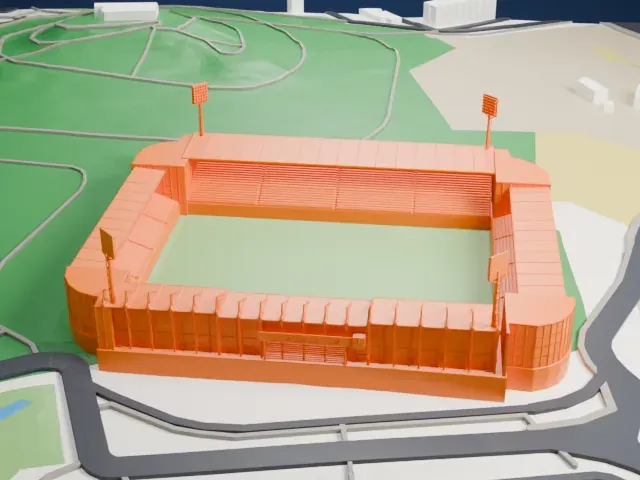 West
The model you print
Estadio El Alcoraz in 3D
The landmark on its own, at its size on a 160 mm print. Print friendly thickens thin parts for a 0.4 mm nozzle; Full detail keeps every part.
- On a 160 mm print
- 12 mm
- Scale
- 1:3,750
12 mm tall on a 160 mm print
Make this print opens the generator on a 600 m square around the landmark. Buildings print at close to true scale, so the landmark grows with the print size.
- Four floodlight towers
Four floodlight towers with lamp heads stand around the pitch. Print friendly adapts these thin parts to the print scale; Full detail keeps them on a larger print. Printing slowly helps the tall tips.
- Roof over the main stand
A roof with fine supports covers one long stand. A layer height of 0.12–0.16 mm and a bigger print size keep the supports and the seat tiers readable.
- One piece with the ground
Estadio El Alcoraz is joined to the ground in the exported file, and the four-side check found no floating parts, so nothing needs gluing.
- Pick the detail for your nozzle
In the Buildings settings, set Landmark detail to Print friendly to adapt thin parts and small details to the print scale. Full detail keeps every modeled feature, for larger prints or a finer nozzle.
- Colors
Buildings, roads, water and ground arrive as separate filament slots in the 3MF. Estadio El Alcoraz takes the building color.
- File format
You get a 3MF for Bambu Studio, OrcaSlicer or PrusaSlicer. Any of them can save it as STL if you need one.
About Estadio El Alcoraz
Estadio El Alcoraz stands in Huesca, a city in Aragon, Spain, and serves as the home ground of SD Huesca, the city's foremost professional club. It takes its name from the battle of Alcoraz, fought on that spot in 1096. The stadium lies next to San Jorge's hill. The architect Raimundo Bambó designed and built it, and the club's president at the time, José Maria Mur, proposed the project, which took 4 years and cost roughly 15 million pesetas (some 90,000 euros).
SD Huesca played Deportivo Aragón in the opening match on January 16, 1972. In 1986, with the club deep in debt, the stadium went to auction, and about 200 managers and fans formed a society that won it, saving the ground from the bank's embargo. Later events included a Copa del Rey match against Cádiz CF in 1990 and a Spain Under-21 match against Greece on June 6, 2003, which Spain won 2–0.
After SD Huesca rose to Segunda División in the 2008/2009 season, the stadium gained a roof, an extended central stand and a rebuilt presidential box, among other changes. When the club reached La Liga, the stadium grew in 2018 from under 5,500 seats to 7,638, with work on the stands, VIP areas, press room and parking.
About this model
Estadio El Alcoraz is one of more than 4,900 landmark models in Mini Skyline. They are made with AI, and each one is checked from four sides in its real surroundings before release. Everything around it is built from OpenStreetMap and Overture map data. If you would rather print the shape from map data, turn off Landmark models in the Buildings settings.
Keep exploring