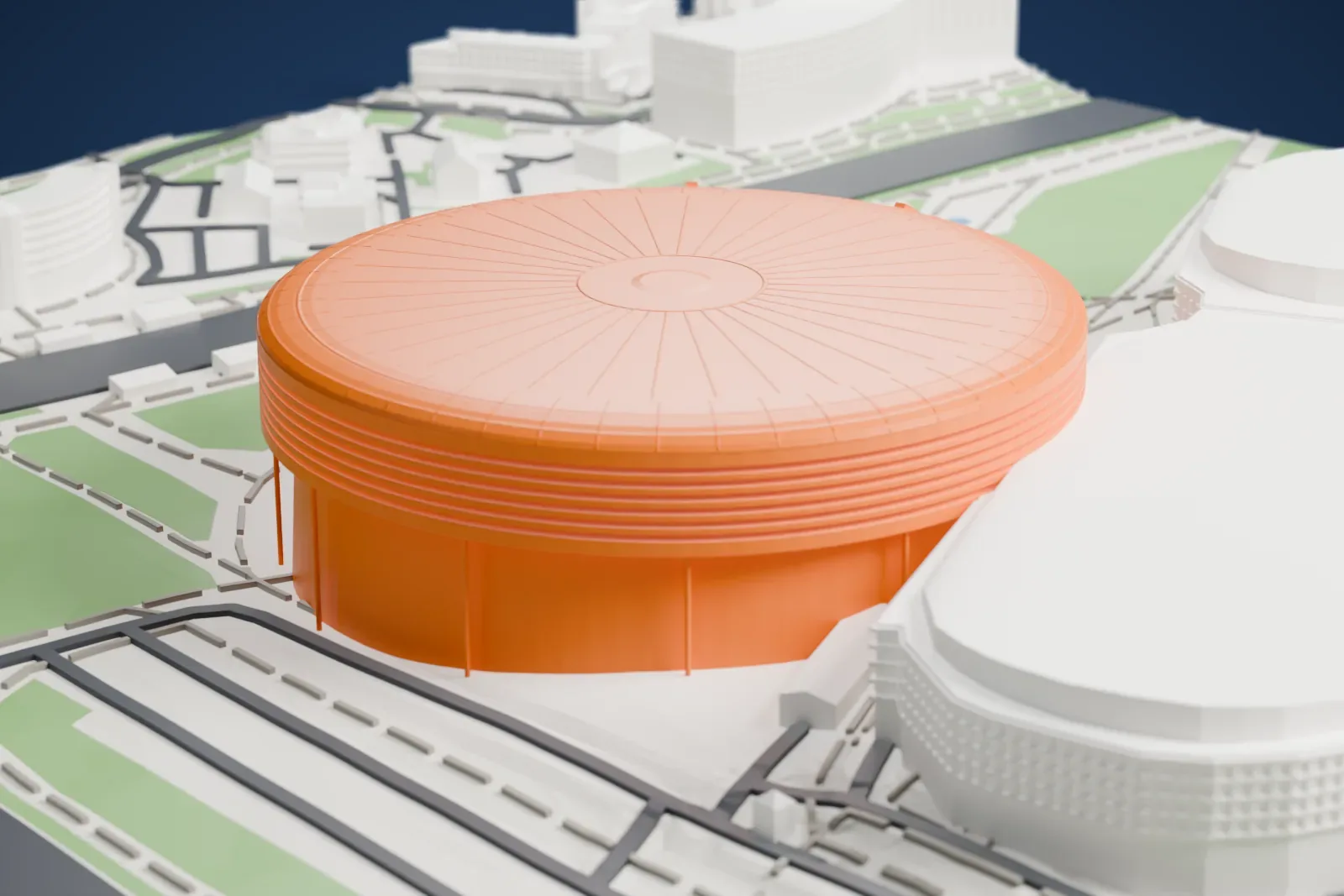
3D print Minsk-Arena
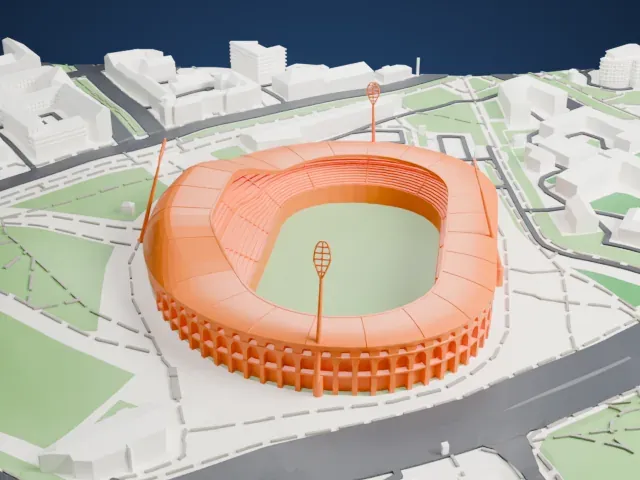
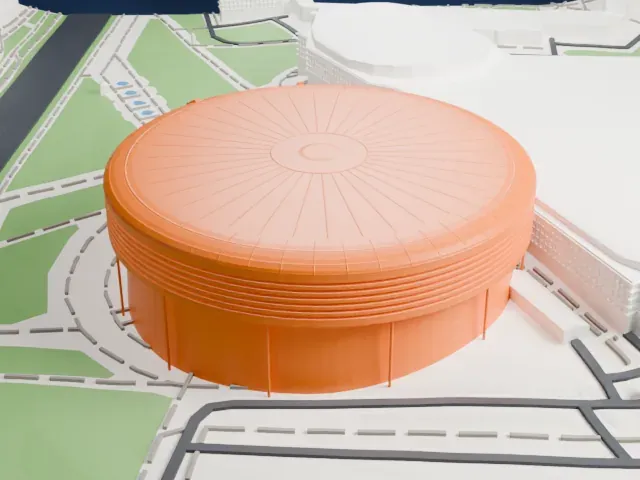
A free, printable model of Minsk-Arena, a round drum with a saucer roof and a glazed entrance bay with stairs, with the surrounding streets and buildings, generated from real map data in your browser.
-
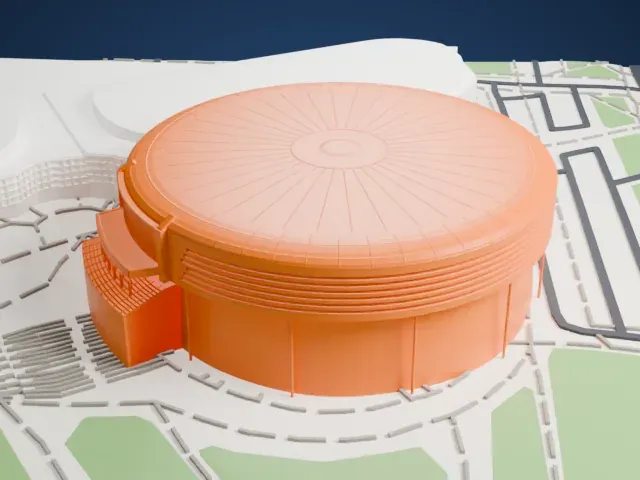 North
-
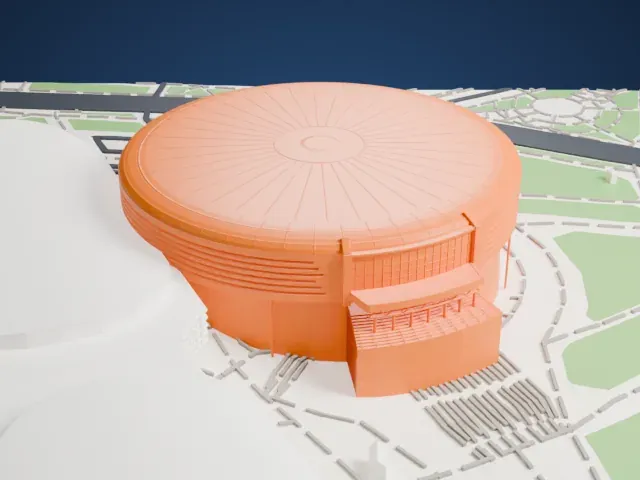 East
-
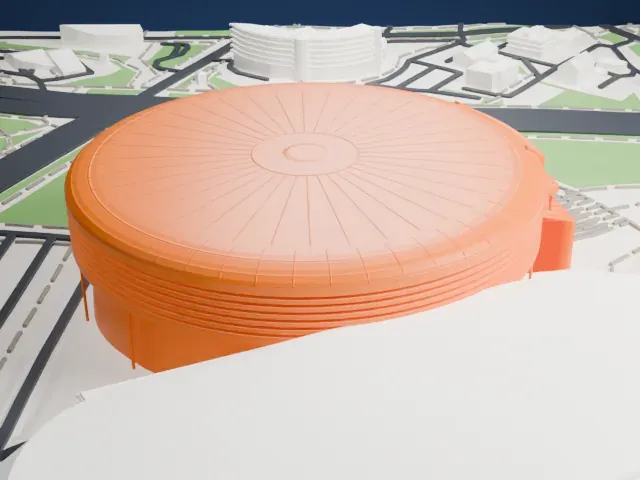 South
-
 West
- On a 160 mm print
- 17 mm
- Scale
- 1:3,750
17 mm tall on a 160 mm print
Make this print opens the generator on a 600 m square around the landmark. Buildings print at close to true scale, so the landmark grows with the print size.
- Six bands on the drum
Six horizontal window strips are recessed into the round drum, with plain bands above and below them. Layers of 0.12 to 0.16 mm keep all six bands distinct.
- Canopy, truss and stairs
The entrance canopy carries a lattice truss and stands over a broad flight with many handrails. Print friendly adapts these fine members; Full detail keeps them for a large print.
- One piece with the ground
Minsk-Arena is joined to the ground in the exported file, and the four-side check found no floating parts, so nothing needs gluing.
- Pick the detail for your nozzle
In the Buildings settings, set Landmark detail to Print friendly to adapt thin parts and small details to the print scale. Full detail keeps every modeled feature, for larger prints or a finer nozzle.
- Colors
Buildings, roads, water and ground arrive as separate filament slots in the 3MF. Minsk-Arena takes the building color.
- File format
You get a 3MF for Bambu Studio, OrcaSlicer or PrusaSlicer. Any of them can save it as STL if you need one.
About Minsk-Arena
Minsk-Arena is Minsk's main indoor arena, in the capital of Belarus. Its complex adds an open parking structure of several levels, with 1,080 spaces, to a main hall that can take 15,000 people, and joins it to a velodrome of 2,000 seats and a 3,000-seat rink for speed skating. A presidential decree at the close of 2005 set the project going; building began in spring 2006, with Bilproekt as general designer and Minskprombud as general contractor.
The velodrome came into use on December 30, 2008, its 250 m track laid in Siberian spruce and linked straight through to the ice hall that followed on January 30, 2010. The oval in that hall measures 400 meters, and it was the first indoor hall for speed skating in Belarus. Ice covers roughly 10,000 m2 in all, half of it given over to speed skating, while two hockey rinks and two curling sheets lie inside the oval.
Ice hockey is one of the building's main uses: HC Dinamo Minsk, a Kontinental Hockey League club, plays at home here, in a building that replaced the 1966 Minsk Sports Palace and its roughly 3,300 places. The formal opening on January 30, 2010 coincided with the league's 2nd All-Star Game; Dinamo had already faced Metallurg Magnitogorsk there on January 14, 2010. The 2014 IIHF World Championship used it as one of its two main venues, and it has staged the Junior Eurovision Song Contest in 2010 and 2018.
About this model
Minsk-Arena is one of more than 4,300 landmark models in Mini Skyline. They are made with AI, and each one is checked from four sides in its real surroundings before release. Everything around it is built from OpenStreetMap and Overture map data. If you would rather print the shape from map data, turn off Landmark models in the Buildings settings.
Keep exploring