3D print Vaught–Hemingway Stadium
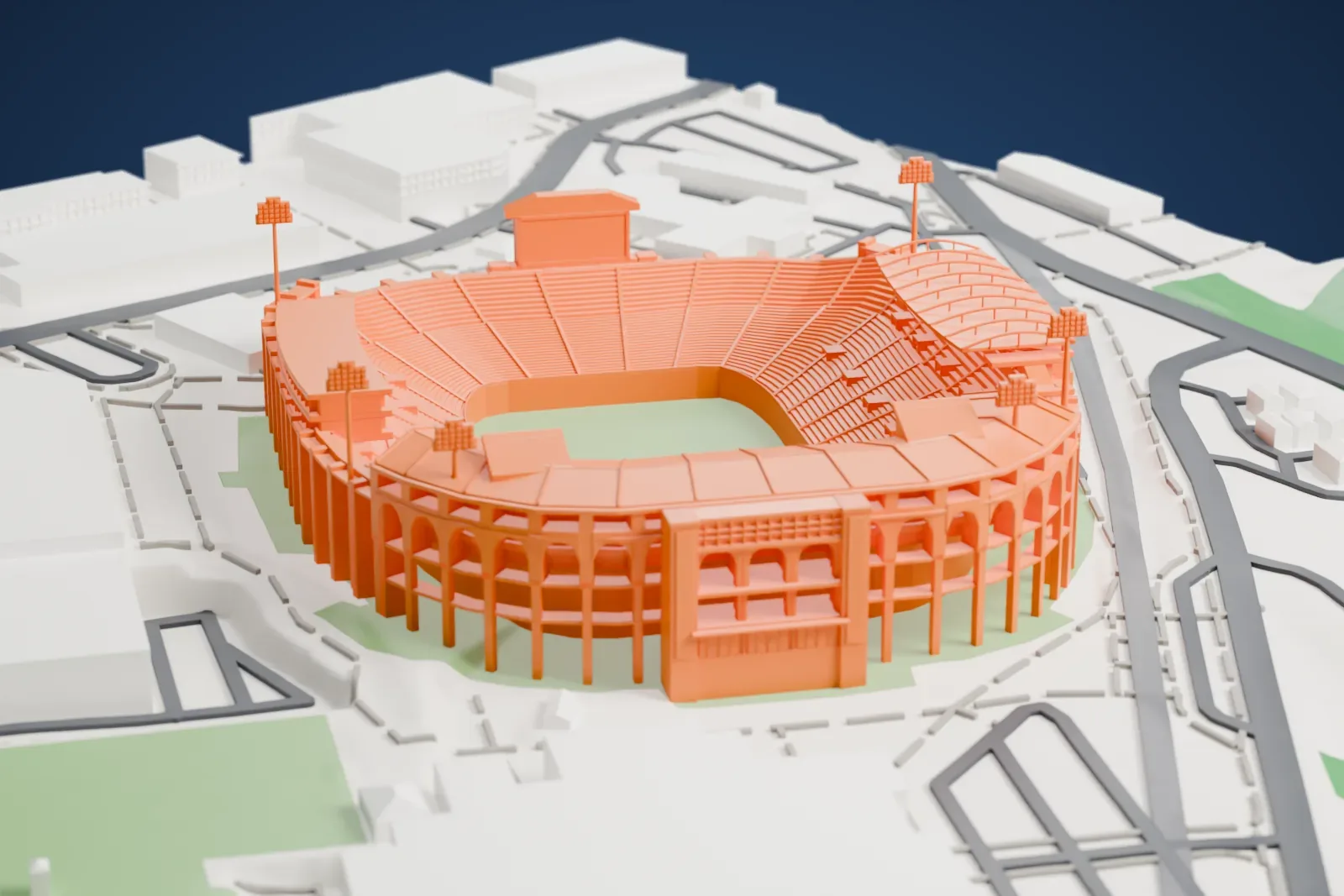
A free, printable model of the stadium's tiered bowl, arched outer wall and tall light towers, with the roads, large buildings and open ground around it, generated from real map data in your browser.
-
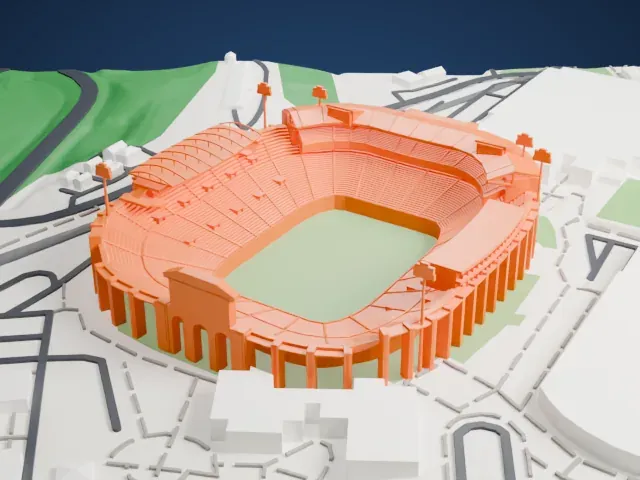 North
-
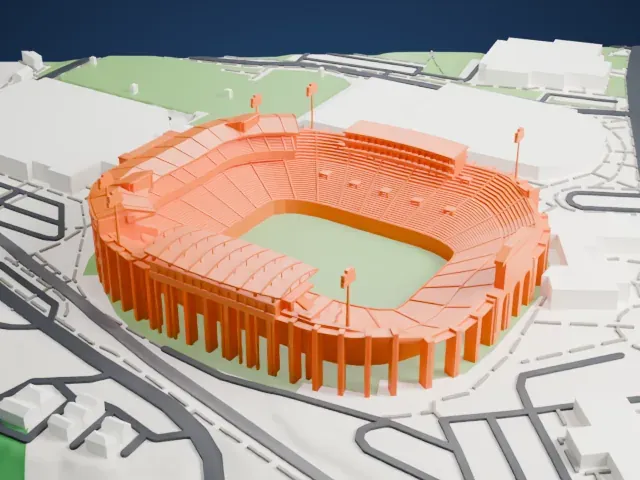 East
-
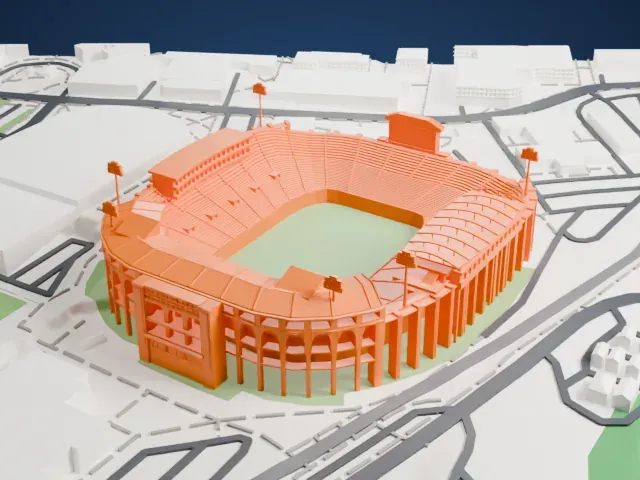 South
-
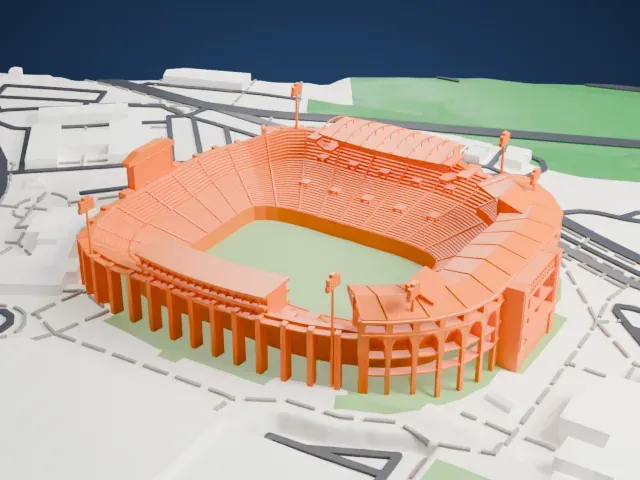 West
- On a 160 mm print
- 17 mm
- Scale
- 1:3,750
17 mm tall on a 160 mm print
Make this print opens the generator on a 600 m square around the landmark. Buildings print at close to true scale, so the landmark grows with the print size.
- Thin light towers
Slender light towers stand around the stadium. Print friendly adapts these thin parts to your print scale; Full detail keeps them. Print slowly with good cooling so the tall tips form cleanly.
- Columns and arches outside
A row of tall, narrow columns and arched openings wraps the outer wall. A larger print and layers of 0.12 to 0.16 mm keep these vertical details crisp.
- One piece with the ground
Vaught–Hemingway Stadium is joined to the ground in the exported file, and the four-side check found no floating parts, so nothing needs gluing.
- Pick the detail for your nozzle
In the Buildings settings, set Landmark detail to Print friendly to adapt thin parts and small details to the print scale. Full detail keeps every modeled feature, for larger prints or a finer nozzle.
- Colors
Buildings, roads, water and ground arrive as separate filament slots in the 3MF. Vaught–Hemingway Stadium takes the building color.
- File format
You get a 3MF for Bambu Studio, OrcaSlicer or PrusaSlicer. Any of them can save it as STL if you need one.
About Vaught–Hemingway Stadium
Vaught–Hemingway Stadium sits in University, Mississippi, United States, although its address is in Oxford. This outdoor stadium is the home field for the Rebels, the University of Mississippi's college football team. Construction began in 1915 as a project sponsored by the federal government. Expansions and renovations over time have enlarged the stadium and modernized it, letting the Rebels host every home game on campus. Until the early to mid-1990s, many of Ole Miss's major rivalry games were played at Mississippi Veterans Memorial Stadium in Jackson, about 270 km (170 miles) south of campus.
The stadium was first named for Judge William Hemingway, a law professor who chaired the university's committee on athletics. Coach Johnny Vaught's name was added on October 12, 1982, and on September 5, 1998 the field was named to honor Dr. Jerry Hollingsworth, a longtime supporter, giving the official title "Vaught–Hemingway Stadium at Hollingsworth Field". The playing surface has changed often. It was one of the first stadiums in the country to swap natural grass for artificial turf, in 1970, and it went back to natural grass in 1984. AstroPlay arrived in 2003, FieldTurf in 2009 and natural grass again in 2016.
In 2002, the south end zone's bleachers gave way to a rounded bowl with luxury boxes and covered club seats in an upper deck, and capacity grew by nearly 10,000, to 60,580. A 2016 expansion completed the bowl shape and added 3,458 seats, bringing capacity to 64,038 and making it the largest stadium in the state. The Manning Center, an indoor practice and locker room complex of 14,000 m2 (150,000 square feet), opened in 2004 and connects to the stadium through a secured tunnel.
About this model
Vaught–Hemingway Stadium is one of more than 4,300 landmark models in Mini Skyline. They are made with AI, and each one is checked from four sides in its real surroundings before release. Everything around it is built from OpenStreetMap and Overture map data. If you would rather print the shape from map data, turn off Landmark models in the Buildings settings.
Keep exploring