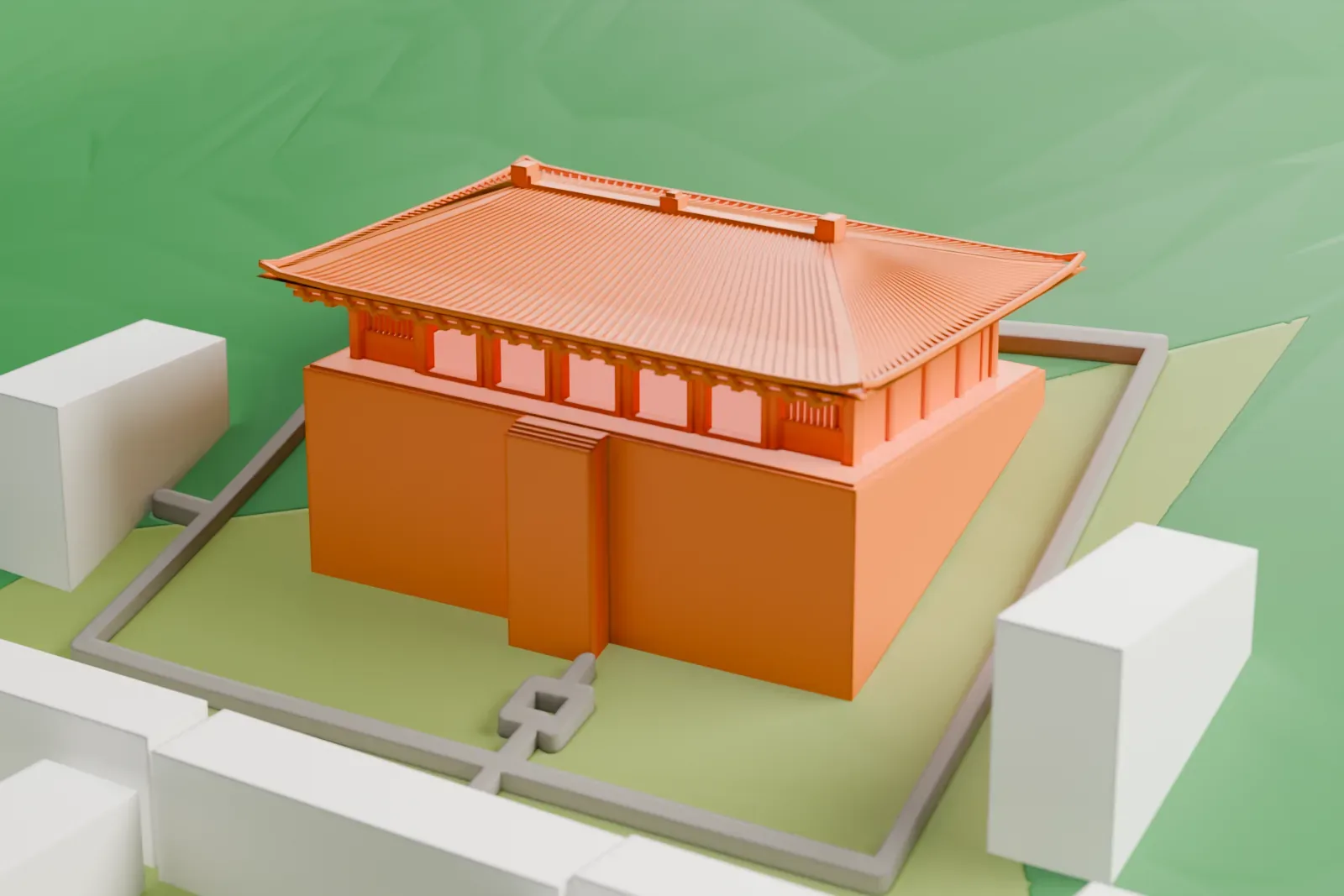
3D print Foguang Temple
A free, printable model of Foguang Temple, a hall with a broad ridged tile roof on a stone base, on a green hillside, generated from real map data in your browser.
-
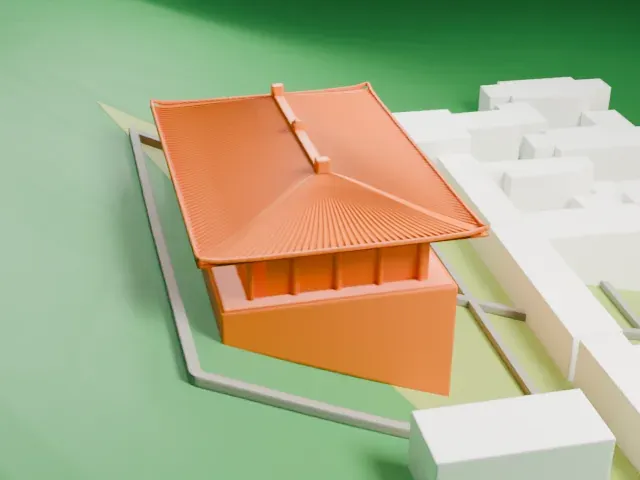 North
-
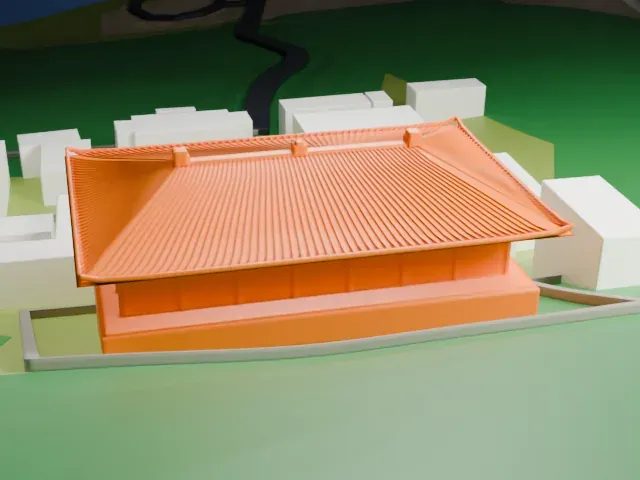 East
-
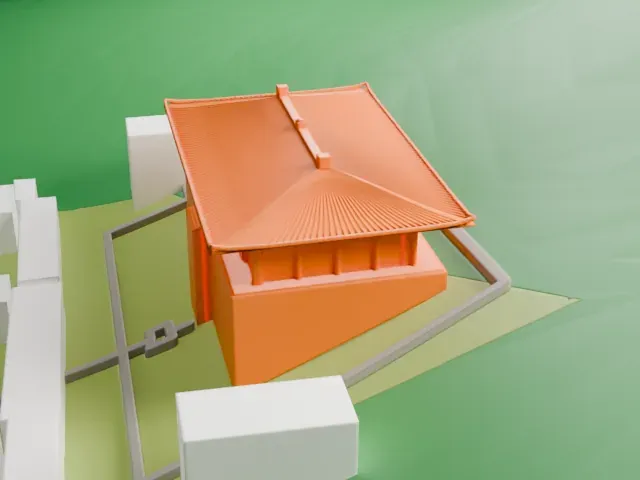 South
-
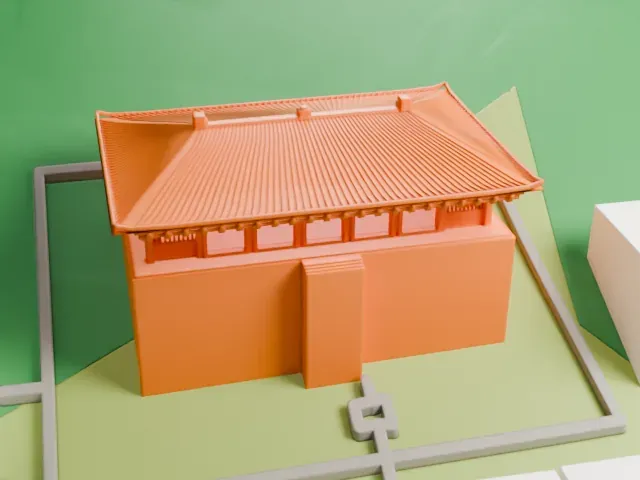 West
The model you print
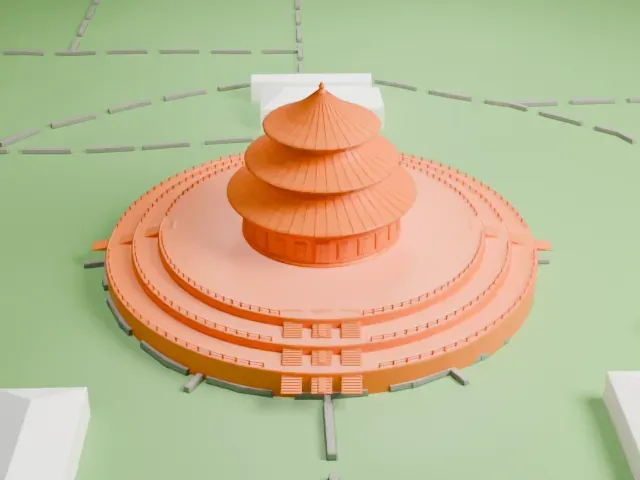
Foguang Temple in 3D
The landmark on its own, at its size on a 160 mm print. Print friendly thickens thin parts for a 0.4 mm nozzle; Full detail keeps every part.
- On a 160 mm print
- 7 mm
- Scale
- 1:3,750
7 mm tall on a 160 mm print
Make this print opens the generator on a 600 m square around the landmark. Buildings print at close to true scale, so the landmark grows with the print size.
- Fine roof tile ridges
Many thin ridges run down the broad hipped roof. Print friendly adapts these fine lines to the print scale; Full detail and a 0.12–0.16 mm layer height keep them on a larger print.
- Wide overhanging eaves
The roof overhangs the walls on all sides and its corners curve upward. Slow printing with cooling helps these thin edges, and a bigger print keeps them sturdier.
- One piece with the ground
Foguang Temple is joined to the ground in the exported file, and the four-side check found no floating parts, so nothing needs gluing.
- Pick the detail for your nozzle
In the Buildings settings, set Landmark detail to Print friendly to adapt thin parts and small details to the print scale. Full detail keeps every modeled feature, for larger prints or a finer nozzle.
- Colors
Buildings, roads, water and ground arrive as separate filament slots in the 3MF. Foguang Temple takes the building color.
- File format
You get a 3MF for Bambu Studio, OrcaSlicer or PrusaSlicer. Any of them can save it as STL if you need one.
About Foguang Temple
Foguang Temple is a Buddhist temple in Wutai County, Shanxi Province, China, five kilometers from Doucun Town. The complex spans about 8.4 acres and holds more than 120 structures from the Northern Wei to the Qing dynasty. It is listed within the Mount Wutai site, a UNESCO World Heritage Site. Its origins lie in the fifth century, under the Northern Wei dynasty.
The main hall, the Dongda Hall, dates from 857, in the Tang dynasty. Among dated wooden buildings in China, it is third oldest, and the largest of the oldest three. This single-story hall has seven bays and measures 34 by 17.7 meters (110 by 58 ft), and it sits on the far eastern side of the temple, standing on a large stone platform. It is described as the only building that combines Tang-dynasty architecture, sculpture, murals and calligraphic inscriptions in one structure, known as the "Four Supremacies".
Emperor Wuzong banned Buddhism in China in 845, and as part of the persecution the temple was burned to the ground; only the Zushi pagoda survived from its early history. It was rebuilt in 857, with most of the funds coming from a woman named Ning Gongyu and the work directed by a monk named Yuancheng. In 1937, the historians of architecture Liang Sicheng and Lin Huiyin rediscovered the temple. The grounds also hold the Wenshu Hall, dating from 1137, and one of just two Northern Wei pagodas that survive in China.
About this model
Foguang Temple is one of more than 6,500 landmark models in Mini Skyline. They are made with AI, and each one is checked in its real surroundings before release. Each model is written as code from public descriptions, plans, photographs and aerial views used only as references; no image or third-party model is copied into it. Everything around it is built from OpenStreetMap and Overture map data. Rights in the building itself, its name and any brands on it are not granted by Mini Skyline; clear them separately before you sell prints. If you would rather print the shape from map data, turn off Landmark models in the Buildings settings.
Mini Skyline is not affiliated with, or endorsed by, the owners of this building or its names and marks.
Keep exploring