3D print the Grand Palais
A free, printable model of the Grand Palais and the streets and buildings around it in Paris, generated from real map data in your browser.
-
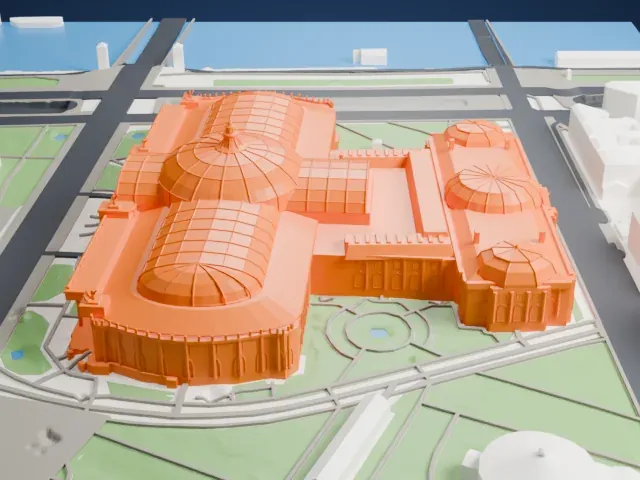 North
-
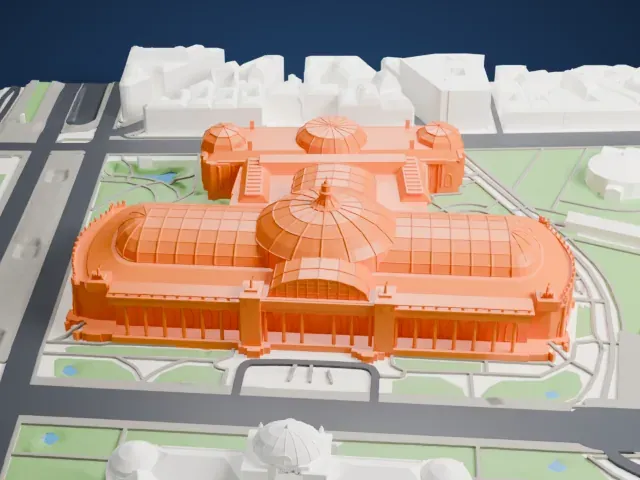 East
-
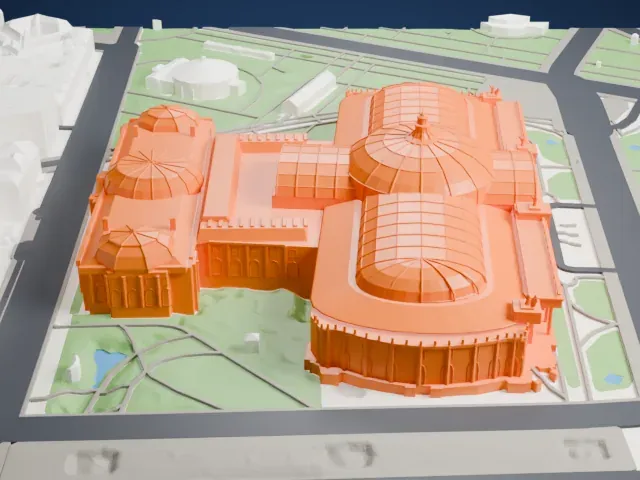 South
-
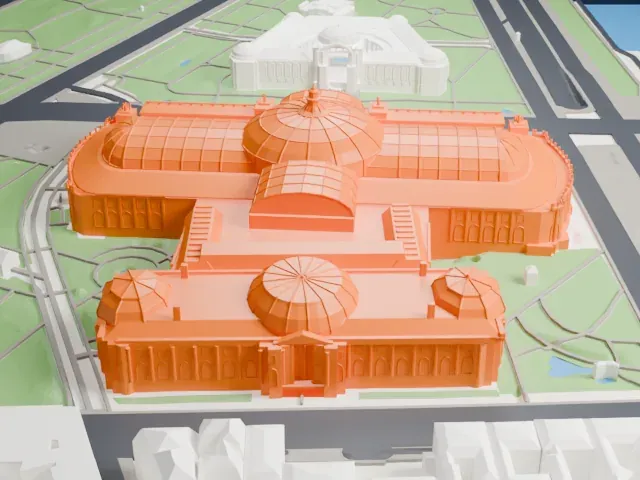 West
The model you print
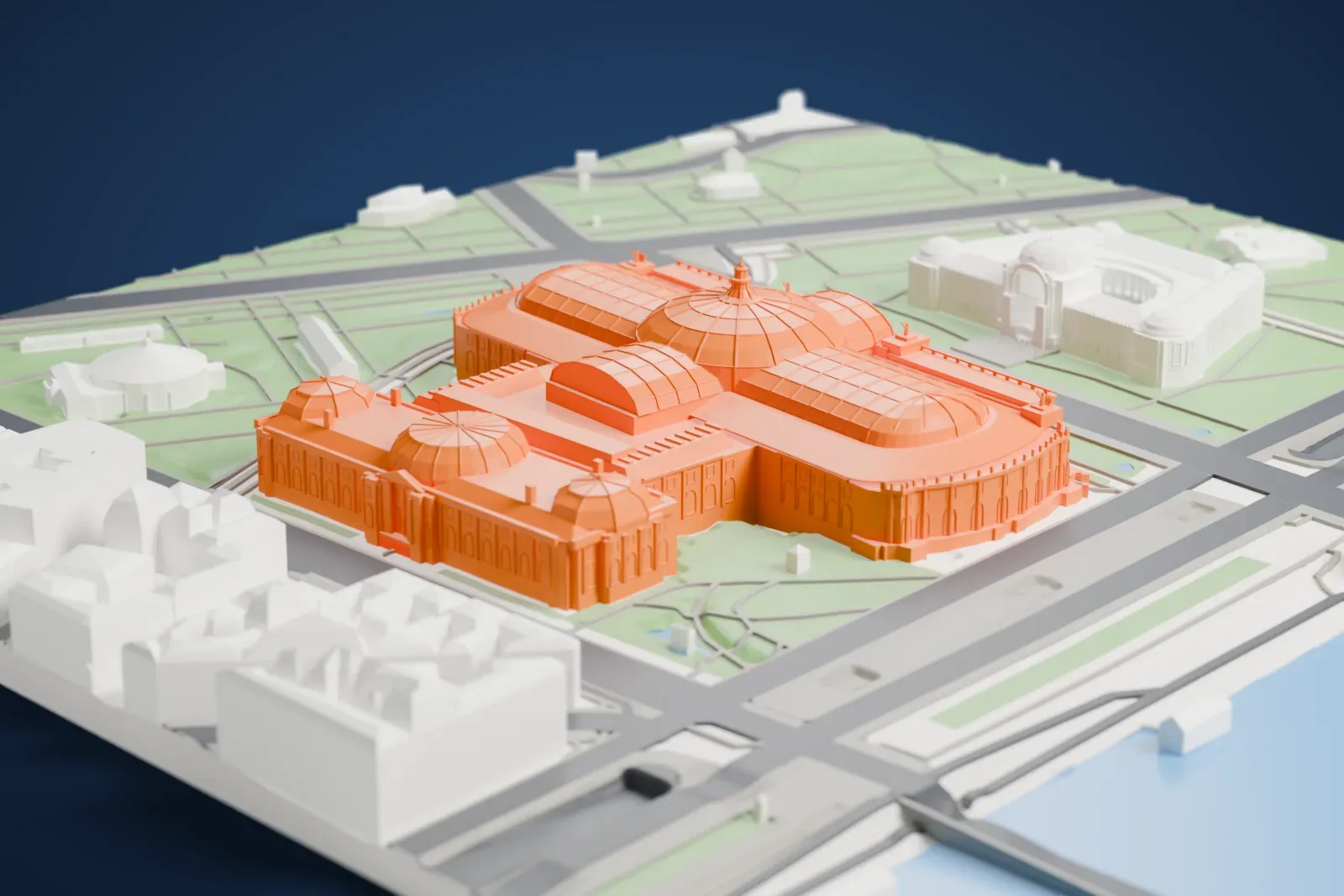
Grand Palais in 3D
The landmark on its own, at its size on a 160 mm print. Print friendly thickens thin parts for a 0.4 mm nozzle; Full detail keeps every part.
- On a 160 mm print
- 18 mm
- Scale
- 1:3,750
18 mm tall on a 160 mm print
Make this print opens the generator on a 600 m square around the landmark. Buildings print at close to true scale, so the landmark grows with the print size.
- The long glass vault
The hall's long barrel vault is the shape to watch. A larger print, or Full detail with a fine nozzle, keeps the curve and the facade edges crisp.
- Layers for the roofline
The vault roof spans the whole main hall. Layers of 0.12 to 0.16 mm keep its long curve crisp, and a slower print helps it stay even.
- One piece with the ground
The Grand Palais is joined to the ground in the exported file, and the four-side check found no floating parts, so nothing needs gluing.
- Pick the detail for your nozzle
In the Buildings settings, set Landmark detail to Print friendly to adapt thin parts and small details to the print scale. Full detail keeps every modeled feature, for larger prints or a finer nozzle.
- Colors
Buildings, roads, water and ground arrive as separate filament slots in the 3MF. The Grand Palais takes the building color.
- File format
You get a 3MF for Bambu Studio, OrcaSlicer or PrusaSlicer. Any of them can save it as STL if you need one.
About the Grand Palais
The Grand Palais, in the 8th arrondissement of Paris, is an exhibition hall and museum complex that also counts as a historic site. It stands on Avenue Winston-Churchill, with the Champs-Élysées on one side and the Seine on the other. Work began in 1897, after the Palais de l'Industrie came down, as part of the preparations for the Universal Exposition of 1900, which also left the neighboring Petit Palais and the Pont Alexandre III.
The palace was meant to host big official art exhibitions, and a pediment on the building carries an inscription describing it as a monument the Republic dedicated to the glory of French art. It was built in Beaux-Arts taste, with ornate stone facades, glass vaults, reinforced concrete and an iron and light-steel frame. The contract went to four architects, Charles Girault, Albert Thomas, Albert Louvet and Henri Deglane, and the opening was held on May 1, 1900.
The principal space extends nearly 240 m (790 ft), and the nave measures about 200 m (660 ft) by 50 m (160 ft). Under the main framework the roof stands 35 m (115 ft) clear of the floor, and under the central cupola it reaches 45 m (148 ft), while the campanile is about 60 m (200 ft) tall. The iron, steel and glass barrel vault made it one of the last big transparent buildings modeled on London's Crystal Palace, and copper quadrigas by Georges Récipon top both corners of the main facade.
About this model
The Grand Palais is one of more than 5,500 landmark models in Mini Skyline. They are made with AI, and each one is checked in its real surroundings before release. Each model is written as code from public descriptions, plans, photographs and aerial views used only as references; no image or third-party model is copied into it. Everything around it is built from OpenStreetMap and Overture map data. Rights in the building itself, its name and any brands on it are not granted by Mini Skyline; clear them separately before you sell prints. If you would rather print the shape from map data, turn off Landmark models in the Buildings settings.
Mini Skyline is not affiliated with, or endorsed by, the owners of this building or its names and marks.
Same skyline