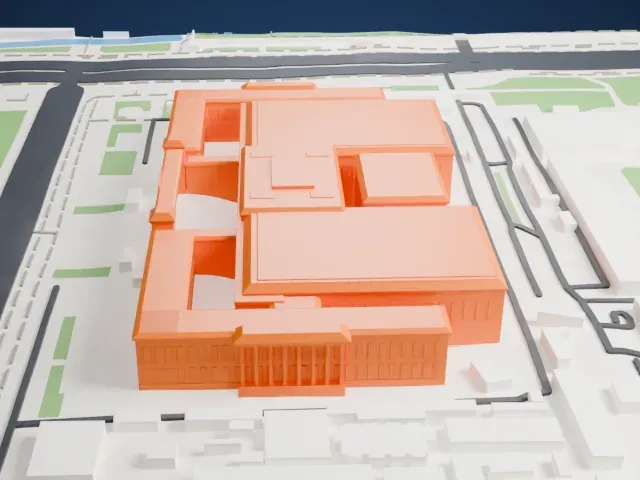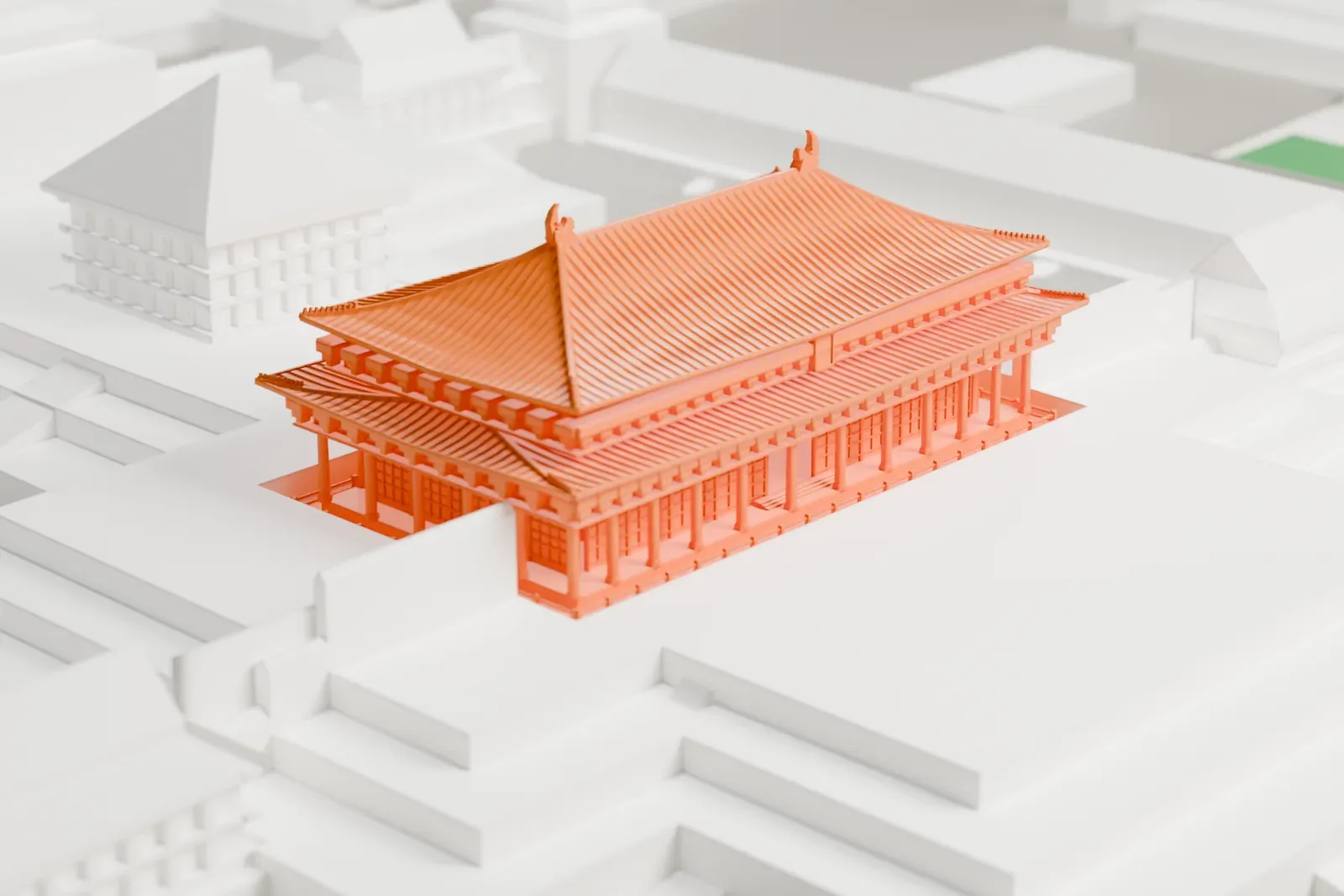
3D print the Hall of Supreme Harmony
A free, printable model of the Hall of Supreme Harmony on its three-level terrace in Beijing's Forbidden City, with the surrounding city, generated from real map data in your browser.
-
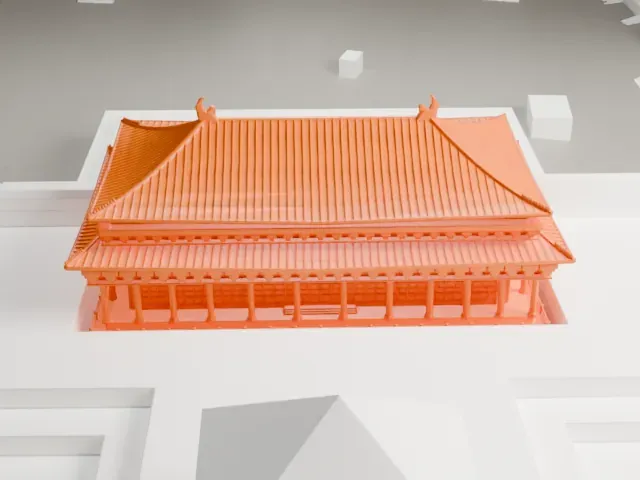 North
-
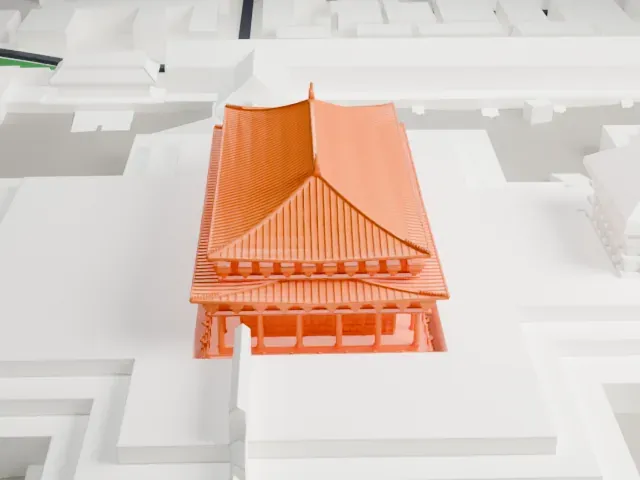 East
-
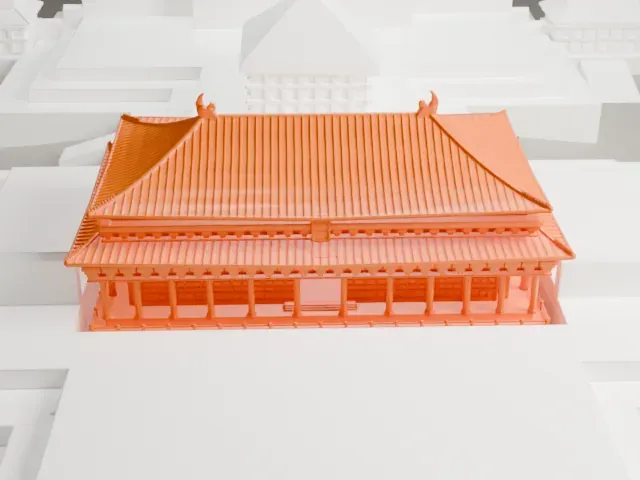 South
-
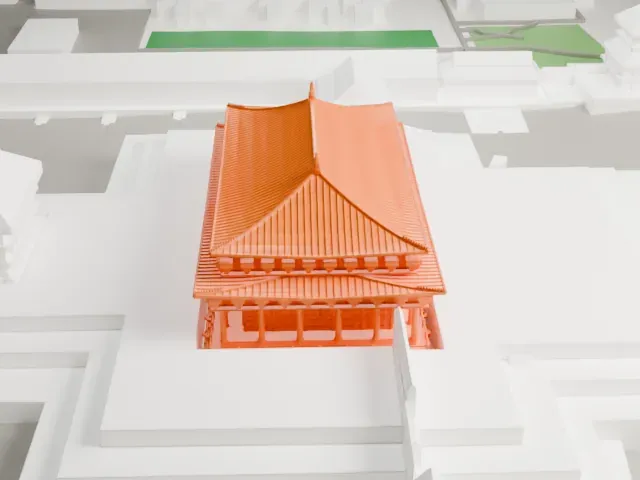 West
The model you print
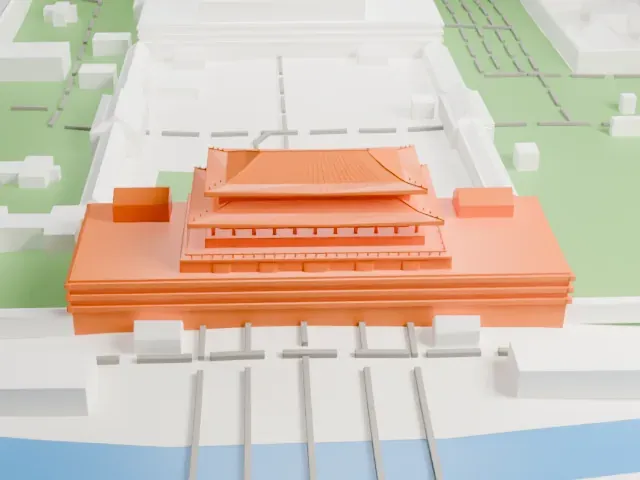
Hall of Supreme Harmony in 3D
The landmark on its own, at its size on a 160 mm print. Print friendly thickens thin parts for a 0.4 mm nozzle; Full detail keeps every part.
- Real height
- 30 m
- On a 160 mm print
- 10 mm
- Scale
- 1:3,750
30 m of the Hall of Supreme Harmony, 10 mm on your shelf
Make this print opens the generator on a 600 m square around the landmark. Buildings print at close to true scale, so the landmark grows with the print size.
- Curved hip roofs
Two curved four-sided hip roofs and the paired ridge ornaments define the silhouette. Print friendly simplifies the tile courses and corner figures; Full detail keeps them for a large print.
- Brackets and terrace
The veranda columns, stepped brackets and three-stage marble base carry fine repeated detail. A larger print or 0.12–0.16 mm layers helps the brackets and balustrade read cleanly.
- One piece with the ground
The Hall of Supreme Harmony is joined to the ground in the exported file, and the four-side check found no floating parts, so nothing needs gluing.
- Pick the detail for your nozzle
In the Buildings settings, set Landmark detail to Print friendly to adapt thin parts and small details to the print scale. Full detail keeps every modeled feature, for larger prints or a finer nozzle.
- Colors
Buildings, roads, water and ground arrive as separate filament slots in the 3MF. The Hall of Supreme Harmony takes the building color.
- File format
You get a 3MF for Bambu Studio, OrcaSlicer or PrusaSlicer. Any of them can save it as STL if you need one.
About the Hall of Supreme Harmony
The Hall of Supreme Harmony is the biggest hall inside the Forbidden City, Beijing, China. It sits on the complex's main axis, just behind the Gate of Supreme Harmony, atop three marble levels and among bronze incense burners. In China it ranks among the largest wooden buildings and is the largest surviving one. Ming and Qing emperors held enthronement and wedding ceremonies here. The name changed repeatedly: first the Hall of Venerating Heaven, then the Hall of Imperial Supremacy in 1562, and finally the present name, given by the Shunzhi Emperor in 1645.
Construction and fire have shaped the building over centuries. The original hall dates to 1421, in the Ming dynasty, and fire destroyed it seven times during the Qing. Its last rebuilding spanned 1695 to 1697. A 16th-century reconstruction shrank the plan from roughly 95 by 48 meters (312 by 157 ft) to 65 by 37 meters (213 by 121 ft); the stated reason was that logs big enough for the old size could not be obtained.
Inside, eleven bays span the width, the central room takes nine of them, and the depth is five bays; nine and five carried imperial symbolism. Gold covers the six columns nearest the throne, and dragons decorate the whole interior. The throne is red sandalwood, and above it the ceiling holds a caisson with a coiled dragon. Ming emperors conducted state business in the hall; under the Qing it served only for ceremonies including enthronements, investitures and imperial weddings.
About this model
The Hall of Supreme Harmony is one of more than 4,900 landmark models in Mini Skyline. They are made with AI, and each one is checked from four sides in its real surroundings before release. Everything around it is built from OpenStreetMap and Overture map data. If you would rather print the shape from map data, turn off Landmark models in the Buildings settings.
Same skyline