3D print the Hermannsdenkmal
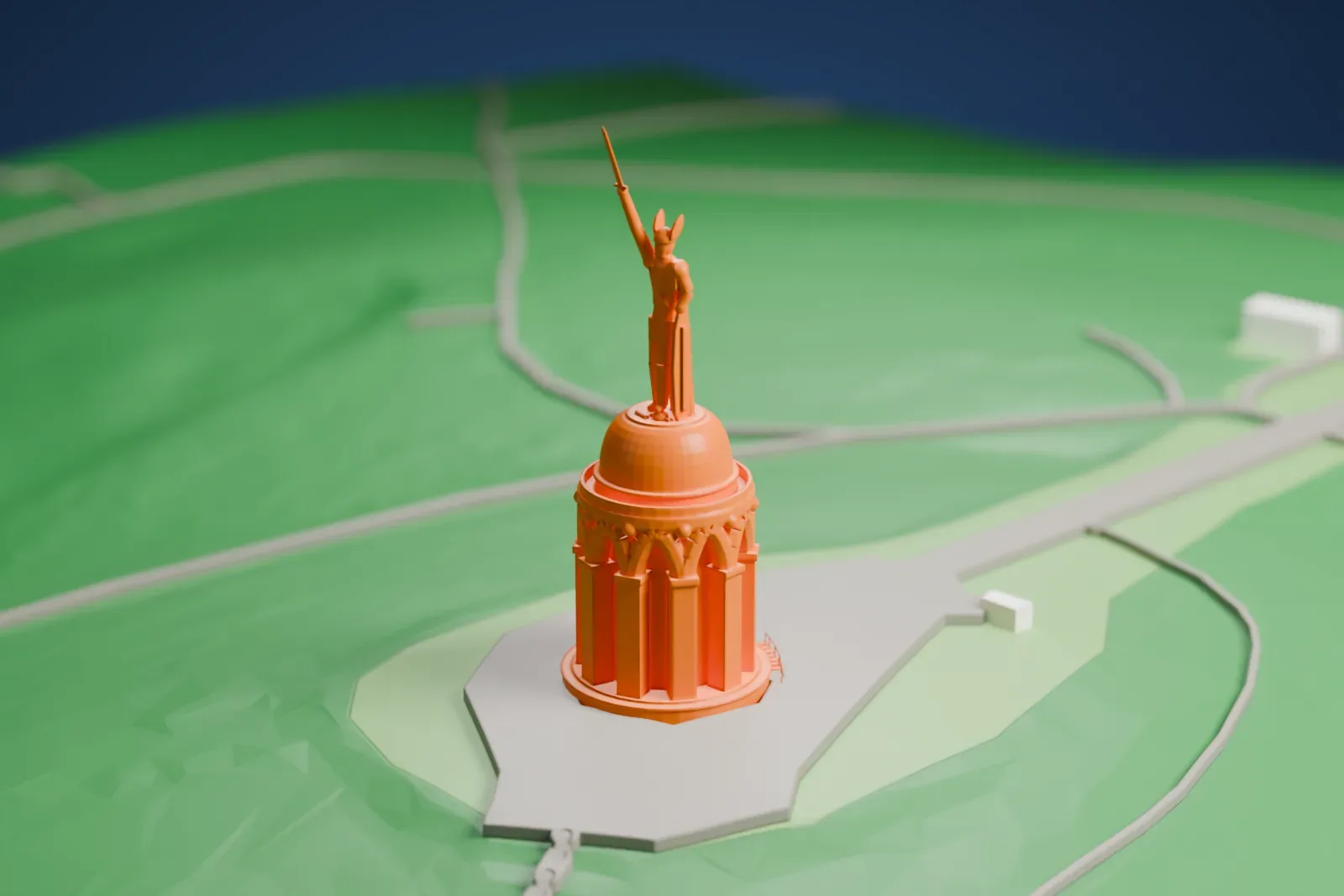
A free, printable model of the Hermannsdenkmal, a domed monument topped by a statue, with the forested hill and paths around it, generated from real map data in your browser.
-
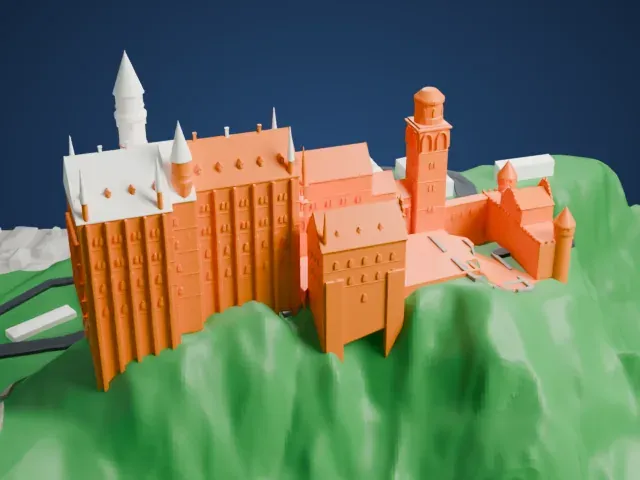
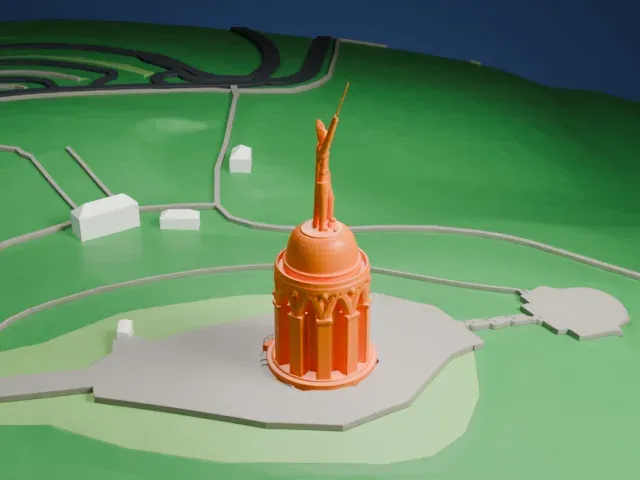 North
-
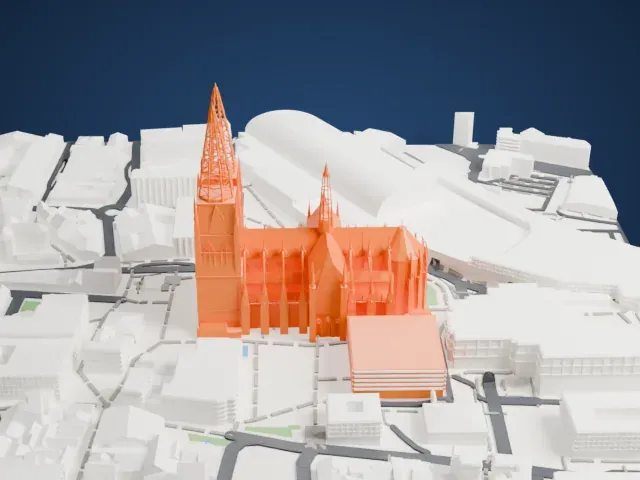
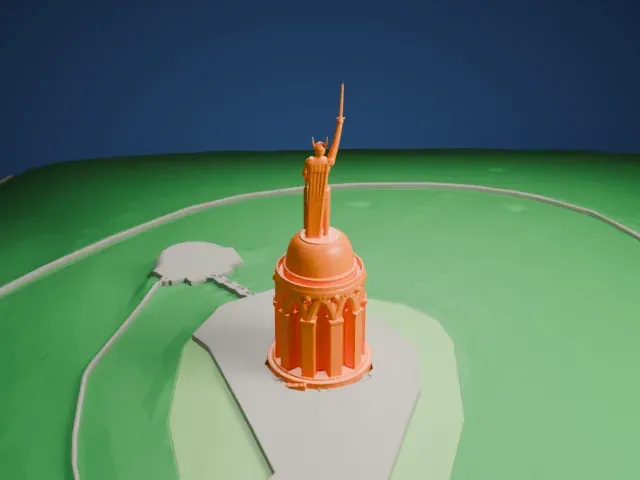 East
-
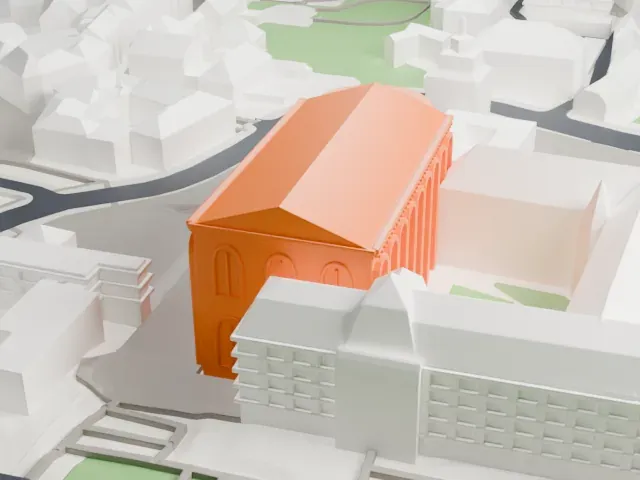
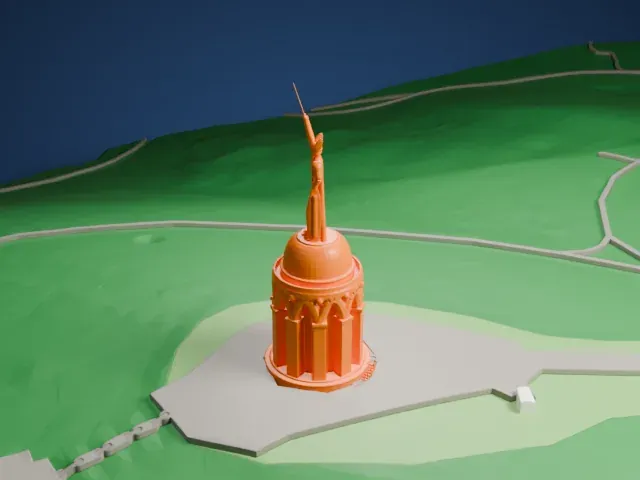 South
-
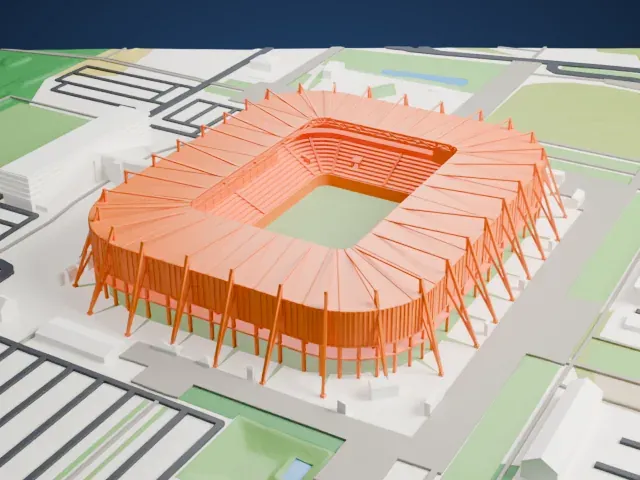
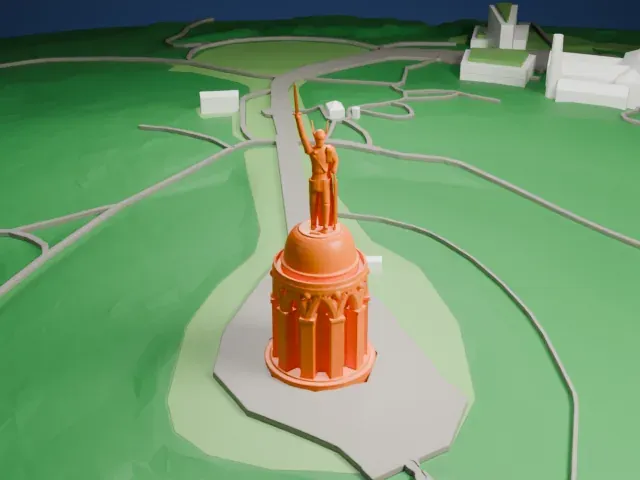 West
The model you print
Hermannsdenkmal in 3D
The landmark on its own, at its size on a 160 mm print. Print friendly thickens thin parts for a 0.4 mm nozzle; Full detail keeps every part.
- On a 160 mm print
- 14 mm
- Scale
- 1:3,750
14 mm tall on a 160 mm print
Make this print opens the generator on a 600 m square around the landmark. Buildings print at close to true scale, so the landmark grows with the print size.
- Statue with a raised sword
The figure on top and its thin raised sword are the most fragile part. Use Print friendly, or Full detail at a larger print size with 0.12-0.16 mm layers and slow, cooled printing near the tip.
- Arches under the dome
The ring of pointed arches and slim piers below the dome is fine detail. Larger prints keep these arches open and readable.
- One piece with the ground
The Hermannsdenkmal is joined to the ground in the exported file, and the four-side check found no floating parts, so nothing needs gluing.
- Pick the detail for your nozzle
In the Buildings settings, set Landmark detail to Print friendly to adapt thin parts and small details to the print scale. Full detail keeps every modeled feature, for larger prints or a finer nozzle.
- Colors
Buildings, roads, water and ground arrive as separate filament slots in the 3MF. The Hermannsdenkmal takes the building color.
- File format
You get a 3MF for Bambu Studio, OrcaSlicer or PrusaSlicer. Any of them can save it as STL if you need one.
About the Hermannsdenkmal
The Hermann Memorial (Hermannsdenkmal) is a monument in Germany's North Rhine-Westphalia, in the Lippe district, southwest of the town of Detmold. It occupies the Grotenburg, a densely forested 386 m hill in the Teutoburg Forest range, within the remains of a circular rampart. Building ran from 1838 to 1875 to honor the Cherusci war chief Arminius, called Hermann in German, and his victory over Rome in a battle fought in the Teutoburg Forest in 9 AD.
Ernst von Bandel arrived in the Teutoburg Forest in 1836 to realize his life's dream of a monument to Arminius, and he settled on the Grotenburg. In October 1838 the foundation stone went in. After King Ludwig I of Bavaria asked for a change, Bandel's final design of 1840 capped the temple with a dome surrounded by a gallery. The pedestal was finished in 1844, though it ran over its cost estimate by 4,000 thaler.
By 1860 an internal iron frame for the statue had been designed. In a Hanover workshop, Bandel worked on the copper plates from 1862. The monument was inaugurated on August 16, 1875, with Emperor William I attending, and some 20,000 to 30,000 people joined the festivities. Experts regard Kalkriese, roughly 100 km northwest, as the more likely site of the battle.
About this model
The Hermannsdenkmal is one of more than 6,500 landmark models in Mini Skyline. They are made with AI, and each one is checked in its real surroundings before release. Each model is written as code from public descriptions, plans, photographs and aerial views used only as references; no image or third-party model is copied into it. Everything around it is built from OpenStreetMap and Overture map data. Rights in the building itself, its name and any brands on it are not granted by Mini Skyline; clear them separately before you sell prints. If you would rather print the shape from map data, turn off Landmark models in the Buildings settings.
Mini Skyline is not affiliated with, or endorsed by, the owners of this building or its names and marks.
Keep exploring