3D print the Hobby–Eberly Telescope
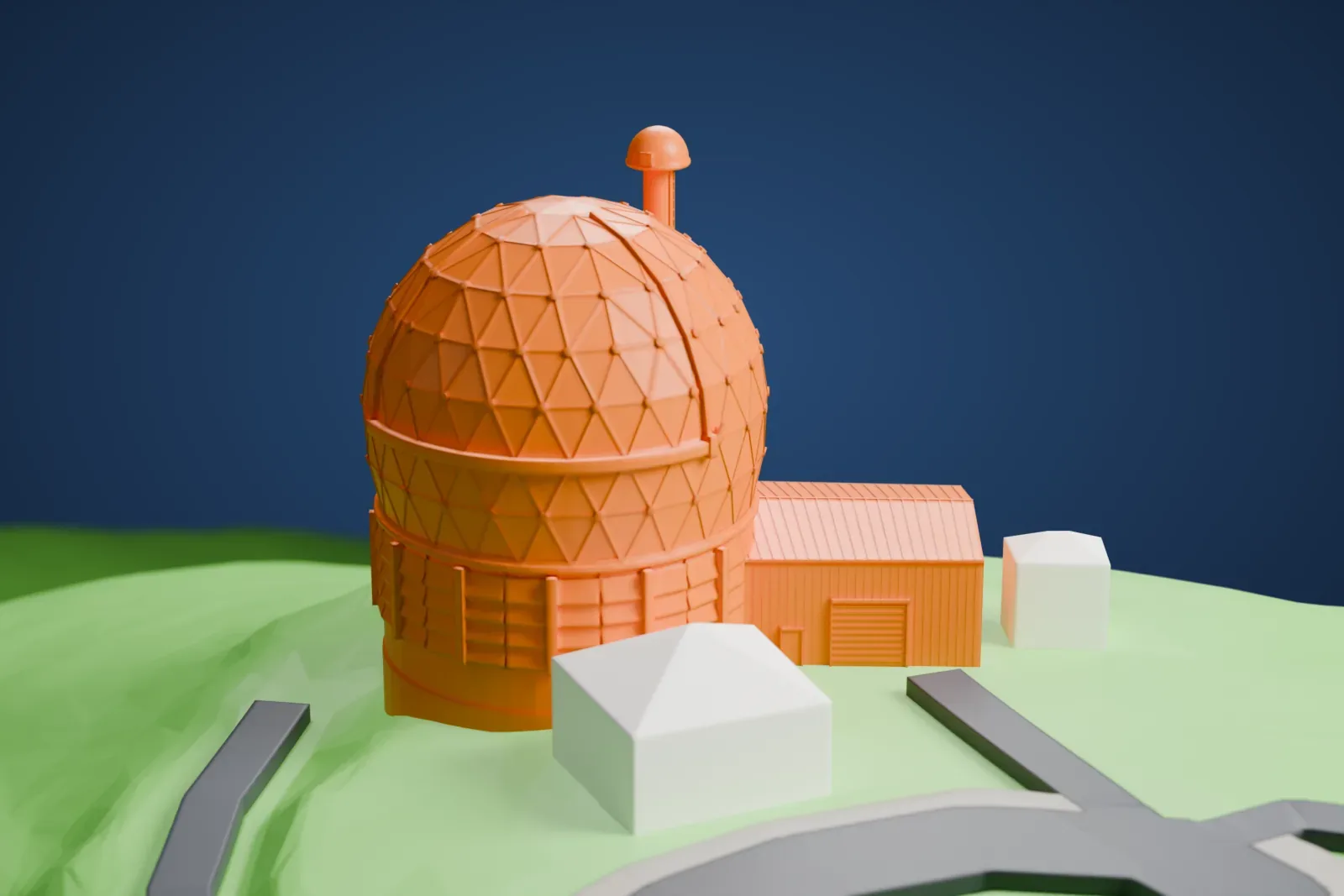
A free, printable model of the telescope's faceted dome, service wing and slim tower, on open green terrain with a road and a few small buildings, generated from real map data in your browser.
-
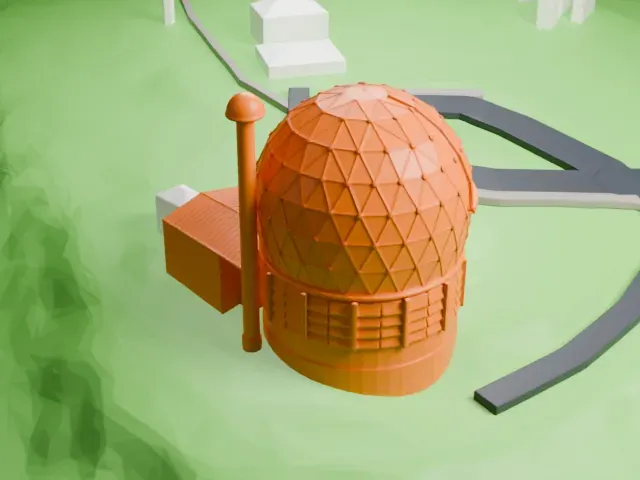 North
-
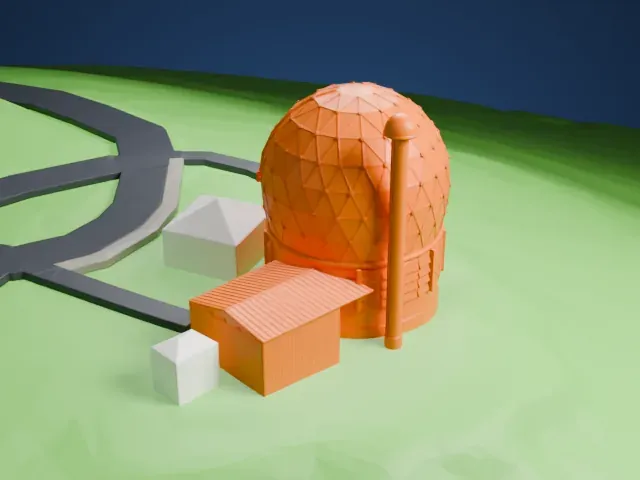 East
-
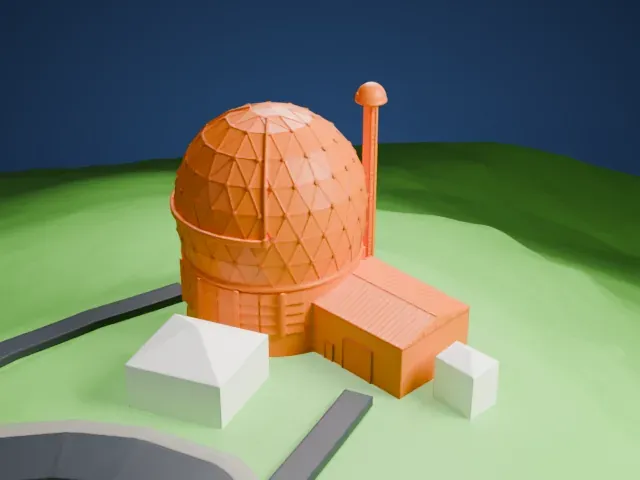 South
-
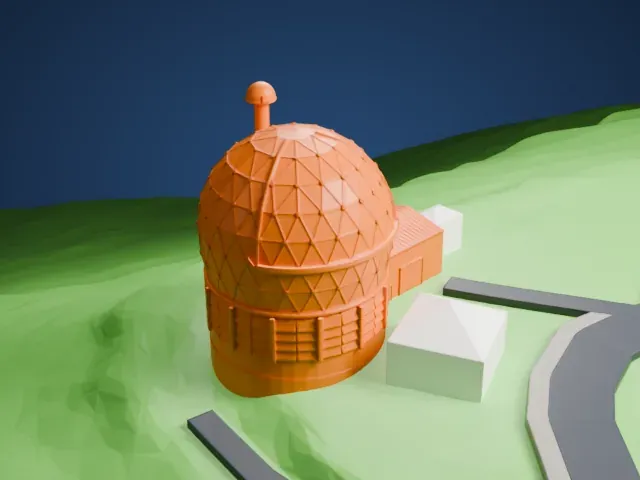 West
The model you print
Hobby–Eberly Telescope in 3D
The landmark on its own, at its size on a 160 mm print. Print friendly thickens thin parts for a 0.4 mm nozzle; Full detail keeps every part.
- On a 160 mm print
- 10 mm
- Scale
- 1:3,750
10 mm tall on a 160 mm print
Make this print opens the generator on a 600 m square around the landmark. Buildings print at close to true scale, so the landmark grows with the print size.
- Faceted dome skin
The dome is covered in a triangular panel pattern with raised seams, and a ring of louvers sits below it. Print friendly adapts these small seams to the print scale; Full detail keeps them on a larger print.
- Slim tower with a cap
A slender round tower with a rounded cap stands beside the dome. Printing slowly and using a layer height of 0.12–0.16 mm helps this thin, tall part print cleanly.
- One piece with the ground
The Hobby–Eberly Telescope is joined to the ground in the exported file, and the four-side check found no floating parts, so nothing needs gluing.
- Pick the detail for your nozzle
In the Buildings settings, set Landmark detail to Print friendly to adapt thin parts and small details to the print scale. Full detail keeps every modeled feature, for larger prints or a finer nozzle.
- Colors
Buildings, roads, water and ground arrive as separate filament slots in the 3MF. The Hobby–Eberly Telescope takes the building color.
- File format
You get a 3MF for Bambu Studio, OrcaSlicer or PrusaSlicer. Any of them can save it as STL if you need one.
About the Hobby–Eberly Telescope
The Hobby–Eberly Telescope (HET) has a 10-meter aperture (33 ft) and stands at the McDonald Observatory in the Davis Mountains of Texas. It is counted among the world's largest optical telescopes. It is named for Bill Hobby, a former lieutenant governor of Texas, and for Robert E. Eberly, a benefactor of Penn State, and the University of Texas McDonald Observatory operates it for a consortium of institutions.
Several design choices keep the cost down. The main mirror stays fixed at a 55° angle and turns only about its base, so a target is followed by shifting the instruments at the focus instead. That reaches about 70–81% of the sky and lets one target be followed for as long as two hours. The mirror is built from 91 hexagonal segments, which costs less than making one large mirror, and the design was more than 5 times as cost efficient for the size of its aperture as a more traditional telescope.
First light came in 1996. Since then the telescope has been used for studies of everything from the Solar System to other galaxies, and it has found planets orbiting other stars, measuring radial velocities down to a precision of 1 m/s. A tower next to it, named CCAS (Center of Curvature Alignment Sensor Tower), calibrates the mirror segments. The Southern African Large Telescope was based on this design.
About this model
The Hobby–Eberly Telescope is one of more than 4,900 landmark models in Mini Skyline. They are made with AI, and each one is checked from four sides in its real surroundings before release. Everything around it is built from OpenStreetMap and Overture map data. If you would rather print the shape from map data, turn off Landmark models in the Buildings settings.
Keep exploring