3D print the Hopperstad Stave Church
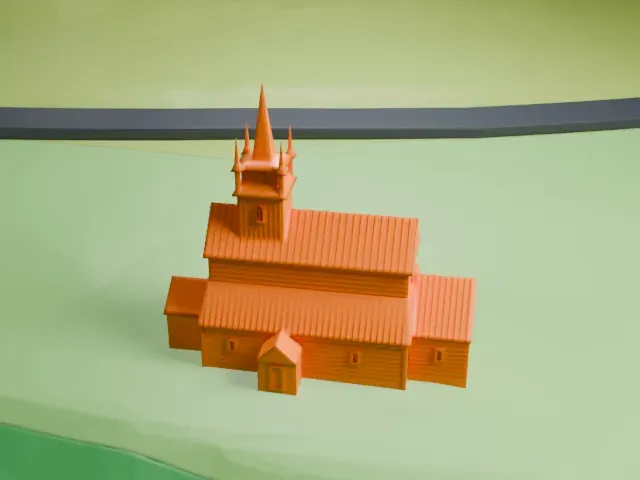
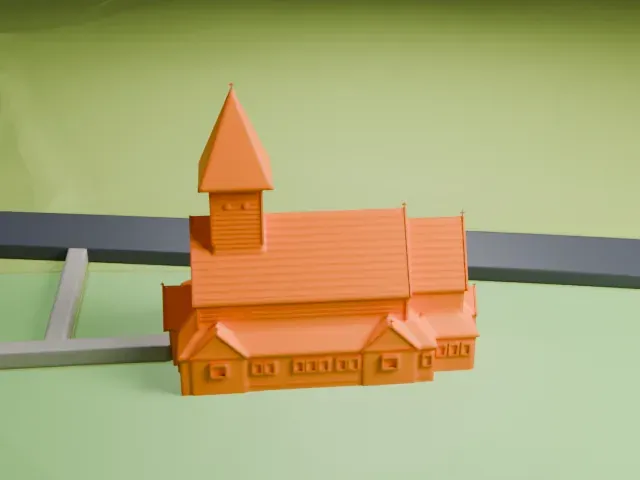
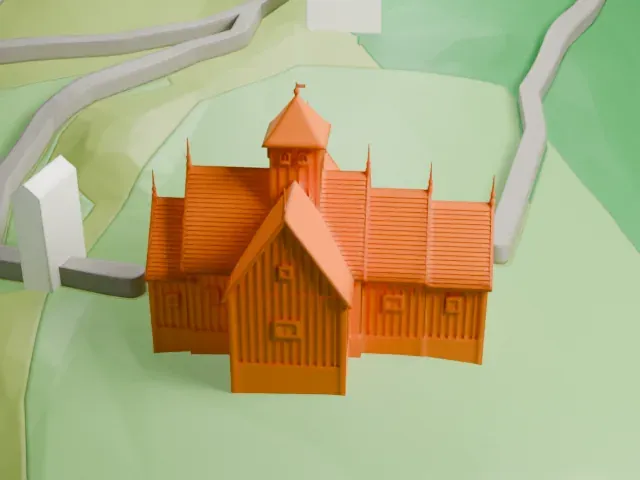
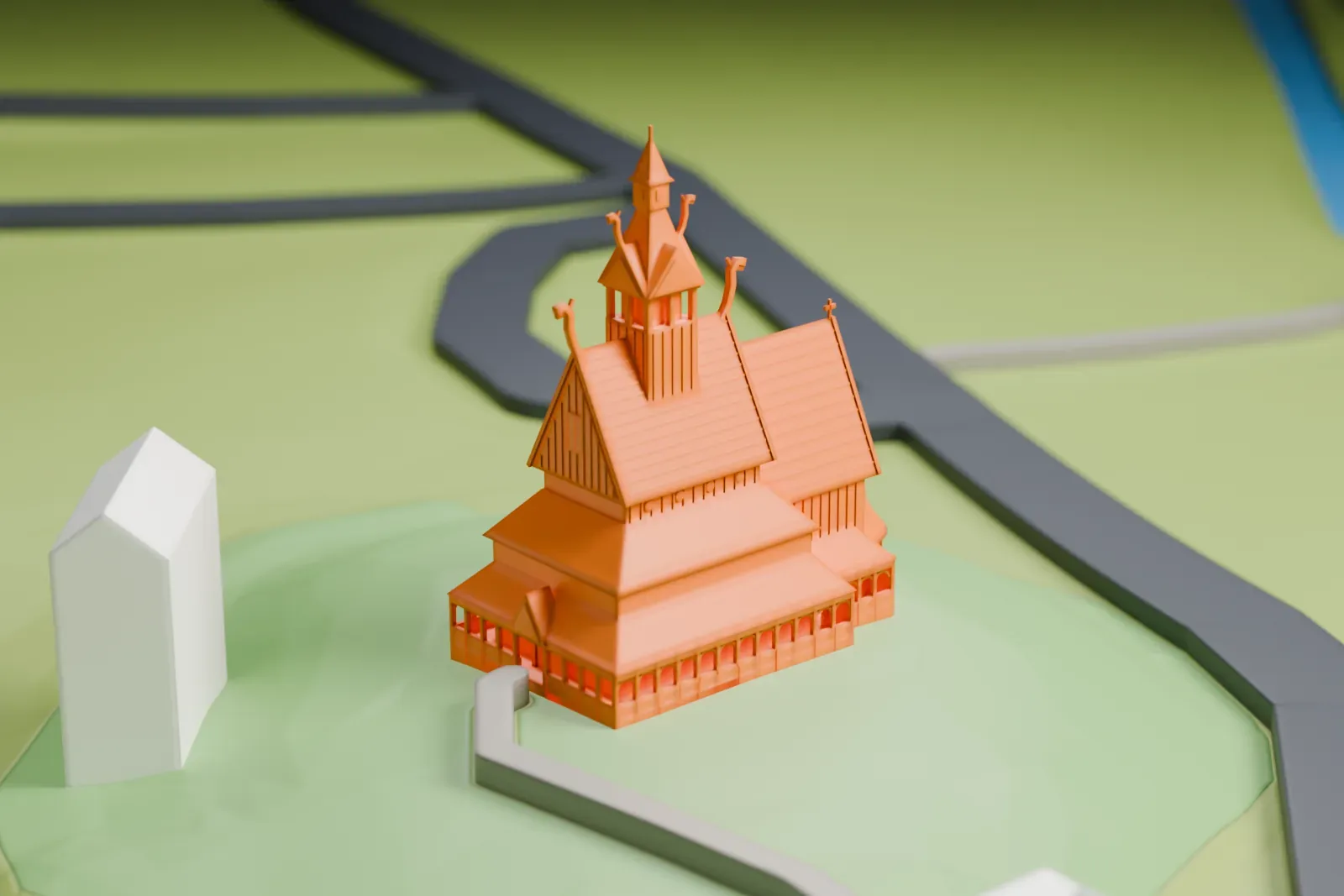
A free, printable model of Hopperstad Stave Church, with its stepped roofs, curved roof finials and slim central spire, set on a green hillside, generated from real map data in your browser.
-
 North
-
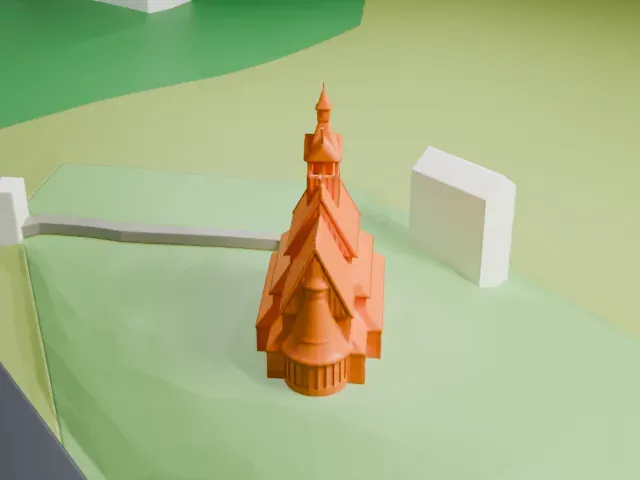 East
-
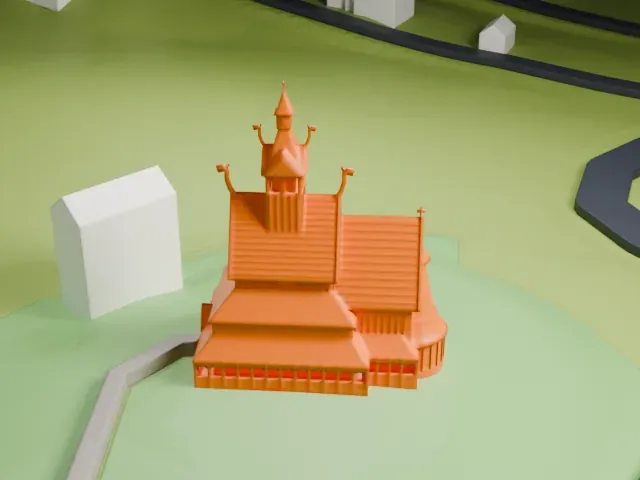 South
-
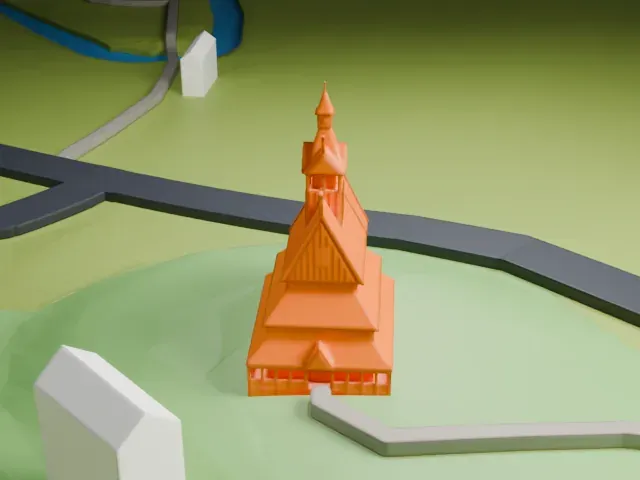 West
The model you print
Hopperstad Stave Church in 3D
The landmark on its own, at its size on a 160 mm print. Print friendly thickens thin parts for a 0.4 mm nozzle; Full detail keeps every part.
- On a 160 mm print
- 6 mm
- Scale
- 1:3,750
6 mm tall on a 160 mm print
Make this print opens the generator on a 600 m square around the landmark. Buildings print at close to true scale, so the landmark grows with the print size.
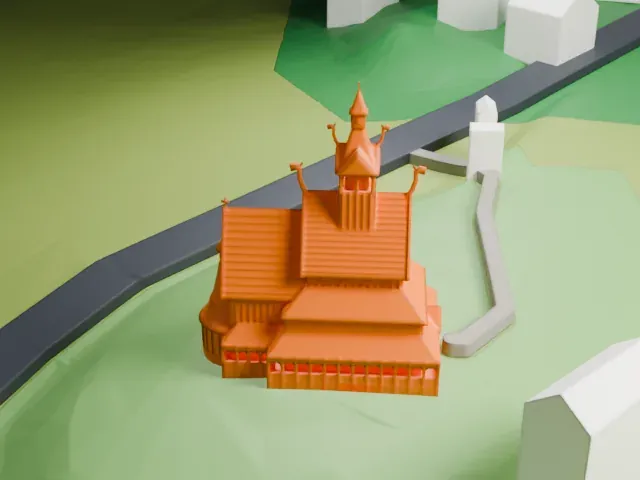
- Curved finials and a slim spire
Curved finials rise from the roof ridges, and a slim spire tops the central turret. Print slowly with good cooling, and choose Full detail on a larger print to keep them.
- Stacked roof tiers and arcade
Many stepped roof tiers and a small arcade ring the base. Print friendly adapts them to the print scale; a layer height of 0.12–0.16 mm keeps the tiers crisp.
- One piece with the ground
The Hopperstad Stave Church is joined to the ground in the exported file, and the four-side check found no floating parts, so nothing needs gluing.
- Pick the detail for your nozzle
In the Buildings settings, set Landmark detail to Print friendly to adapt thin parts and small details to the print scale. Full detail keeps every modeled feature, for larger prints or a finer nozzle.
- Colors
Buildings, roads, water and ground arrive as separate filament slots in the 3MF. The Hopperstad Stave Church takes the building color.
- File format
You get a 3MF for Bambu Studio, OrcaSlicer or PrusaSlicer. Any of them can save it as STL if you need one.
About the Hopperstad Stave Church
Hopperstad Stave Church is a historic parish church belonging to the Church of Norway, standing in Vikøyri village, in Vik Municipality, Vestland county. It is a brown, wooden stave church from the 12th century, assumed to date from around 1130, and it remains at its original site. About 30 people can sit in it. It is among Norway's oldest surviving stave churches.
The earliest surviving records mention the church in 1322. It probably replaced a small stave church from the mid-11th century, being built in the early to mid 12th century. In the 1600s the nave was extended westward and a bell-tower added. The church was sold to private owners at the Norwegian church auction in 1723, which helped the King settle debts from the Great Northern War. In 1814 it served as a polling station in Norway's first national elections, held for the 1814 assembly that wrote the Constitution of Norway.
About 700 years after it went into use, the church was abandoned in 1877, when a new Vik Church was built. A society for preserving ancient Norwegian monuments bought it in 1880 and tore down the later additions. The architect Peter Andreas Blix rebuilt it between 1884 and 1891, using Borgund Stave Church as his model. It is a stave church with a triple nave, of the Borgund type, and it has three portals; the western portal is a fine example of medieval wood carving. A replica stands in Moorhead, Minnesota, dedicated in 1998.
About this model
The Hopperstad Stave Church is one of more than 6,500 landmark models in Mini Skyline. They are made with AI, and each one is checked in its real surroundings before release. Each model is written as code from public descriptions, plans, photographs and aerial views used only as references; no image or third-party model is copied into it. Everything around it is built from OpenStreetMap and Overture map data. Rights in the building itself, its name and any brands on it are not granted by Mini Skyline; clear them separately before you sell prints. If you would rather print the shape from map data, turn off Landmark models in the Buildings settings.
Mini Skyline is not affiliated with, or endorsed by, the owners of this building or its names and marks.
Keep exploring