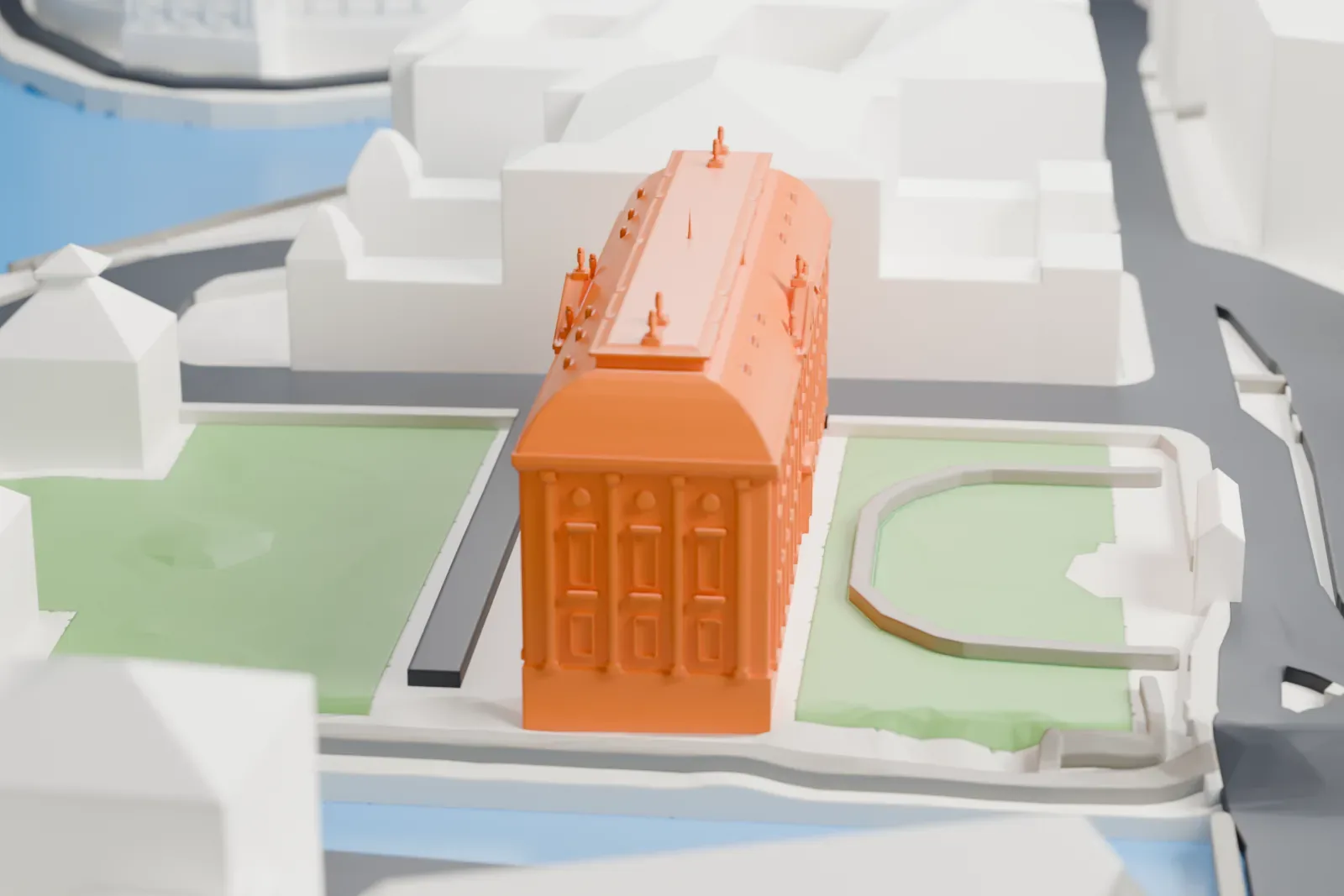
3D print the House of Nobility (Sweden)
A free, printable model of the House of Nobility with its decorated roofline, the water beside it and the park and streets around it, generated from real map data in your browser.
-
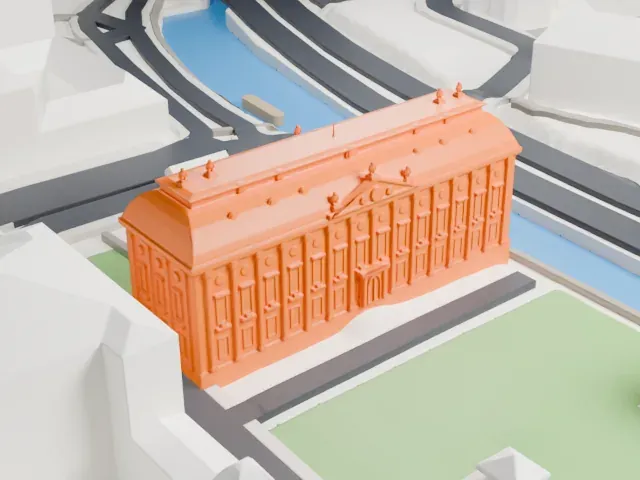 North
-
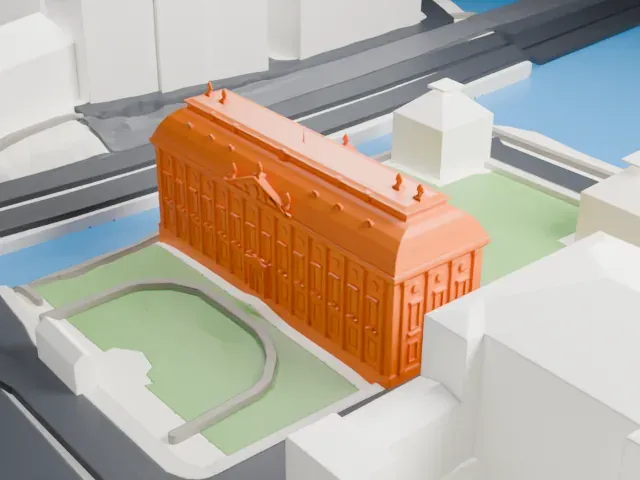 East
-
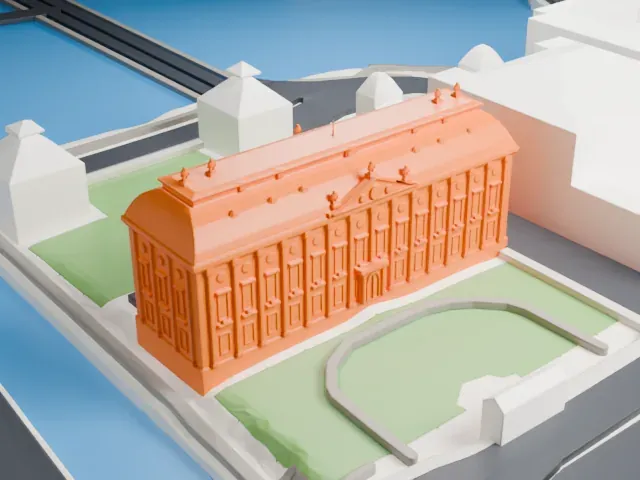 South
-
 West
The model you print
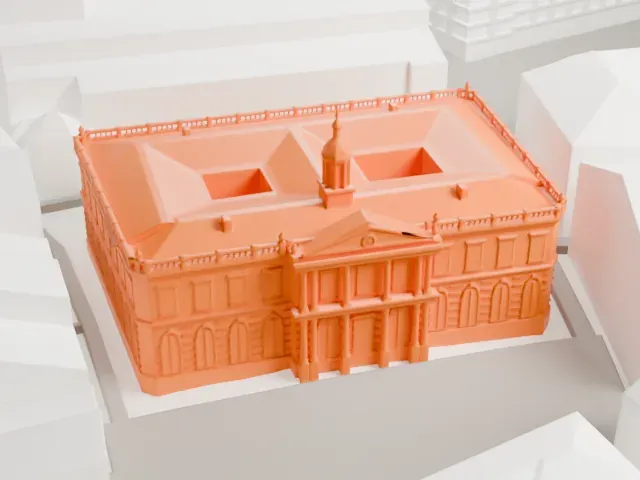
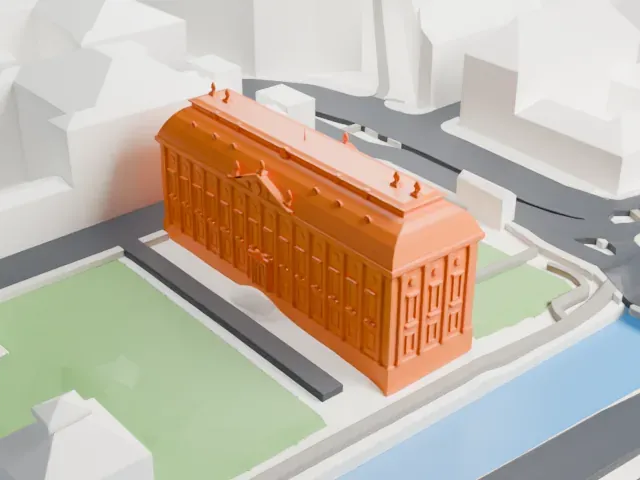
House of Nobility (Sweden) in 3D
The landmark on its own, at its size on a 160 mm print. Print friendly thickens thin parts for a 0.4 mm nozzle; Full detail keeps every part.
- On a 160 mm print
- 8 mm
- Scale
- 1:3,750
8 mm tall on a 160 mm print
Make this print opens the generator on a 600 m square around the landmark. Buildings print at close to true scale, so the landmark grows with the print size.
- Rooftop ornaments and pilasters
Small statues and ornaments line the roof edge, and the facade has many tall, shallow pilasters. Print friendly adapts them to the print scale; Full detail on a larger print keeps each one.
- One piece with the ground
The House of Nobility (Sweden) is joined to the ground in the exported file, and the four-side check found no floating parts, so nothing needs gluing.
- Pick the detail for your nozzle
In the Buildings settings, set Landmark detail to Print friendly to adapt thin parts and small details to the print scale. Full detail keeps every modeled feature, for larger prints or a finer nozzle.
- Colors
Buildings, roads, water and ground arrive as separate filament slots in the 3MF. The House of Nobility (Sweden) takes the building color.
- File format
You get a 3MF for Bambu Studio, OrcaSlicer or PrusaSlicer. Any of them can save it as STL if you need one.
About the House of Nobility (Sweden)
The House of Nobility, or Riddarhuset in Swedish, is both a corporation and a building in Stockholm. The corporation keeps records for the Swedish nobility and represents its interests. The building stands in Stockholm's old town. Lord High Chancellor Axel Oxenstierna bought the plot in 1641 for what he planned as a "well-built and magnificent house" for the Estates.
Construction began in 1641, with various architects in charge over the years. Simon de la Vallée, an architect born in France, began the planning, and a Swedish nobleman killed him in 1642. Work then passed to Heinrich Wilhelm, a German stonemason, and Justus Vingboons, a Dutchman, who is said to have had the decisive influence on the design. Jean de la Vallée, the son of Simon, completed the construction after returning to Holland.
The most significant alteration came in 1870, when two pavilions were added on the waterfront side as freestanding wings, designed by Adolf W. Edelsvärd. A Latin inscription, CLARIS MAIORUM EXEMPLIS, marks the south end, together with a statue of Gustav Vasa, who was king of Sweden from 1523 to 1560. A park with a statue of Axel Oxenstierna lies to the north.
About this model
The House of Nobility (Sweden) is one of more than 6,500 landmark models in Mini Skyline. They are made with AI, and each one is checked in its real surroundings before release. Each model is written as code from public descriptions, plans, photographs and aerial views used only as references; no image or third-party model is copied into it. Everything around it is built from OpenStreetMap and Overture map data. Rights in the building itself, its name and any brands on it are not granted by Mini Skyline; clear them separately before you sell prints. If you would rather print the shape from map data, turn off Landmark models in the Buildings settings.
Mini Skyline is not affiliated with, or endorsed by, the owners of this building or its names and marks.
Same skyline