3D print the Liuhe Pagoda
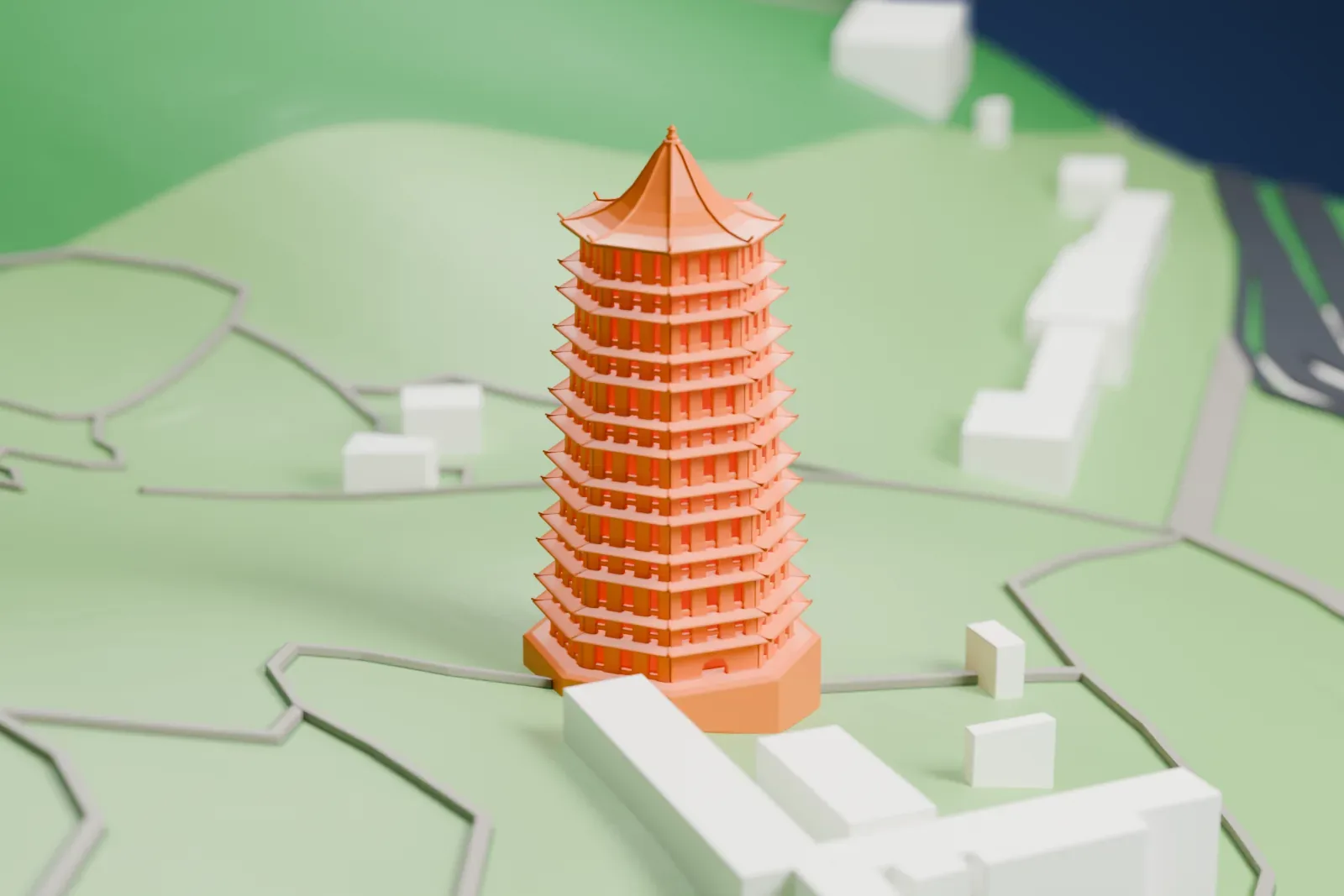
A free, printable model of the Liuhe Pagoda in Hangzhou, a tall octagonal tower of stacked tiers with curved eaves, shown with grass, paths and water nearby, generated from real map data in your browser.
-
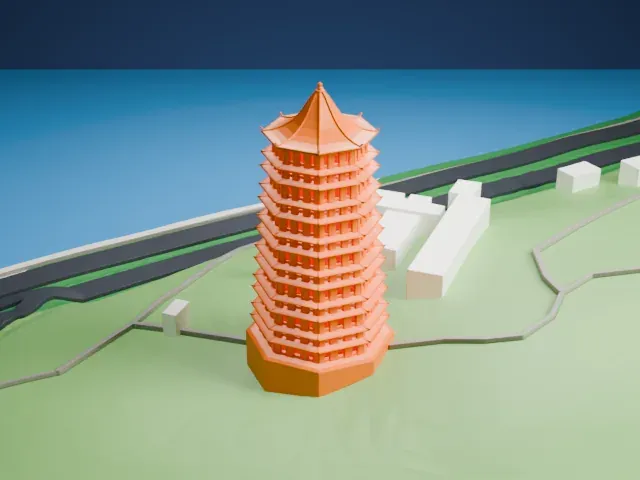 North
-
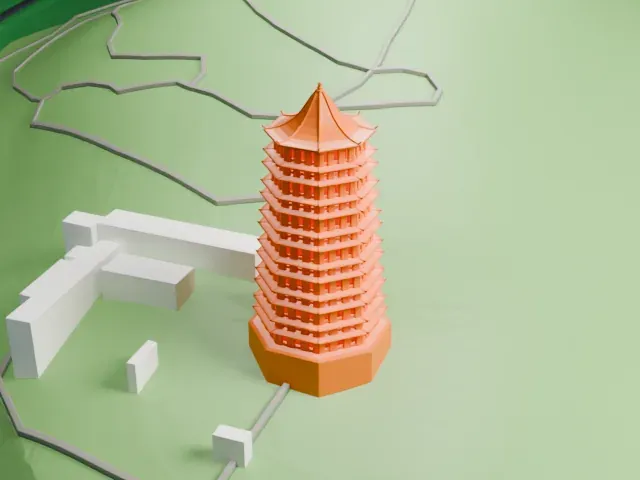 East
-
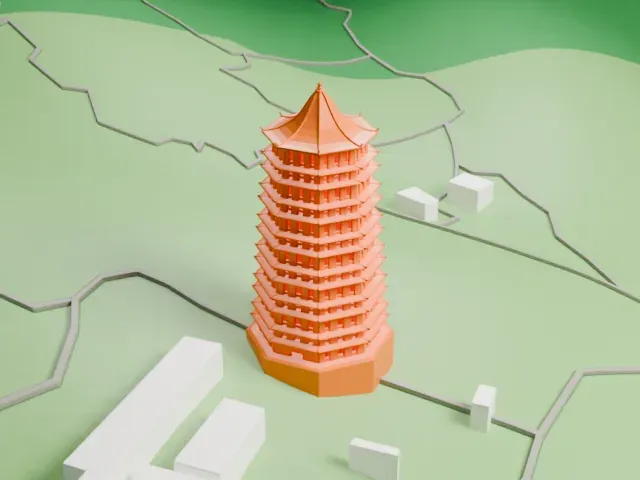 South
-
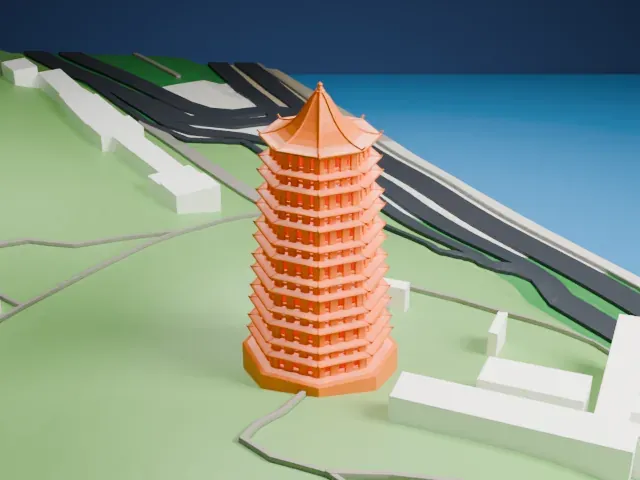 West
The model you print
Liuhe Pagoda in 3D
The landmark on its own, at its size on a 160 mm print. Print friendly thickens thin parts for a 0.4 mm nozzle; Full detail keeps every part.
- Real height
- 60 m
- On a 160 mm print
- 18 mm
- Scale
- 1:3,750
60 m of the Liuhe Pagoda, 18 mm on your shelf
Make this print opens the generator on a 600 m square around the landmark. Buildings print at close to true scale, so the landmark grows with the print size.
- Layers of curved eaves
The pagoda is a tall stack of tiers, each with overhanging eaves. Print friendly adapts thin eaves to the print scale; Full detail keeps every tier on a large print. A 0.12–0.16 mm layer height keeps each tier crisp.
- Slender roof and finial
The topmost roof narrows to a thin finial. Print slowly with cooling so the tip does not droop, and choose a larger print size to keep it.
- One piece with the ground
The Liuhe Pagoda is joined to the ground in the exported file, and the four-side check found no floating parts, so nothing needs gluing.
- Pick the detail for your nozzle
In the Buildings settings, set Landmark detail to Print friendly to adapt thin parts and small details to the print scale. Full detail keeps every modeled feature, for larger prints or a finer nozzle.
- Colors
Buildings, roads, water and ground arrive as separate filament slots in the 3MF. The Liuhe Pagoda takes the building color.
- File format
You get a 3MF for Bambu Studio, OrcaSlicer or PrusaSlicer. Any of them can save it as STL if you need one.
About the Liuhe Pagoda
Liuhe Pagoda, or Six Harmonies Pagoda in English, is a Chinese multi-story pagoda in the south of Hangzhou, in Zhejiang province. It stands beneath Yuelun Hill, looking out on the Qiantang River. The Wuyue Kingdom originally built it in 970. It was destroyed in 1121 and fully rebuilt by 1165 under the Southern Song.
Its name, Liuhe, refers to six Buddhist ordinances. It is said to have been built to tame the river's tidal bore and to aid navigation on the Qiantang. The present pagoda is made of wood and brick, and extra exterior eaves came in the Ming and Qing dynasties. It is octagonal and about 59.89 meters (196.5 ft) high; it looks like a thirteen-story tower but has only seven interior stories.
A spiral staircase leads to the top floor. The seven ceilings each carry carved and painted figures, among them animals, flowers, birds and characters. Every story has four parts: outer walls, a zigzag corridor, inner walls and a small chamber. Joseph Needham, a British sinologist, wrote that the pagoda doubled as a lighthouse on the river.
About this model
The Liuhe Pagoda is one of more than 6,500 landmark models in Mini Skyline. They are made with AI, and each one is checked in its real surroundings before release. Each model is written as code from public descriptions, plans, photographs and aerial views used only as references; no image or third-party model is copied into it. Everything around it is built from OpenStreetMap and Overture map data. Rights in the building itself, its name and any brands on it are not granted by Mini Skyline; clear them separately before you sell prints. If you would rather print the shape from map data, turn off Landmark models in the Buildings settings.
Mini Skyline is not affiliated with, or endorsed by, the owners of this building or its names and marks.
Keep exploring