3D print Rouen Cathedral
A free, printable model of Rouen Cathedral and the dense streets and buildings around it, generated from real map data in your browser.
-
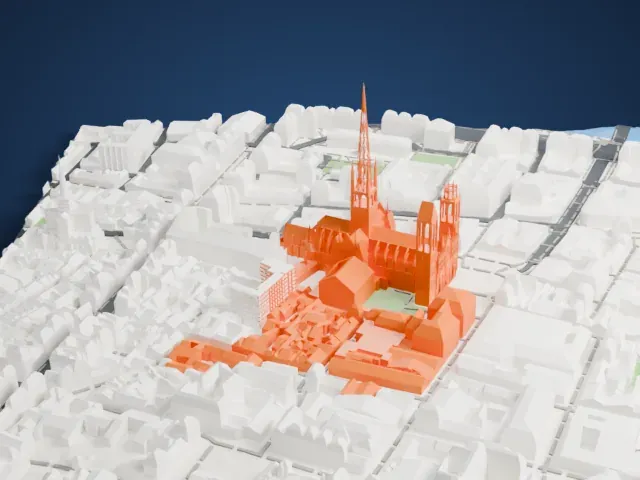 North
-
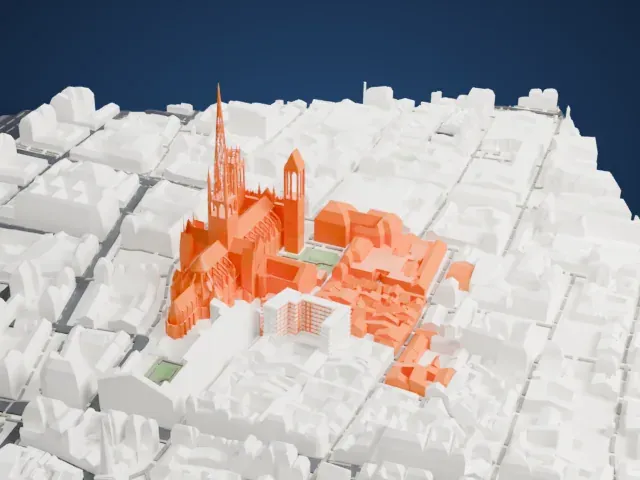 East
-
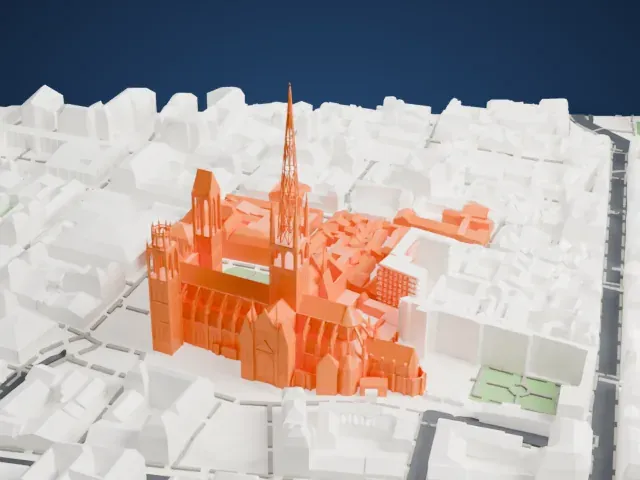 South
-
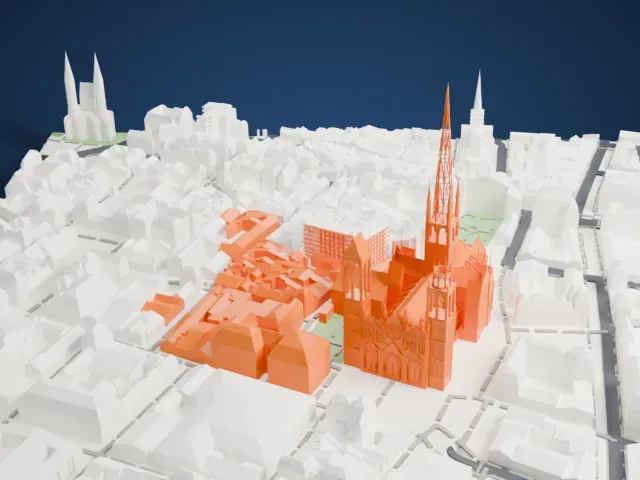 West
The model you print
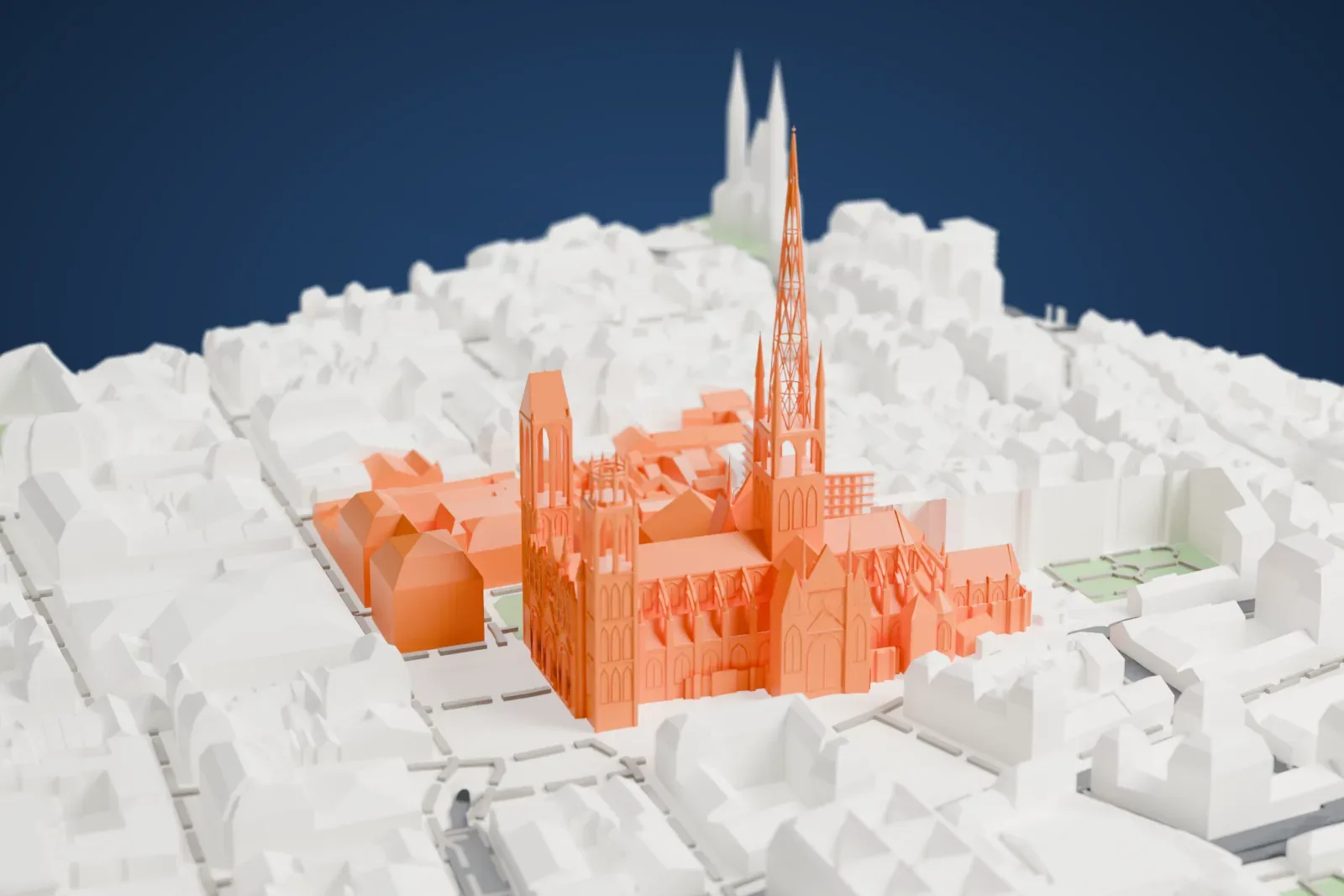
Rouen Cathedral in 3D
The landmark on its own, at its size on a 160 mm print. Print friendly thickens thin parts for a 0.4 mm nozzle; Full detail keeps every part.
- Real height
- 151 m
- On a 160 mm print
- 41 mm
- Scale
- 1:3,750
151 m of Rouen Cathedral, 41 mm on your shelf
Make this print opens the generator on a 600 m square around the landmark. Buildings print at close to true scale, so the landmark grows with the print size.
- An open lattice spire
The very tall spire is an open lattice of thin bars. Print friendly adapts it to the print scale; Full detail keeps every bar, which suits a larger print. Print slowly, with cooling, for the thin tip.
- Pinnacles and carved fronts
Small pinnacles crowd the tower tops and the west front is richly detailed. A bigger print keeps more of it, and layers of 0.12 to 0.16 mm keep fine vertical detail crisp.
- One piece with the ground
Rouen Cathedral is joined to the ground in the exported file, and the four-side check found no floating parts, so nothing needs gluing.
- Pick the detail for your nozzle
In the Buildings settings, set Landmark detail to Print friendly to adapt thin parts and small details to the print scale. Full detail keeps every modeled feature, for larger prints or a finer nozzle.
- Colors
Buildings, roads, water and ground arrive as separate filament slots in the 3MF. Rouen Cathedral takes the building color.
- File format
You get a 3MF for Bambu Studio, OrcaSlicer or PrusaSlicer. Any of them can save it as STL if you need one.
About Rouen Cathedral
Rouen Cathedral, a Catholic church in the Normandy city of Rouen, France, is where the Archbishop of Rouen, who holds the title of Primate of Normandy, has his seat. The cathedral is best known for three towers, every one in a different style. Work on it spanned more than eight hundred years, and its features run from Early Gothic through late Flamboyant to Renaissance. Claude Monet also made it the subject of an impressionist series of paintings.
The Romanesque cathedral was consecrated on October 1, 1063. A Gothic rebuilding began under Gautier the Magnificent, who in 1185 demolished the Romanesque nave, and a major fire in 1200 damaged the unfinished church. Later, Cardinal-Archbishop Georges d'Amboise added Renaissance features to the Gothic design. People who gave to the tower begun in 1488 were granted dispensations to eat milk and butter in Lent, and it soon gained the nickname Butter Tower. While that tower was going up, the west front began to show weakness and tilt, and d'Amboise ordered its complete reconstruction in a lavishly ornate Flamboyant style, with hundreds of sculpted figures and layers of lacelike stone tracery.
A fire started by lightning in 1822 destroyed the central tower's Renaissance spire, which had been built of wood and lead. Jean-Antoine Alavoine, an architect, suggested a cast-iron replacement, which proved highly controversial. The replacement spire stands 151 m (495 ft) tall. Between 1876 and 1880 it briefly made Rouen Cathedral the tallest building in the world, until Cologne Cathedral was completed.
About this model
Rouen Cathedral is one of more than 5,500 landmark models in Mini Skyline. They are made with AI, and each one is checked in its real surroundings before release. Each model is written as code from public descriptions, plans, photographs and aerial views used only as references; no image or third-party model is copied into it. Everything around it is built from OpenStreetMap and Overture map data. Rights in the building itself, its name and any brands on it are not granted by Mini Skyline; clear them separately before you sell prints. If you would rather print the shape from map data, turn off Landmark models in the Buildings settings.
Mini Skyline is not affiliated with, or endorsed by, the owners of this building or its names and marks.
Keep exploring